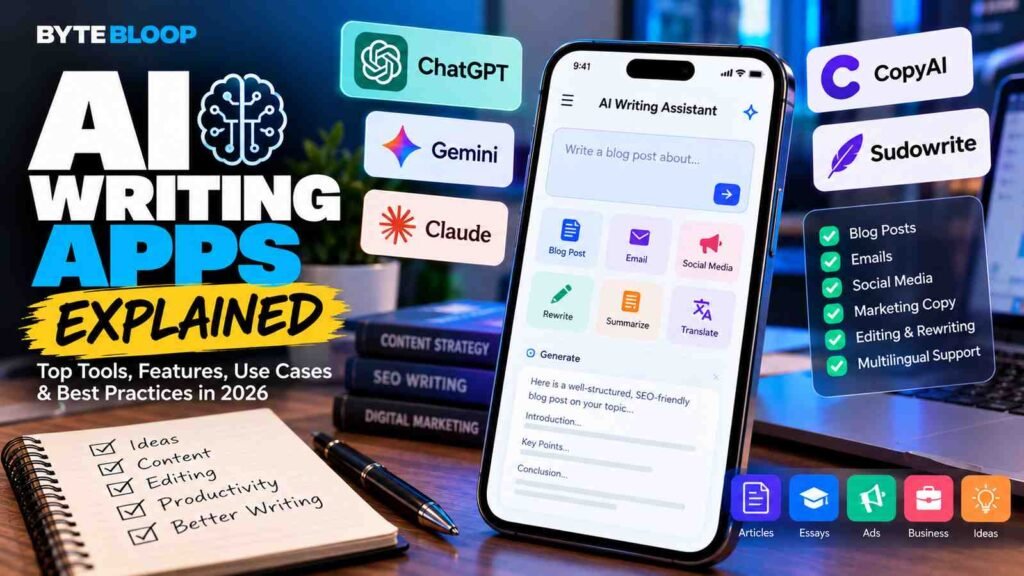
AI Writing Apps: Explained
Introduction
This guide covers ai writing apps explained in detail. Understanding ai writing apps explained helps readers make better, more informed decisions.
AI writing apps have moved beyond novelty to become essential tools for professionals, students, and creative writers alike. By leveraging large language models such as GPT‑4, Gemini, and Claude, these apps can draft emails, generate blog posts, craft marketing copy, and even suggest edits in real time. The rapid adoption of AI in mobile environments means users can tap into powerful generative capabilities from the convenience of their smartphones or tablets. Understanding how these apps work, what features they offer, and how to choose the right one is crucial for anyone looking to boost productivity or elevate writing quality. In this guide, we break down the core technologies, highlight popular examples, and provide practical tips for integrating AI writing into everyday workflows. Understanding ai writing apps explained helps readers make better, more informed decisions.
From auto‑completion to tone analysis, AI writing apps bring a suite of functionalities that can replace or augment traditional word processors. They also raise questions about data privacy, content originality, and the evolving role of human writers. By the end of this article, you will know the main categories of AI writing tools, how to evaluate them, and the best use cases for different audiences. Understanding ai writing apps explained helps readers make better, more informed decisions.
How AI Writing Apps Work — ai writing apps explained
At their core, AI writing apps rely on transformer‑based language models trained on vast corpora of text. These models predict the next word in a sequence, allowing them to generate coherent sentences from a simple prompt. Mobile implementations often use lightweight inference engines or remote APIs to keep device resources in check. Many apps combine the model with user‑specific fine‑tuning, enabling personalized tone, style, or industry jargon. Understanding ai writing apps explained helps readers make better, more informed decisions.
Key Features to Look For
Prompt Flexibility: The ability to start with a keyword, outline, or full paragraph and let the model expand. Understanding ai writing apps explained helps readers make better, more informed decisions.
Tone & Style Controls: Options to adjust formality, voice, or brand voice. Understanding ai writing apps explained helps readers make better, more informed decisions.
Real‑time Editing: Inline suggestions that appear as you type. Understanding ai writing apps explained helps readers make better, more informed decisions.
Multilingual Support: Generating content in multiple languages with consistent quality. Understanding ai writing apps explained helps readers make better, more informed decisions.
Plagiarism Checking: Built‑in scanners that compare output against large databases.
Offline Mode: Some apps offer local inference for privacy‑conscious users.
Popular AI Writing Apps in 2026
According to a recent roundup of 30+ AI tools, the following apps stand out for their versatility and performance:
- ChatGPT Mobile – Offers the full GPT‑4 experience with a polished UI and voice input.
- Google Gemini – Integrates with Google Workspace, providing smart drafting and data‑driven insights.
- Claude 3 – Known for its safety filters and conversational tone, ideal for customer support scripts.
- CopyAI – Focuses on marketing copy, landing pages, and ad headlines.
- Sudowrite – Tailored for fiction writers, offering plot suggestions and character development prompts.
Use Cases Across Industries
Business: Generate meeting minutes, email templates, and product descriptions quickly.
Education: Draft essays, research summaries, and study guides with citation support.
Creative Writing: Brainstorm plot twists, dialogue, and world‑building details.
Marketing: Produce SEO‑optimized blog posts, social media captions, and ad copy at scale.
Legal & Finance: Draft contracts, risk assessments, and compliance summaries with built‑in terminology checks.
Choosing the Right App for You
Start by defining your primary goal: drafting, editing, or ideation. Next, evaluate the model’s language coverage and customization options. Consider data security—some apps store drafts in the cloud, while others offer local processing. Finally, test free trials or demo versions to gauge user experience and output quality.
Best Practices for Using AI Writing Apps
1. Provide Clear Prompts: The more context you give, the better the output.
2. Review for Accuracy: AI can hallucinate facts; always verify key details.
3. Iterate Quickly: Use the app’s revision history to refine drafts without starting over.
4. Respect Copyright: Avoid using AI output as direct plagiarism; treat it as a first draft.
5. Integrate with Existing Tools: Many apps offer plugins for Google Docs, Microsoft Word, and Slack to streamline workflows.
Future Trends
As 2026 sees tighter integration of multimodal models, AI writing apps will soon support image‑to‑text generation, real‑time video subtitles, and even voice‑to‑text editing. Privacy‑preserving techniques like federated learning will allow users to benefit from shared knowledge without exposing personal data.
Key Takeaways
- AI writing apps use transformer models for real‑time content generation
- Key features include tone control, multilingual support, and plagiarism checks
- Popular tools like ChatGPT, Gemini, and Claude dominate the market
- Choosing a tool depends on your specific use case and data privacy needs
- Future updates will bring multimodal capabilities and stronger privacy safeguards
Frequently Asked Questions
What is an AI writing app?
An AI writing app is a mobile or web application that uses large language models to generate, edit, or suggest written content based on user prompts.
What are the key features of AI writing apps?
Key features include prompt flexibility, tone and style controls, real‑time editing, multilingual support, plagiarism checking, and sometimes offline mode.
What are the best use cases for AI writing apps?
They excel in business drafting, educational content creation, creative writing ideation, marketing copy production, and legal or financial document drafting.
What are the pros and cons of AI writing apps?
Pros: rapid content creation, style consistency, and time savings. Cons: potential hallucinations, data privacy concerns, and reliance on model quality.
Conclusion
Based on the available information and industry analysis, AI writing apps in 2026 provide a powerful blend of speed, customization, and integration that can transform how professionals create content. By selecting tools that match your workflow and maintaining rigorous review practices, users can harness these technologies to boost productivity while mitigating risks such as hallucinations and privacy exposure.
Related Reading
- How to Build an AI-Powered Mobile App in 2026
Related Articles