AI Robotics AI: Key Features
Introduction (Ai Robotics Ai Key Features)
Ai Robotics Ai Key Features is a topic worth understanding well. AI robotics merges intelligent software with physical machines, enabling tasks that once required human intervention. In 2026, the field has expanded beyond industrial automation to include healthcare, logistics, and consumer products. The integration of machine learning, computer vision, and real‑time decision making allows robots to adapt to dynamic environments. This synergy boosts productivity, reduces errors, and opens new business models. Understanding the core features helps engineers, managers, and investors evaluate the technology’s impact.
At its heart, AI robotics relies on three pillars: perception, cognition, and action. Perception systems use sensors and deep learning to interpret surroundings. Cognition modules plan and reason, often leveraging generative or agentic AI to anticipate future states. Action layers translate decisions into precise motor commands, ensuring safe interaction with humans and objects. Together, these layers create a closed loop that adapts continuously.
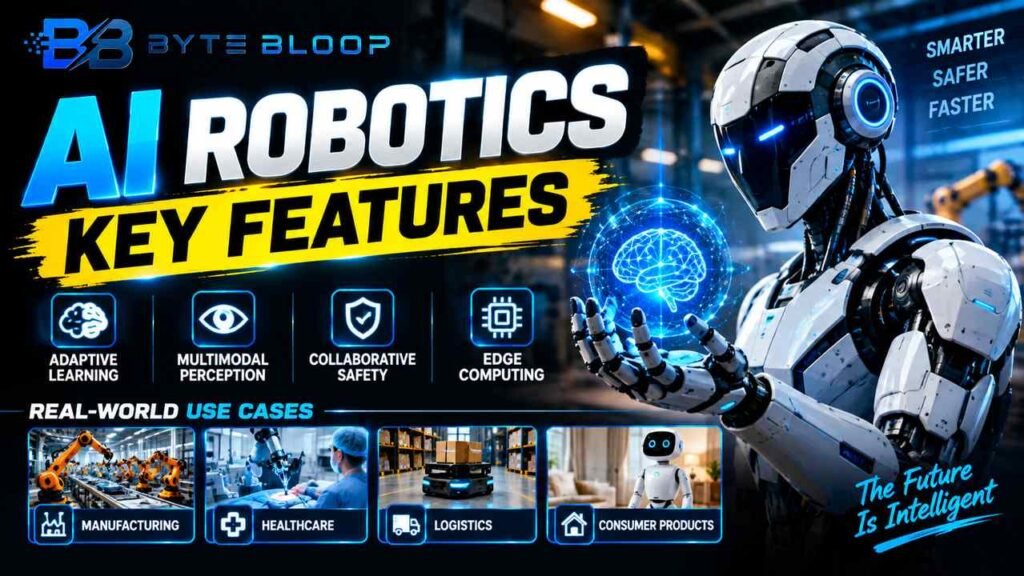
Key features that distinguish modern AI robots include adaptive learning, multimodal perception, collaborative safety, and edge computing. Each feature addresses specific industry challenges and unlocks new capabilities. Below, we explore these attributes in depth, provide real‑world examples, and weigh their advantages and drawbacks.
Adaptive Learning
Adaptive learning lets robots refine their behavior through experience. Instead of hard‑coded routines, models update weights based on sensor feedback. According to the 2026 AI Index Report, over 90% of frontier models are industry‑produced, emphasizing continuous improvement. Adaptive learning reduces setup time for new tasks and enables robots to handle variations in payload or environment. For example, a warehouse robot can learn to navigate around newly placed pallets without manual reprogramming.
This matters directly for anyone exploring ai robotics ai key features.
Multimodal Perception
Multimodal perception fuses visual, auditory, and tactile data. Deep convolutional networks interpret camera feeds, while lidar and force sensors capture depth and contact. This fusion creates robust situational awareness, especially in cluttered or low‑light settings. In surgical robotics, multimodal perception allows instruments to adjust grip strength based on tissue resistance, improving patient outcomes.
Collaborative Safety
Safety in shared workspaces has become a priority. Collaborative safety features include force‑limiting joints, real‑time collision detection, and human‑recognition algorithms. These systems enable robots to work side‑by‑side with employees without protective cages. A notable case is the automotive assembly line where collaborative robots perform spot welding while technicians conduct quality checks.
Getting ai robotics ai key features right can make a real difference.
Edge Computing
Edge computing brings AI inference closer to the robot’s hardware. By processing data locally, latency drops below 10 milliseconds, critical for tasks like autonomous navigation. Edge devices also reduce bandwidth costs and improve privacy. For instance, a delivery drone uses on‑board edge AI to avoid no‑fly zones in real time, eliminating the need for constant cloud connectivity.
Practical Use Cases
1. Manufacturing: AI robots optimize assembly lines, adjust to part variations, and predict maintenance needs.
That is a core part of understanding ai robotics ai key features.
2. Healthcare: Surgical assistants learn from each operation, enhancing precision and reducing recovery time.
3. Logistics: Autonomous forklifts and drones manage inventory, lowering labor costs and speeding delivery.
Many readers look into ai robotics ai key features for exactly this reason.
4. Consumer Products: Home assistants adapt to user habits, offering personalized services and energy savings.
Pros and Cons
Pros: Increased efficiency, reduced human error, scalability, and new revenue streams.
It is worth revisiting ai robotics ai key features as things develop.
Cons: High upfront cost, cybersecurity risks, need for skilled operators, and potential job displacement.
Key Takeaways
- Adaptive learning reduces task setup time
- Multimodal perception enhances safety in complex environments
- Collaborative safety enables human‑robot teamwork
- Edge computing lowers latency and bandwidth needs
- Robotics AI drives efficiency across manufacturing, healthcare, and logistics
Frequently Asked Questions
What is AI robotics?
AI robotics combines artificial intelligence algorithms with physical robots to perform tasks that require perception, decision making, and action.
Ai Robotics Ai Key Features remains highly relevant here.
What are the key features of AI robotics?
Key features include adaptive learning, multimodal perception, collaborative safety, and edge computing, each enabling smarter, safer, and faster robotic systems.
What are the best use cases for AI robotics?
Manufacturing automation, surgical assistance, logistics automation, and consumer home assistants are leading use cases that benefit from AI robotics.
What are the pros and cons of AI robotics?
Pros: higher efficiency, reduced error, scalability. Cons: high initial cost, cybersecurity concerns, skill gaps, and potential workforce impact.
Conclusion
Based on the available information and industry analysis, AI robotics delivers transformative efficiency and adaptability across sectors. By leveraging adaptive learning, multimodal perception, collaborative safety, and edge computing, these systems can operate safely alongside humans while continuously improving performance. However, organizations must address cost, security, and workforce implications to fully realize the technology’s benefits.
Related Reading
- AI Trends 2026: Generative and Agentic Advances
Sources & References
Related Articles