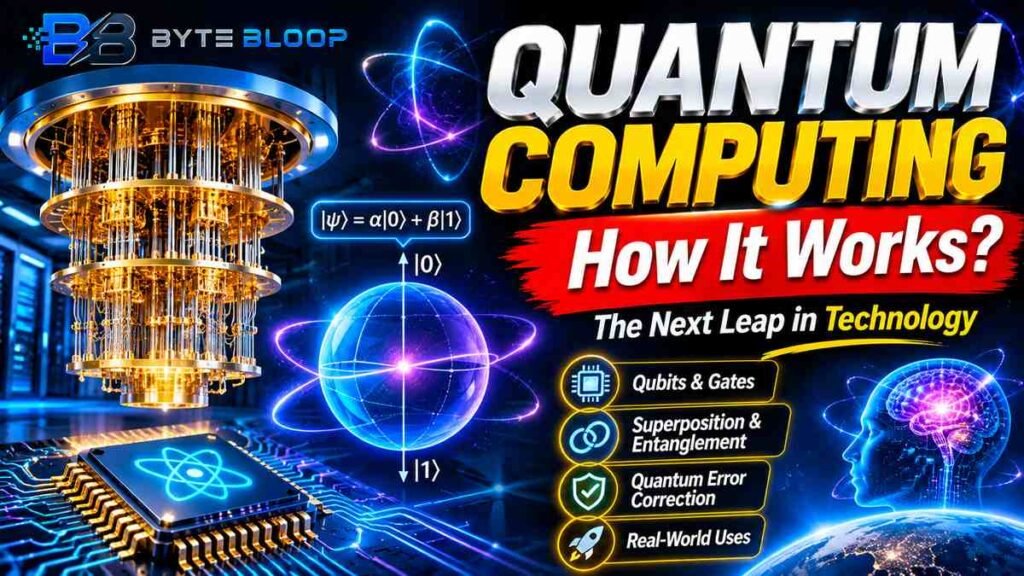
Quantum Computing: How It Works
Introduction (Quantum Computing How It Works)
Quantum Computing How It Works is a topic worth understanding well. Quantum computing is a rapidly emerging technology that harnesses the laws of quantum mechanics to solve problems that are intractable for classical computers. Unlike a traditional computer that encodes information in bits—each bit being either 0 or 1—a quantum computer uses qubits, which can represent 0, 1, or any quantum superposition of these states simultaneously.
This ability to exist in multiple states at once, combined with entanglement and interference, allows quantum processors to explore many computational paths in parallel, dramatically speeding up certain calculations. The field has attracted attention from academia, industry, and governments because it promises breakthroughs in cryptography, material science, drug discovery, and optimization problems. However, quantum hardware remains fragile, with qubits susceptible to decoherence and noise, requiring sophisticated error correction and isolation techniques.
Despite these challenges, companies like IBM, Google, and D-Wave have released prototype machines that demonstrate proof‑of‑concept algorithms, and research continues to push toward practical, fault‑tolerant systems. In this guide, we unpack the core concepts, illustrate how quantum operations are performed, and examine where the technology is headed.
Qubits: The Building Blocks
At the heart of a quantum computer is the qubit. Physical realizations include superconducting circuits, trapped ions, topological states, and photonic systems. Each platform exploits quantum phenomena such as superposition—where a qubit can be in a weighted sum of 0 and 1—and entanglement—where two qubits share a correlated state that cannot be described independently. According to IBM’s overview, a qubit’s state is represented by a point on the Bloch sphere, and quantum gates manipulate its position on that sphere.
Quantum Gates and Circuits
Quantum gates are the quantum analog of classical logic gates. They are reversible, unitary operations that rotate qubits on the Bloch sphere. Common single‑qubit gates include Pauli‑X (bit‑flip), Pauli‑Z (phase flip), and Hadamard (creates equal superposition). Two‑qubit gates, such as Controlled‑NOT (CNOT), generate entanglement. A sequence of gates forms a quantum circuit, which, when executed, transforms an initial state into an output state that can be measured. Measurement collapses the qubit’s superposition to a definite classical outcome, yielding a probability distribution that reflects the computation’s result.
This matters directly for anyone exploring quantum computing how it works.
Superposition and Parallelism
Superposition allows a single qubit to encode multiple classical bits of information. For an n‑qubit system, the state space grows exponentially to 2^n possible basis states. This exponential scaling is the source of quantum parallelism: a quantum algorithm can evaluate a function on many inputs simultaneously. The famous Shor’s algorithm for integer factorization and Grover’s search algorithm for unsorted databases both exploit this property to achieve polynomial or quadratic speedups over the best classical counterparts.
Getting quantum computing how it works right can make a real difference.
Entanglement and Correlation
Entanglement links qubits such that the state of one instantaneously influences the state of another, regardless of distance. This phenomenon enables protocols like quantum teleportation and superdense coding, and it is essential for many quantum algorithms. Entangled states also provide a resource for quantum error correction, allowing the detection and correction of errors without directly measuring the qubits’ computational value.
That is a core part of understanding quantum computing how it works.
Quantum Error Correction
Because qubits are fragile, quantum error correction (QEC) is critical. QEC schemes encode logical qubits into entangled states of multiple physical qubits, spreading information so that local errors can be detected and corrected. The surface code, for example, uses a two‑dimensional lattice of qubits to detect errors with high fidelity. Implementing QEC dramatically increases the number of physical qubits required per logical qubit, a major engineering hurdle that researchers are actively addressing.
Many readers look into quantum computing how it works for exactly this reason.
Current Hardware Landscape
IBM, Google, and other research labs have built superconducting qubit processors with 50–100 qubits, while D-Wave offers quantum annealers with thousands of qubits tailored for optimization. Ion‑trap systems from companies like IonQ provide high‑fidelity gates but scale more slowly. Each platform balances coherence time, gate speed, connectivity, and error rates, influencing the types of algorithms that can run efficiently.
It is worth revisiting quantum computing how it works as things develop.
Practical Applications
Quantum advantage is most likely to emerge in niche domains where specific problem structures match quantum algorithms. Drug discovery can benefit from quantum simulations of molecular Hamiltonians, enabling more accurate predictions of binding affinities. Materials science can use quantum chemistry methods to design novel alloys or superconductors. Optimization problems in logistics, finance, and machine learning may see speedups from quantum annealing or hybrid quantum‑classical algorithms like the Variational Quantum Eigensolver (VQE). However, for many everyday tasks, classical supercomputers remain more practical.
Quantum Computing How It Works remains highly relevant here.
Hybrid Quantum‑Classical Workflows
Given current noise levels, many real‑world approaches combine classical processors with quantum subroutines. The Variational Quantum Eigensolver, for instance, uses a classical optimizer to adjust quantum circuit parameters, while the quantum device evaluates the energy of a molecular system. This hybrid paradigm extends the reach of near‑term devices and serves as a bridge toward fully fault‑tolerant quantum computers.
This is a key consideration when it comes to quantum computing how it works.
Future Outlook
Researchers predict that scaling to millions of physical qubits, coupled with robust error correction, will be necessary for universal, fault‑tolerant quantum computing. The race to achieve this scale is driving innovations in qubit design, cryogenic engineering, and quantum software stacks. Meanwhile, quantum cloud services are democratizing access, allowing developers to experiment with quantum algorithms without owning hardware.
This matters directly for anyone exploring quantum computing how it works.
Key Takeaways
- Qubits use superposition and entanglement to encode information beyond classical bits
- Quantum gates manipulate qubit states through reversible, unitary operations
- Error correction is essential to protect fragile quantum information
- Current quantum devices excel in specialized tasks like optimization and simulation
- Hybrid quantum‑classical workflows bridge today’s noisy devices and future fault‑tolerant systems
Frequently Asked Questions
What is a qubit?
A qubit is the quantum equivalent of a classical bit, capable of representing 0, 1, or any quantum superposition of both states simultaneously.
Getting quantum computing how it works right can make a real difference.
What are the key features of quantum computing?
Quantum computing leverages superposition, entanglement, and interference to perform parallel computations, offering potential speedups for specific algorithms like Shor’s and Grover’s.
That is a core part of understanding quantum computing how it works.
What are the best use cases for quantum computing?
Applications include cryptanalysis, quantum chemistry simulations, materials discovery, optimization problems, and hybrid machine learning tasks.
Many readers look into quantum computing how it works for exactly this reason.
What are the pros and cons of quantum computing?
Pros: exponential parallelism, new algorithmic capabilities, potential breakthroughs in science and industry. Cons: qubit fragility, noise, high error rates, and the need for extensive error correction.
Conclusion
Based on the available information and industry analysis, quantum computing provides a fundamentally new paradigm that exploits superposition and entanglement to solve certain problems far more efficiently than classical computers. While hardware challenges and error correction remain significant hurdles, ongoing advances in qubit coherence, gate fidelity, and hybrid algorithm design are steadily expanding the technology’s practical reach. As the quantum ecosystem matures, its impact on fields such as cryptography, drug discovery, and optimization is expected to grow, heralding a transformative shift in computational capabilities.
Related Reading
- Quantum Algorithms Explained
- The Future of Quantum Hardware
Sources & References
- What Is Quantum Computing? | IBM
- Quantum computing — A quantum computer is a computer that represents and processes information using quantum states.
- Quantum Computing Explained — These computers work by harnessing quantum physics — the strange, often counterintuitive laws that govern the universe at its smallest scales
- Quantum Computers Explained: How Quantum Computing Works
- Quantum Computing Explained for Engineering (2026)
- Quantum Computing Demystified: A Beginner’s Guide for …
Related Articles