
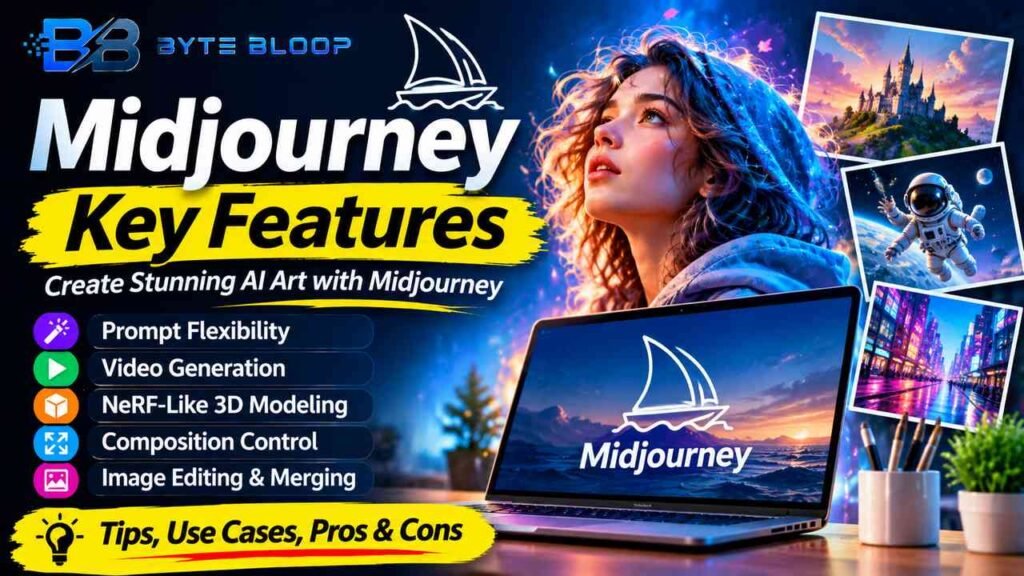
Midjourney: Key Features
Introduction (Midjourney Key Features)
Midjourney Key Features is a topic worth understanding well. Midjourney has become a staple in the AI art community, offering a powerful platform that transforms text prompts into striking visuals. The tool’s evolution through v7 to v8 has introduced advanced semantic understanding, sharper text rendering, and improved spatial coherence, making it more reliable for designers and creators alike. Users can now animate images, edit photos, and merge compositions with simple commands, expanding creative possibilities beyond static images.
With a web interface that supports real‑time collaboration, Midjourney integrates seamlessly into design workflows. The platform’s intuitive prompt syntax allows beginners to experiment quickly while giving seasoned artists granular control over style, lighting, and composition. These features collectively position Midjourney as a versatile asset for marketing, storytelling, and visual prototyping.
In this guide, we dive into the core features that set Midjourney apart, showcase practical examples, and outline best use cases. We also weigh the pros and cons and answer common questions to help you decide if Midjourney fits your creative needs.
Core Features of Midjourney
Prompt Flexibility lets users craft images with simple text or advanced syntax, including style tags and aspect ratios. According to the Midjourney 2026 v8 specs, the model now interprets nuanced language, producing more accurate depictions of complex scenes.
This matters directly for anyone exploring midjourney key features.
Video Generation is a standout addition; users can animate static images or upload their own footage for AI-driven motion. The Getting Started Guide notes that this feature supports both 2D and 3D animation workflows, expanding storytelling options.
NeRF‑Like 3D Modeling in v7 introduced depth perception, enabling realistic perspective and spatial coherence. Designers can now generate immersive assets for virtual reality or game environments.
Getting midjourney key features right can make a real difference.
Composition Control allows placement, perspective, and proportion adjustments directly in the prompt. This level of control, highlighted in the 2026 guide, reduces iteration time for complex scenes.
Image Editing and Merging lets creators upload photos, edit them, or blend multiple images in a single command. The 12‑minute beginner tutorial demonstrates how quickly users can combine elements for a cohesive composition.
That is a core part of understanding midjourney key features.
Practical Use Cases
Marketing Campaigns benefit from rapid generation of concept art, mood boards, and social media visuals. The platform’s speed and variety reduce agency turnaround times.
Film and Animation teams use Midjourney to storyboard scenes, create visual references, and even prototype character designs. The video feature supports early motion studies.
Many readers look into midjourney key features for exactly this reason.
Product Design leverages the tool for mockups, packaging concepts, and UI prototypes, especially when combined with the editing function to refine details.
Educational Content sees educators using Midjourney to illustrate complex topics, generate diagrams, and create engaging visual aids.
It is worth revisiting midjourney key features as things develop.
Pricing and Accessibility
Midjourney operates on a subscription model with tiered plans. The latest v8 release offers a free trial that grants limited image credits, after which users choose between Basic, Standard, or Pro plans. The exact pricing varies by region and is detailed on the official website.
Pros and Cons
Pros: Rapid image creation, advanced prompt control, video and 3D support, strong community resources.
Midjourney Key Features remains highly relevant here.
Cons: Subscription cost for high‑volume use, occasional output unpredictability, limited direct integration with some design suites.
Key Takeaways
- Midjourney’s v8 model improves semantic understanding and spatial coherence
- Video generation expands creative storytelling options
- NeRF‑like 3D modeling supports immersive content creation
- Prompt syntax offers granular control over style and composition
- Subscription plans provide flexibility for hobbyists and professionals
Frequently Asked Questions
What is Midjourney?
Midjourney is an AI image generator that creates visuals from text prompts, offering advanced features like video animation and 3D modeling.
What are the key features of Midjourney?
Key features include flexible prompt syntax, video generation, NeRF‑like 3D modeling, composition control, and image editing/merging.
What are the best use cases for Midjourney?
Ideal for marketing visuals, film storyboarding, product design mockups, and educational illustrations.
What are the pros and cons of Midjourney?
Pros: fast creation, deep control, video/3D support; Cons: subscription cost, occasional output variability, limited integration.
Conclusion
Based on the available information and industry analysis, Midjourney provides a robust platform that blends speed, flexibility, and advanced features, making it a valuable tool for creators across marketing, film, design, and education. Its evolving capabilities, such as video generation and 3D modeling, position it as a forward‑thinking solution in the competitive AI art landscape.
Related Reading
- AI Image Generators Compared: Midjourney vs. Stable Diffusion
Sources & References
- Getting Started Guide — Make your images come alive by transforming them into videos! Learn how to animate both your Midjourney creations and your own images on our Video article.
- Midjourney 2026: v8 Specs, Web Interface & Pricing Manual — Key Features (2026 Update)
Related Articles


