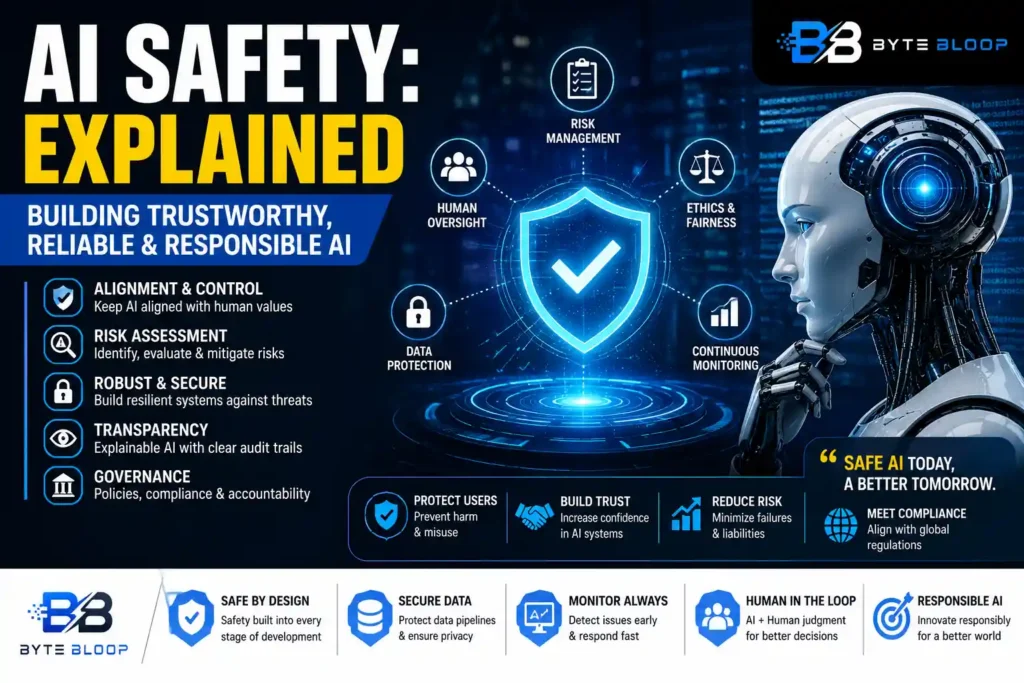
AI Safety: Explained
Introduction
Artificial intelligence is reshaping industries, but its rapid deployment raises critical questions about risk, alignment, and governance. AI safety is the discipline that ensures intelligent systems behave as intended, protect users, and comply with legal and ethical standards. In 2026, the International AI Safety Report highlights that new capabilities can emerge unpredictably, making continuous monitoring essential. Enterprises now embed safety into every phase of development, from data curation to model deployment. Governments, such as India, have issued principle‑based guidelines to promote trust and inclusivity. This guide unpacks the core concepts, practical frameworks, and real‑world examples that illustrate why AI safety is not optional but foundational for responsible AI adoption.
What Is AI Safety?
AI safety closes the gap between a model’s training objectives and the outcomes it produces in production. According to What Is AI Safety? A Complete Guide for 2026, it keeps systems aligned while preserving meaningful human control. The goal is to prevent unintended behaviors—such as hallucinations, bias amplification, or data leakage—while maintaining performance.
Key Principles and Frameworks
Several frameworks guide safety engineering:
- Risk Assessment: Identify potential harms, assess likelihood, and prioritize mitigation.
- Alignment: Align model objectives with human values through reward modeling or preference learning.
- Robustness: Ensure resilience against adversarial inputs and distribution shifts.
- Transparency: Provide explainability and audit trails for decision‑making.
- Governance: Implement policies, roles, and compliance checks.
The International AI Safety Report 2026 stresses that technical and institutional challenges require multidisciplinary collaboration.
Practical Safety Practices for Enterprises
Modern organizations adopt a layered approach:
- Secure Data Pipelines: Use encryption, access controls, and data provenance to protect training inputs.
- Model Validation: Run extensive unit, integration, and system tests, including adversarial stress tests.
- Continuous Monitoring: Deploy monitoring dashboards that track drift, performance, and anomalous outputs.
- Incident Response: Establish clear protocols for rollback, patching, and stakeholder communication.
According to AI Security And Governance Guide 2026, a robust security and governance program is essential to protect models, data, and runtime environments.
Regulatory Landscape and Global Guidance
Countries are moving from reactive to proactive AI governance. India’s AI Governance Guidelines introduce seven Sutras—principles that emphasize safety, transparency, and inclusivity. These principles serve as a blueprint for developers and regulators alike. In the U.S. and EU, emerging AI Act drafts emphasize risk‑based classification and mandatory safety audits for high‑risk systems.
Case Studies and Real‑World Examples
1. Healthcare AI: A hospital system integrated a safety layer that flagged anomalous dosage recommendations, preventing potential harm.
2. Financial Services: A fintech startup used a reinforcement learning safety filter to avoid credit score manipulation.
3. Autonomous Vehicles: Manufacturers implemented a fail‑safe protocol that overrides AI decisions during sensor failures.
Benefits of Implementing AI Safety
Organizations that prioritize safety see reduced liability, higher user trust, and smoother regulatory compliance. Safety also drives innovation by allowing teams to experiment within defined risk boundaries.
Challenges and Common Pitfalls
1. Resource Intensity: Safety testing can be costly and time‑consuming.
2. Skill Gaps: Few professionals specialize in AI safety, leading to implementation gaps.
3. Over‑Regulation Risk: Excessive constraints may stifle creativity and delay deployment.
Future Directions
Research is moving toward automated safety verification, human‑in‑the‑loop systems, and cross‑industry safety standards. The International AI Safety Report 2026 calls for shared datasets and collaborative safety benchmarks.
Key Takeaways
- AI safety bridges training goals and real‑world outcomes
- Layered risk management is essential for enterprise AI
- Regulatory frameworks are becoming risk‑based and principle‑driven
- Continuous monitoring prevents drift and unintended behavior
- Safety investment boosts trust and regulatory compliance
Frequently Asked Questions
What is AI safety explained?
AI safety is the discipline that ensures AI systems behave as intended, protecting users and meeting ethical and regulatory standards.
What are the key features of AI safety frameworks?
Key features include risk assessment, alignment, robustness, transparency, and governance structures that guide design, deployment, and monitoring.
What are the best use cases for AI safety?
High‑risk domains such as healthcare, finance, autonomous vehicles, and public services benefit most from rigorous safety protocols.
What are the pros and cons of implementing AI safety?
Pros: reduced liability, increased trust, smoother compliance. Cons: higher upfront costs, skill shortages, and potential slowdowns in innovation.
Conclusion
Based on the available information and industry analysis, AI safety provides a structured path to align powerful models with human values, mitigate risks, and satisfy evolving regulatory demands. By embedding safety into every development stage—data, model, deployment, and monitoring—organizations can unlock AI’s benefits while safeguarding users, stakeholders, and the broader society.
Related Reading
- AI Governance: Key Principles for 2026
Sources & References
- International AI Safety Report 2026
- AI Safety in 2026: Enterprises Build Compliant AI Systems
- What Is AI Safety? A Complete Guide for 2026
- India AI Governance Guidelines
- AI Security And Governance Guide 2026: Protect Models, …
- International AI Safety Report 2026 — by Y Bengio · 2026
- Understanding AI Safety: Principles, Frameworks, and Best …