AMOLED vs OLED: Key Differences
Introduction
In the world of mobile and display technology, OLED has long been celebrated for its deep blacks and vibrant colors. However, the advent of AMOLED—Active‑Matrix Organic Light‑Emitting Diode—has added a new layer of performance and complexity to the conversation. While both technologies share the same core principle of organic pixels emitting light, the way they are driven and the resulting characteristics differ in ways that can influence device choice, battery life, and user experience. Understanding these nuances is essential for consumers, designers, and tech enthusiasts alike. This guide breaks down the core distinctions between AMOLED and OLED, covering pixel control, brightness, power efficiency, cost, and practical use cases. By the end, you’ll know which technology best aligns with your needs and why.
What Is OLED?
OLED screens use organic compounds that generate light when an electric current passes through them. Each pixel is self‑lit, allowing for true blacks when pixels are turned off and eliminating the need for a backlight. This architecture delivers excellent color accuracy and contrast ratios, making OLED a favorite for high‑end smartphones, TVs, and wearables.
What Is AMOLED?
AMOLED builds on OLED by adding an active‑matrix thin‑film transistor (TFT) layer that individually controls each pixel. This active‑matrix approach enables faster pixel response, higher peak brightness, and more efficient power usage when displaying bright content. AMOLED panels are commonly found in flagship phones and premium displays where performance and battery life are critical.
Key Differences Explained
Pixel Control
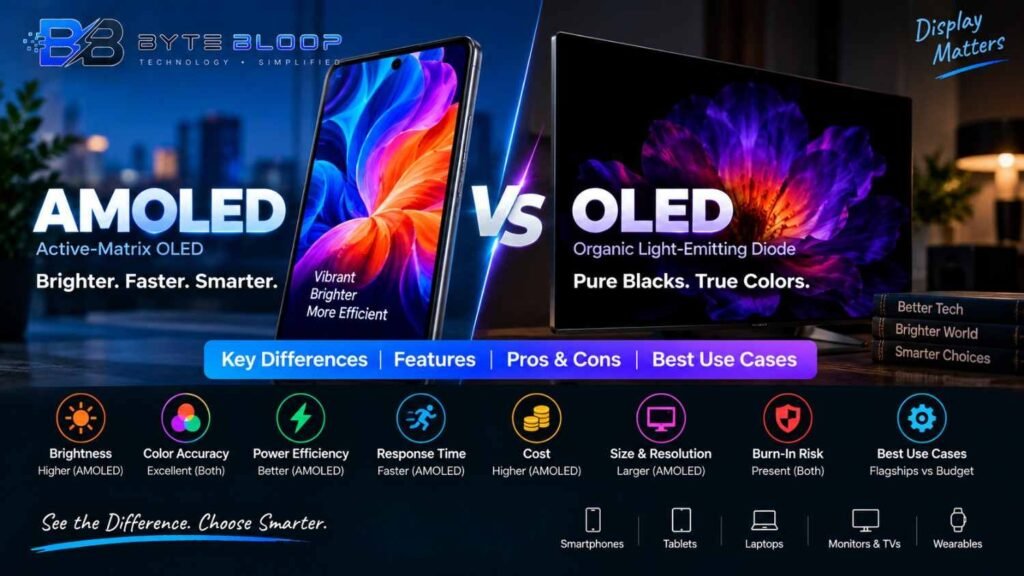
Standard OLED panels may use passive or simple control schemes, whereas AMOLED employs an active‑matrix TFT layer that switches each pixel independently. This results in quicker refresh rates and lower latency, which is especially noticeable in gaming and high‑refresh‑rate displays.
Brightness and Contrast
Because AMOLED can drive pixels at higher currents, it typically achieves greater peak brightness than standard OLED. This makes AMOLED panels more suitable for outdoor use and HDR content, while OLED still offers excellent contrast with deep blacks.
Power Efficiency
When displaying dark or static images, AMOLED panels can turn off many pixels, saving power. OLED panels also benefit from this, but the active‑matrix layer in AMOLED reduces power draw during dynamic content, extending battery life on devices that use it.
Cost and Manufacturing
Adding the TFT layer increases production complexity, driving AMOLED prices 2‑3 times higher than standard OLED and 5‑10 times higher than LCD panels. This cost difference is reflected in the pricing of flagship devices that feature AMOLED displays.
Burn‑In Risk
Both OLED and AMOLED are susceptible to image retention, but AMOLED’s pixel control can help mitigate burn‑in through pixel‑shifting techniques. Nevertheless, prolonged static content can still degrade the display over time.
Size and Resolution Limits
Passive OLED (PMOLED) panels are limited to small sizes (typically under 5 inches) due to manufacturing constraints. AMOLED, with its active matrix, can support larger, higher‑resolution displays suitable for tablets and TVs.
Performance and Features in Practice
Flagship smartphones such as the latest Samsung Galaxy and Apple iPhone models use AMOLED to deliver buttery‑smooth scrolling, high refresh rates, and vibrant HDR. In contrast, some mid‑range phones and budget TVs still use standard OLED to keep costs down while offering excellent color fidelity.
For professional video editing, the consistent color accuracy of OLED is prized, whereas gamers often prefer AMOLED’s faster response times and higher brightness for a more immersive experience.
Pros and Cons
AMOLED Pros
- Higher peak brightness and better HDR performance
- Faster pixel response and lower latency
- Improved power efficiency with dynamic content
AMOLED Cons
- Higher manufacturing cost
- Greater susceptibility to burn‑in with static content
OLED Pros
- Excellent color accuracy and deep blacks
- Lower cost and wider availability
- Reduced burn‑in risk in some implementations
OLED Cons
- Lower peak brightness compared to AMOLED
- Slower pixel response for high‑refresh‑rate applications
Key Takeaways
- AMOLED uses an active‑matrix TFT layer for faster pixel control and higher brightness.
- Standard OLED offers superior color accuracy and lower cost but lower peak brightness.
- AMOLED panels are more power efficient when displaying dynamic content.
- Both technologies can suffer from burn‑in; AMOLED mitigates it with pixel‑shifting.
- Manufacturing costs drive AMOLED to premium device segments.
Frequently Asked Questions
What is the fundamental difference between AMOLED and OLED?
AMOLED adds an active‑matrix TFT layer that controls each pixel individually, enabling faster response and higher brightness, whereas standard OLED may use passive or simpler control schemes.
What are the key features of AMOLED displays?
Higher peak brightness, faster pixel response, better power efficiency with dynamic content, and suitability for high‑refresh‑rate applications.
What are the best use cases for OLED displays?
Professional color‑critical work, budget or mid‑range smartphones, and devices where cost and deep blacks are priorities.
What are the pros and cons of AMOLED?
Pros include higher brightness, faster response, and better power efficiency for dynamic content. Cons are higher cost and increased burn‑in risk with static images.
What are the pros and cons of OLED?
Pros: excellent color accuracy, deep blacks, lower cost. Cons: lower peak brightness, slower response times for high‑refresh‑rate use.
Conclusion
Based on the available information and industry analysis, AMOLED technology delivers superior brightness, faster pixel response, and better power efficiency for dynamic content, making it ideal for flagship smartphones and high‑refresh‑rate displays. Standard OLED, with its lower cost and excellent color accuracy, remains a strong choice for budget devices and professional color‑critical applications. The decision between the two hinges on the specific performance, cost, and use‑case requirements of the end user.
Related Reading
- Choosing the Right Display for Your Smartphone