iPhone vs Samsung: Key Differences in 2026
Introduction
Choosing between an iPhone and a Samsung Galaxy phone involves more than comparing processor speeds or camera megapixels.
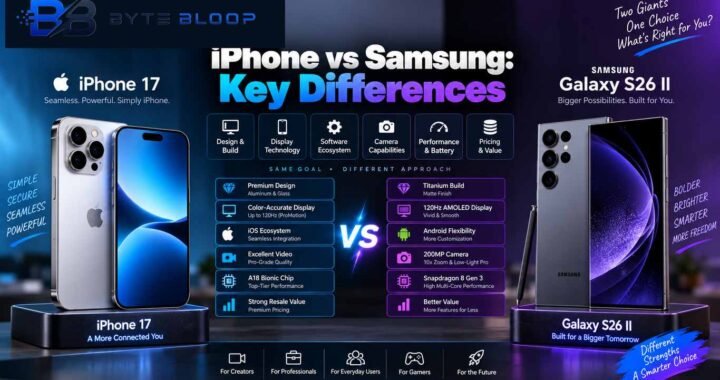
Apple and Samsung take different approaches to smartphone hardware, software, ecosystem integration, cameras, connectivity and device management. In 2026, the standard iPhone 17 and Samsung Galaxy S26 provide a useful example of these differences.
The iPhone 17 features Apple’s A19 chip, a 6.3-inch OLED display with ProMotion up to 120Hz, a 48MP Dual Fusion camera system and storage options of 256GB and 512GB.
The Galaxy S26 also has a 6.3-inch 120Hz display, along with a 50MP main camera, 10MP telephoto camera, 12MP ultra-wide camera, 12GB of memory and 256GB or 512GB storage options in Samsung’s India lineup.
Rather than declaring one brand universally better, this guide compares the major differences so you can understand which approach fits your own requirements.
iPhone vs Samsung at a Glance
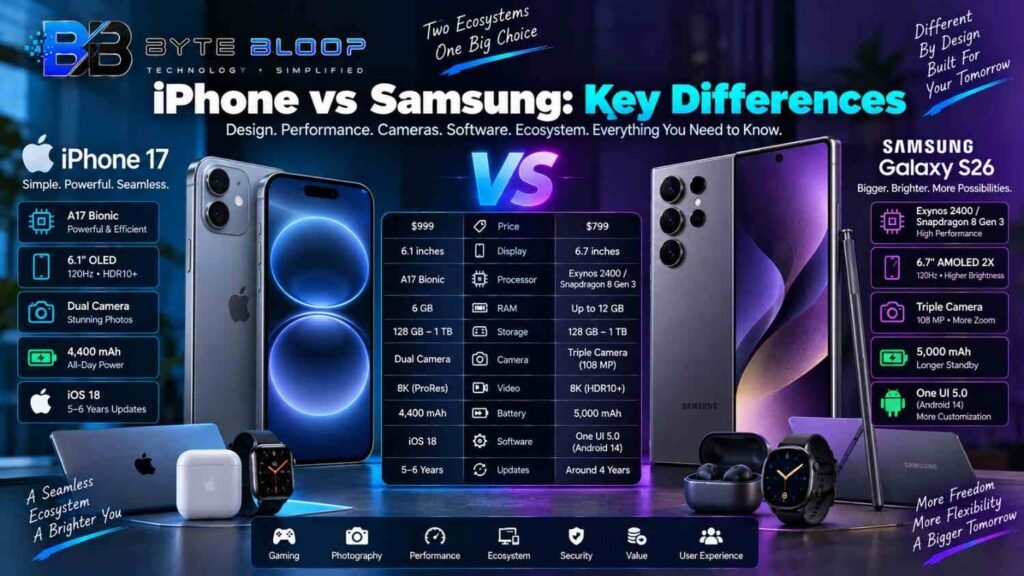
| Feature | iPhone 17 | Galaxy S26 |
|---|---|---|
| Operating system | iOS | Android with Samsung One UI |
| Display | 6.3-inch OLED, up to 120Hz | 6.3-inch Dynamic AMOLED 2X, up to 120Hz |
| Main processor | Apple A19 | Snapdragon 8 Elite Gen 5 for Galaxy / Exynos 2600 depending on market |
| RAM | Apple does not officially list RAM in its standard technical specifications | 12GB in Samsung India configurations |
| Storage | 256GB / 512GB | 256GB / 512GB |
| Rear cameras | 48MP Main + 48MP Ultra Wide | 50MP Wide + 10MP Telephoto + 12MP Ultra Wide |
| Telephoto | 2x optical-quality option from main camera | Dedicated 3x optical telephoto |
| Video | Up to 4K Dolby Vision at 60fps | Up to 8K recording at 30fps |
| Battery | Apple does not publish mAh capacity in its standard specifications | 4,300mAh typical capacity |
| Charging | Up to 50% in around 20 minutes with 40W+ adapter | Samsung advertises up to 69% in around 30 minutes |
| Software | iOS | Android / One UI |
| Biometrics | Face ID | Fingerprint + other biometric/security features |
| Ecosystem | Apple devices and services | Galaxy, Google and SmartThings ecosystem |
Specifications can vary by market, model configuration and software version.
Design and Build
Both phones use premium materials and compact flagship-style designs, but their physical details differ.
The iPhone 17 uses an aluminum design, a Ceramic Shield 2 front and a color-infused glass back. Apple lists the device at 7.95mm thick and 177 grams.
Samsung’s Galaxy S26 is listed at 7.2mm thick and 167 grams in the Indian specifications, making it slightly lighter than the iPhone 17. It also has an IP68 rating for dust and water resistance.
The practical difference is therefore less about which design is objectively better and more about:
- Weight
- Thickness
- Grip
- Materials
- Camera design
- Color options
- Personal preference
Display Technology
Display technology is one area where both phones offer strong specifications.
iPhone 17 Display
Apple’s iPhone 17 includes:
- 6.3-inch OLED display
- 2622 × 1206 resolution
- 460 ppi
- ProMotion adaptive refresh rate up to 120Hz
- Always-On display
- HDR
- True Tone
- P3 wide color
- Up to 3,000 nits outdoor brightness under Apple’s specified conditions
Galaxy S26 Display
Samsung’s Galaxy S26 includes:
- 6.3-inch Dynamic AMOLED 2X display
- 2340 × 1080 resolution
- Up to 120Hz refresh rate
- Vision Booster
- FHD+ resolution
Both phones therefore support high-refresh-rate displays suitable for smooth scrolling, gaming and general everyday use.
When comparing them, don’t look only at the refresh rate. Brightness, resolution, color calibration, outdoor visibility and software behavior also influence the viewing experience.
Performance and Hardware
The iPhone 17 uses Apple’s A19 chip with a six-core CPU, five-core GPU with Neural Accelerators and a 16-core Neural Engine. It also supports hardware-accelerated ray tracing.
The Galaxy S26 uses a Snapdragon 8 Elite Gen 5 for Galaxy or Exynos 2600 depending on market, according to Samsung’s official information.
This makes direct performance comparisons more complicated than simply comparing CPU core counts.
Apple and Samsung use different architectures, operating systems and memory-management approaches. Benchmark results can also vary depending on the test, software version and workload.
For everyday tasks such as:
- Web browsing
- Messaging
- Social media
- Video streaming
- Photography
- Office applications
both platforms offer flagship-level hardware.
For gaming and demanding workloads, sustained performance, thermal management and application optimization are more meaningful than a single benchmark number.
RAM and Storage
One major difference is how Apple and Samsung present memory specifications.
Samsung officially lists the Galaxy S26 with 12GB of memory and 256GB or 512GB storage in India.
Apple’s standard iPhone 17 technical specifications focus on its A19 chip and storage configurations rather than publishing a RAM figure on the specification page. The available storage options are 256GB and 512GB.
This is an important point when comparing the two.
More advertised RAM does not automatically mean a faster phone.
iOS and Android manage memory differently, so RAM capacity should not be compared as if both operating systems use memory in exactly the same way.
Camera Systems
The camera approach is another major difference.
iPhone 17 Cameras
The iPhone 17 has a 48MP Dual Fusion camera system consisting of:
- 48MP Fusion Main camera
- 48MP Fusion Ultra Wide
- 2x optical-quality telephoto option
- Up to 4x optical zoom range
Apple also includes computational photography features such as Photonic Engine, Deep Fusion and Smart HDR.
Galaxy S26 Cameras
The Galaxy S26 uses:
- 50MP wide camera
- 12MP ultra-wide camera
- 10MP telephoto camera
- 3x optical zoom
- 2x optical-quality zoom
- Up to 30x digital zoom
Samsung also includes optical image stabilization on the rear camera system.
The important difference is the camera system’s design.
The Galaxy S26 includes a dedicated telephoto camera, while the standard iPhone 17 uses its main and ultra-wide cameras plus a 2x optical-quality option rather than a dedicated telephoto lens.
Video Recording
Video is another area where specifications differ.
The iPhone 17 supports 4K Dolby Vision video recording at up to 60fps and includes features such as Cinematic mode and stabilized video recording.
Samsung’s Galaxy S26 supports 8K video recording at 30fps according to Samsung’s specifications.
However, higher resolution does not automatically mean better video in every situation.
For video creators, consider:
- Stabilization
- Dynamic range
- Color processing
- Microphone quality
- Editing compatibility
- File sizes
- Storage requirements
- Frame-rate options
This is particularly important if you plan to record long-form YouTube videos or short-form social content.
Charging and Battery
Battery specifications require some care because Apple does not publish the iPhone 17’s battery capacity in mAh on its standard technical specification page.
Apple instead provides usage estimates and charging information. The company rates the iPhone 17 for up to 30 hours of video playback and says it can reach up to 50% charge in around 20 minutes with a 40W or higher adapter and compatible USB-C charging cable.
Samsung lists the Galaxy S26 with a 4,300mAh typical battery capacity and says it can reach up to 69% charge in around 30 minutes under its specified charging conditions.
This shows why battery capacity alone should not be used to compare phones.
Battery life depends on:
- Processor efficiency
- Display brightness
- Refresh rate
- Network conditions
- Background applications
- Gaming
- Camera use
- Software optimization
Software: iOS vs Android and One UI
The software experience may be the biggest difference between the two ecosystems.
The iPhone 17 runs Apple’s iOS platform. Apple’s current iPhone 17 materials reference iOS 26 rather than the older iOS 18 stated in the original draft.
Samsung’s Galaxy S26 runs Android with Samsung’s One UI software environment. Samsung’s current support documentation references One UI 8 with Android 16.
iOS generally emphasizes
- Consistent interface design
- Apple’s ecosystem integration
- Centralized software distribution
- Tight hardware/software integration
- Apple’s services and accessories
Samsung’s Android/One UI approach provides
- More interface customization
- Android’s broader system flexibility
- Samsung-specific features
- Deeper multitasking options
- Integration with Galaxy and SmartThings devices
Neither approach is universally suitable for every user.
Software and Security Updates
Software support is an important long-term consideration.
Samsung states that the Galaxy S26 series receives seven generations of OS upgrades and seven years of security updates.
Apple does not publish a simple fixed number of years for iPhone software support in the same way Samsung does. Instead, Apple has historically continued supporting iPhone models across multiple major iOS releases.
For buyers, the practical lesson is:
Check the manufacturer’s current support policy rather than assuming an arbitrary number of years.
Ecosystem and Device Integration
The ecosystem difference can have a major effect on everyday use.
Apple’s ecosystem
An iPhone can integrate closely with products and services such as:
- Mac
- Apple Watch
- AirPods
- iPad
- iCloud
- Apple TV
Features such as AirDrop, Continuity and iCloud synchronization can be particularly useful for people who already use multiple Apple devices.
Samsung’s ecosystem
Samsung provides integration across products such as:
- Galaxy Buds
- Galaxy Watch
- Galaxy tablets
- Galaxy phones
- SmartThings-compatible devices
- Galaxy PCs and accessories
Samsung also supports features such as Samsung DeX on compatible devices. Samsung’s Galaxy S26 specifications list DeX support.
Connectivity
Modern connectivity is strong on both platforms.
The iPhone 17 supports:
- 5G
- Wi-Fi 7
- Bluetooth 6
- USB-C
- NFC
- eSIM
The Galaxy S26 supports:
- 5G
- Wi-Fi 7
- Bluetooth 5.4
- NFC
- USB Type-C
- Dual-SIM-related configurations depending on market
Connectivity specifications can vary by region, so buyers should always check the exact model intended for their country.
Price in India
Prices can change because of discounts, promotions, storage variants and retailer offers.
At the time of checking official Indian listings:
- iPhone 17 256GB: ₹99,900 on Apple’s current India buy page.
- Galaxy S26 256GB: Samsung India’s listed MRP is ₹87,999, with the actual selling price potentially affected by promotions or offers.
Apple’s launch announcement had listed a different introductory price for the iPhone 17, illustrating why current pricing should be checked directly before publishing or purchasing.
For this reason, BYTE BLOOP should avoid presenting an old launch price as a permanent current price.
iPhone vs Samsung: Which Is Different for Different Users?
Rather than declaring one phone the universal winner, consider the type of user.
For Apple ecosystem users
An iPhone may fit naturally if you already use:
- Mac
- Apple Watch
- AirPods
- iPad
- iCloud
The value comes partly from how these products work together.
For Samsung and Android users
A Galaxy phone may make sense if you value:
- Android flexibility
- Samsung One UI
- Customization
- Galaxy device integration
- DeX
- Broader Android hardware choices
For mobile photographers
Compare:
- Camera hardware
- Telephoto capability
- Computational photography
- Low-light performance
- Video features
- Editing workflow
For content creators
Look at:
- Video formats
- Stabilization
- Audio recording
- Storage
- USB connectivity
- Editing applications
- Cloud workflow
For gamers
Consider:
- Sustained processor performance
- Thermal management
- Display refresh rate
- Touch response
- Battery endurance
- Game optimization
Common Mistakes When Comparing iPhone and Samsung
Comparing RAM Numbers Directly
12GB of Android RAM and an unspecified iPhone RAM figure cannot be interpreted as a simple “more is better” comparison.
Comparing Megapixels Only
A 50MP or 48MP sensor does not automatically determine final image quality.
Sensor size, optics, processing and stabilization matter too.
Comparing Battery Capacity Alone
Apple does not publish the iPhone 17’s mAh capacity in its standard specifications, while Samsung does publish a 4,300mAh figure for the Galaxy S26. Battery capacity therefore isn’t an apples-to-apples comparison by itself.
Assuming 8K Automatically Means Better Video
Resolution is only one part of video quality.
Using Old Software Versions
The original draft mentioned iOS 18 and One UI 5.0/Android 14. Those are outdated for a 2026 comparison. Apple’s iPhone 17 documentation references iOS 26, while Samsung’s current documentation references One UI 8 with Android 16.
Using Old Specifications
Smartphone specifications can change across generations and markets. Always verify them against the manufacturer’s current product page.
iPhone vs Samsung: What Should You Compare Before Buying?
Use this checklist:
- Display — size, brightness, resolution and refresh rate
- Processor — performance and efficiency
- RAM — consider the operating system as well
- Storage — choose enough capacity for your usage
- Camera system — lenses, stabilization and processing
- Video — resolution, frame rates and codecs
- Battery — capacity plus real-world endurance
- Charging — wired and wireless charging
- Software support — current update policy
- Ecosystem — devices you already own
- Connectivity — 5G, Wi-Fi, Bluetooth and USB
- Price — compare the exact storage variant and current offers
Key Takeaways
- iPhone and Samsung use different hardware and software strategies.
- The iPhone 17 uses Apple’s A19 chip and a 6.3-inch 120Hz OLED display.
- Galaxy S26 has a 6.3-inch 120Hz Dynamic AMOLED 2X display and 12GB memory in the Indian configurations.
- iPhone 17 uses a 48MP main and 48MP ultra-wide camera system, while Galaxy S26 adds a dedicated 10MP 3x telephoto camera.
- Samsung provides a dedicated telephoto camera on the standard S26; the standard iPhone 17 does not.
- iPhone 17 supports 4K Dolby Vision recording, while Galaxy S26 supports 8K recording.
- Samsung advertises seven generations of OS upgrades and seven years of security updates for the Galaxy S26 series.
- Ecosystem integration can be just as important as hardware specifications.
- Prices should always be checked for the exact model and storage configuration before purchasing.
Frequently Asked Questions
Is iPhone better than Samsung?
There is no single answer that applies to every user. The two platforms differ in software, ecosystem, camera design, hardware configuration and customization. The better fit depends on the features and devices you prioritize.
Which has the better camera, iPhone or Samsung?
Both use advanced camera hardware and computational photography. The Galaxy S26 has a dedicated 10MP 3x telephoto camera, while the iPhone 17 uses a 48MP main and 48MP ultra-wide system with a 2x optical-quality option.
Does Samsung have more RAM than iPhone?
Samsung officially lists 12GB of memory for the Galaxy S26 configurations in India. Apple does not list a RAM figure on the standard iPhone 17 technical specification page. RAM numbers should therefore not be treated as a direct performance ranking.
Does the iPhone 17 support 120Hz?
Yes. Apple lists ProMotion with adaptive refresh rates up to 120Hz on the iPhone 17.
Does the Galaxy S26 have a 120Hz display?
Yes. Samsung lists a maximum refresh rate of 120Hz for the Galaxy S26’s Dynamic AMOLED 2X display.
Which has faster charging?
Charging performance depends on the exact conditions and charger used. Apple says the iPhone 17 can reach up to 50% in around 20 minutes with a 40W or higher adapter, while Samsung says the Galaxy S26 can reach up to 69% in around 30 minutes under its specified conditions.
Does the Galaxy S26 support 8K video?
Yes. Samsung’s specifications list UHD 8K video recording at 30fps for the Galaxy S26.
Does the iPhone 17 support 8K video?
Apple’s standard iPhone 17 specifications list video recording up to 4K Dolby Vision at 60fps rather than 8K recording.
Which phone has longer software support?
Samsung explicitly states seven generations of OS upgrades and seven years of security updates for the Galaxy S26 series. Apple does not publish an equivalent fixed-year promise on the iPhone 17 specification page, so Apple’s support should be evaluated based on its current software compatibility and historical support rather than an invented fixed number.
Should I choose iPhone or Samsung for gaming?
Compare the exact models rather than the brands. Look at sustained performance, thermal behavior, display refresh rate, battery endurance and game optimization.
Conclusion
The iPhone vs Samsung comparison in 2026 is less about finding one universally superior phone and more about understanding two different approaches to smartphones.
The iPhone 17 combines Apple’s A19 chip, 6.3-inch 120Hz OLED display, Dual Fusion camera system and integration with Apple’s wider ecosystem.
The Galaxy S26 combines a 6.3-inch 120Hz Dynamic AMOLED 2X display, 12GB memory in the Indian configuration, a triple-camera system with dedicated telephoto hardware, Android with One UI and extensive Galaxy ecosystem integration.
For someone already invested in Apple products, iPhone’s ecosystem features may be particularly relevant. Someone who prefers Android customization, Samsung’s Galaxy features or the broader flexibility of the Android platform may evaluate the Galaxy differently.
The best way to compare the two is to look at the exact models, current prices, software support, camera requirements, ecosystem and everyday workload rather than relying on a single specification.
Related Reading
Note: I have intentionally not invented additional BYTE BLOOP URLs. The existing iphone-vs-samsung URL from your original article should remain the canonical URL if that is the page being updated.
Official Sources
- Apple iPhone 17 Technical Specifications
- Apple India — Buy iPhone 17
- Samsung India — Galaxy S26
- Samsung India — Galaxy S26 Specifications
- Samsung India — One UI Software Updates
Featured Image
Placement: Introduction ke immediately baad.
ALT:iPhone vs Samsung comparison in 2026
Suggested Caption:iPhone and Samsung take different approaches to smartphone hardware, software, cameras and ecosystem integration in 2026.
Image concept:
Professional editorial comparison graphic showing an iPhone 17 and Galaxy S26 side-by-side, with subtle visual callouts for display, camera, processor, software and ecosystem. Avoid excessive text and avoid declaring a winner.
Rank Math Settings
Focus Keyword:iPhone vs Samsung
SEO Title:iPhone vs Samsung: Key Differences in 2026
Meta Description:iPhone vs Samsung explained for 2026: compare display, performance, cameras, battery, software, updates, ecosystem, charging and pricing.
Slug:iphone-vs-samsung
Image ALT:iPhone vs Samsung comparison in 2026
Internal Links
Primary internal link:
Android vs iOS: Key Differences
Additional contextual link: