Bitcoin: Explained
Introduction
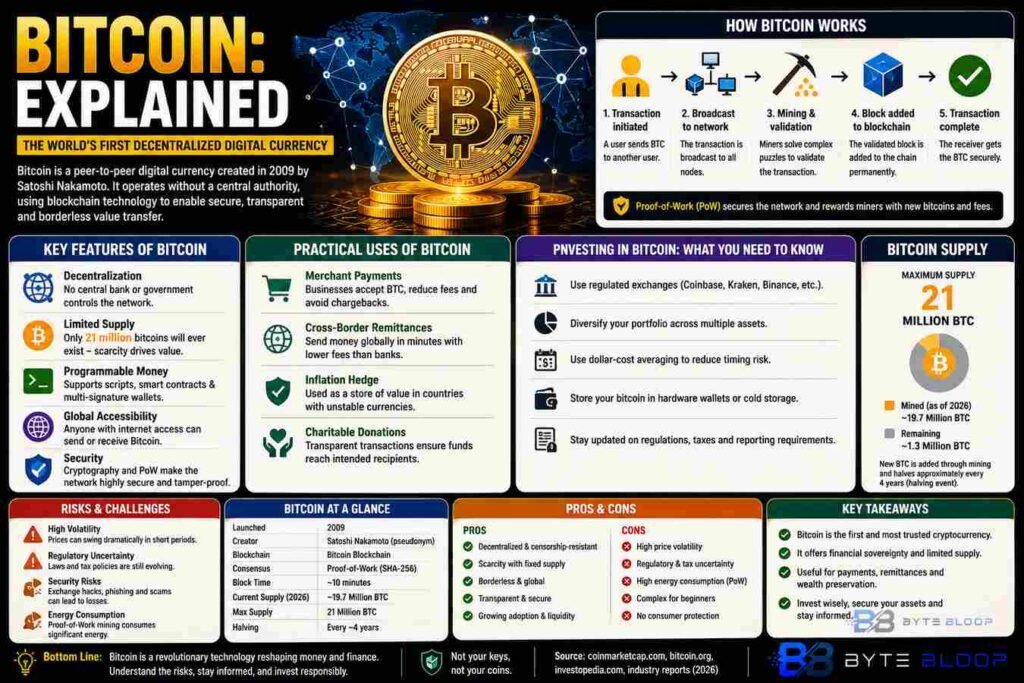
Bitcoin is the first and most well‑known cryptocurrency, created in 2009 by an anonymous figure named Satoshi Nakamoto. It introduced a peer‑to‑peer digital payment system that operates without a central authority, relying instead on a distributed ledger called the blockchain. At its core, Bitcoin is a digital asset that can be transferred, stored, and verified on a network of computers worldwide. Its value is driven by supply constraints—only 21 million coins will ever exist—combined with growing demand from investors, merchants, and technologists. Because it offers a new form of monetary sovereignty, Bitcoin has become a touchstone for the broader crypto market, influencing everything from regulatory policy to enterprise blockchain adoption. Understanding Bitcoin is therefore essential for anyone navigating the evolving landscape of digital finance, whether you’re a casual observer, a seasoned trader, or a business exploring blockchain solutions. This guide breaks down the fundamentals of Bitcoin, explains how it works, and highlights practical considerations for those looking to engage with the cryptocurrency.
How Bitcoin Works
Bitcoin operates on a public ledger called the blockchain, which records every transaction in chronological order. Each block contains a set of transactions and a reference to the previous block, creating a chain that is resistant to tampering. The network is secured by miners—nodes that solve complex mathematical puzzles to validate transactions and add new blocks. In return for their computational effort, miners receive newly minted bitcoins and transaction fees. This proof‑of‑work consensus mechanism ensures that no single entity can control the ledger, preserving the integrity of the system.
Key Features of Bitcoin
- Decentralization: No central bank or government controls the supply or issuance.
- Limited Supply: Cap of 21 million coins creates scarcity and potential for price appreciation.
- Programmable Money: Scripts allow for simple smart contracts and multi‑signature wallets.
- Global Accessibility: Anyone with internet access can send or receive Bitcoin.
- Security: Cryptographic hash functions and the proof‑of‑work consensus make the network highly secure.
Practical Uses of Bitcoin
While many people view Bitcoin primarily as an investment vehicle, it also serves practical functions. Merchants can accept Bitcoin as payment, bypassing traditional payment processors and reducing fees. Remittance services use Bitcoin to send cross‑border money faster and cheaper than bank wires. Some individuals use Bitcoin as a hedge against local currency inflation, especially in countries with unstable monetary policies. Finally, Bitcoin’s transparency makes it attractive for charitable donations, where donors can verify that funds reach their intended recipients.
Investing in Bitcoin: What You Need to Know
Before buying Bitcoin, investors should assess their risk tolerance, understand the volatility, and choose a regulated exchange. Diversifying across multiple crypto assets can reduce exposure to a single coin’s price swings. Dollar‑cost averaging—investing a fixed amount at regular intervals—helps mitigate timing risk. It’s also vital to secure holdings in hardware wallets or cold storage to protect against hacks. Regulatory developments in 2026 have introduced clearer guidelines for crypto exchanges, but investors must stay updated on evolving tax treatment and reporting requirements.
Risks and Challenges
Bitcoin’s price volatility can lead to significant gains and losses within short periods. Regulatory uncertainty remains a concern, as governments worldwide debate how to classify and tax digital assets. Security risks include exchange hacks and phishing attacks, underscoring the importance of strong personal security practices. Finally, the energy consumption of proof‑of‑work mining has attracted criticism, prompting discussions about more sustainable consensus mechanisms.
Key Takeaways
- Bitcoin is a decentralized digital currency with a capped supply of 21 million coins.
- Its blockchain uses proof‑of‑work mining to secure transactions and issue new coins.
- Investors should diversify, use regulated exchanges, and secure holdings in cold storage.
- Bitcoin offers practical use cases such as cross‑border payments and inflation hedging.
- Regulatory and environmental concerns remain significant challenges for widespread adoption.
Frequently Asked Questions
What is Bitcoin?
Bitcoin is a decentralized digital currency that operates on a peer‑to‑peer network, using a public ledger called the blockchain to record transactions without a central authority.
What are the key features of Bitcoin?
Key features include decentralization, a fixed supply cap of 21 million coins, proof‑of‑work mining, and a transparent public ledger that ensures security and immutability.
What are the best use cases for Bitcoin?
Bitcoin is used for investment, cross‑border remittances, merchant payments, and as a hedge against local currency inflation, especially in unstable economies.
What are the pros and cons of Bitcoin?
Pros: decentralization, scarcity, security, and global accessibility. Cons: price volatility, regulatory uncertainty, high energy consumption, and potential security risks from exchanges.
Conclusion
Based on the available information and industry analysis, Bitcoin provides a pioneering example of decentralized digital money that has reshaped perceptions of value transfer and financial sovereignty. Its capped supply, robust security model, and growing acceptance across merchants and investors underscore its significance as both a speculative asset and a functional payment medium. However, volatility, regulatory developments, and environmental concerns highlight that Bitcoin’s future will depend on continued technological evolution and policy clarity. For those entering the market, a careful, diversified approach coupled with strong security practices will be key to navigating this dynamic landscape.
Related Reading
- Ethereum 2.0: What’s New and Why It Matters
This article is for informational and educational purposes only and should not be considered financial, investment, or trading advice.
This article is for informational and educational purposes only and should not be considered financial, investment, or trading advice.
