Business Loans: Explained
Introduction
Starting or expanding a business often requires more than just a great idea and a solid plan; it demands reliable capital. A business loan provides that capital, allowing entrepreneurs to purchase equipment, cover operating costs, or invest in growth initiatives. In India, the loan landscape is diverse, ranging from traditional term loans to innovative government-backed schemes that cater specifically to MSMEs. Understanding the nuances of each option can mean the difference between a smooth expansion and a cash‑flow crisis. This guide breaks down the most common loan types, eligibility criteria, and the practical steps you need to take to secure funding. It also highlights key government schemes that can reduce borrowing costs and simplify the application process. Whether you’re a startup founder or an established business owner, knowing how to navigate the loan market is essential for sustained success. Finally, we’ll share real‑world examples and expert tips to help you choose the right loan for your unique needs.
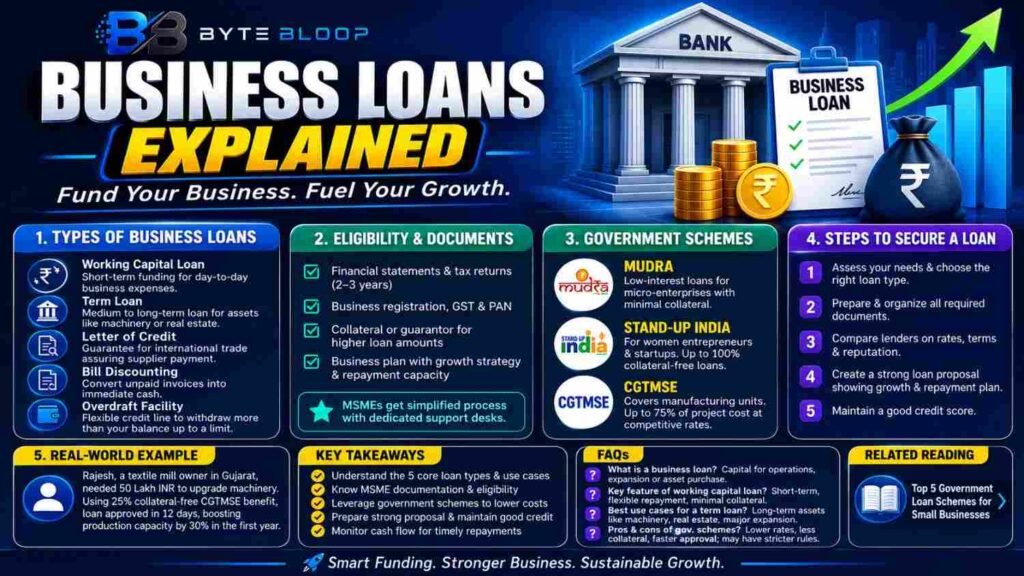
1. Types of Business Loans in India
Business loans come in various shapes, each designed to meet specific financial needs.
- Working Capital Loan – Short‑term funding to cover day‑to‑day expenses such as inventory and payroll.
- Term Loan – Medium to long‑term financing for fixed assets like machinery or real estate.
- Letter of Credit – A guarantee that facilitates international trade by assuring suppliers of payment.
- Bill Discounting – Converts unpaid invoices into immediate cash, improving liquidity.
- Overdraft Facility – A flexible credit line that allows you to withdraw more than your account balance, up to a set limit.
2. Eligibility and Documentation
Most banks require a blend of financial health indicators and business documentation.
- Clear financial statements and tax returns for the past 2–3 years.
- Proof of business registration, GST, and PAN.
- Collateral or a guarantor, especially for larger loan amounts.
- Business plan outlining growth strategy and repayment capacity.
MSMEs often enjoy simplified processes, with many banks offering dedicated MSME desks that streamline approvals.
3. Government Schemes to Watch
India’s government actively supports small businesses through targeted loan programs.
- Mudra – Low‑interest loans for micro‑enterprises, with minimal collateral requirements.
- Stand‑Up India – Focuses on women entrepreneurs and startups, providing up to 100 % collateral‑free loans.
- CGTMSE – Covers manufacturing units, offering up to 75 % of the project cost at competitive rates.
Leveraging these schemes can reduce both interest rates and documentation burdens.
4. Practical Steps to Secure a Loan
Preparation is key to a smooth approval process.
- Assess your funding needs and choose the loan type that aligns with your business cycle.
- Compile all required documents and ensure they are up‑to‑date.
- Shop around: compare rates, repayment terms, and lender reputation across banks and fintech platforms.
- Prepare a concise loan proposal highlighting how the funds will drive growth and how you plan to repay.
- Maintain a healthy credit score; lenders scrutinize personal and business credit histories.
Once approved, monitor cash flow closely to meet repayment schedules and avoid penalties.
5. Real‑World Example
Rajesh, a textile mill owner in Gujarat, needed 50 Lakh INR to upgrade machinery. He applied for a term loan through a state‑bank, leveraging a 25 % collateral‑free window offered by the CGTMSE scheme. The bank approved the loan in 12 days, and Rajesh’s production capacity increased by 30 %, boosting revenue within the first year.
Key Takeaways
- Understand the 5 core loan types and their use cases
- Know the documentation and eligibility requirements for MSMEs
- Leverage government schemes to lower costs and simplify approval
- Prepare a strong loan proposal and maintain good credit
- Monitor cash flow to ensure timely repayments
Frequently Asked Questions
What is a business loan?
A business loan is a financial product offered by banks or lenders that provides capital to businesses for various purposes such as working capital, expansion, or equipment purchase.
What are the key features of a working capital loan?
Working capital loans are short‑term, designed to cover day‑to‑day expenses, have flexible repayment terms tied to the business cycle, and often require minimal collateral.
What are the best use cases for a term loan?
Term loans are ideal for purchasing long‑term assets like machinery, real estate, or for major expansion projects where the repayment period aligns with the asset’s useful life.
What are the pros and cons of using government loan schemes?
Pros include lower interest rates, reduced collateral, and faster approval; cons may involve stricter eligibility criteria and specific usage restrictions.
Conclusion
Based on the available information and industry analysis, business loans provide a critical lifeline for enterprises seeking growth, operational stability, and competitive advantage. By understanding the spectrum of loan types—from working capital to term loans—and aligning them with business objectives, entrepreneurs can secure the right funding mix. Government schemes further democratize access, offering reduced rates and simplified processes for MSMEs. Ultimately, a well‑structured loan strategy, backed by thorough documentation and realistic repayment planning, empowers businesses to scale sustainably while mitigating financial risk.
Related Reading
- Top 5 Government Loan Schemes for Small Businesses