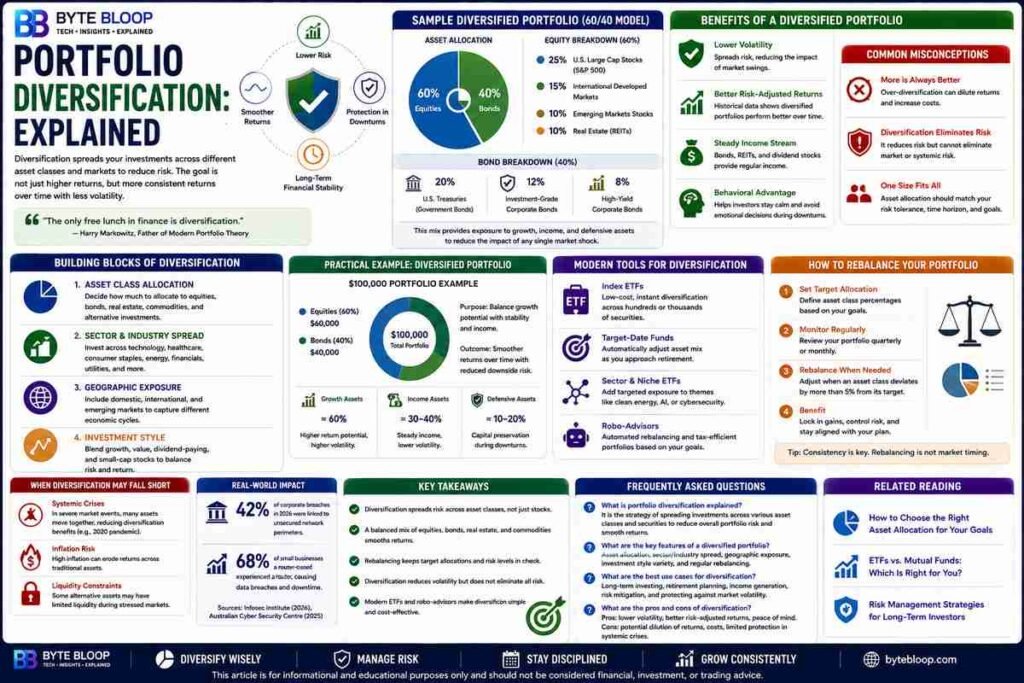
Portfolio Diversification: Explained
Introduction
When investors talk about portfolio diversification, they refer to a strategy that spreads capital across different asset classes—stocks, bonds, real estate, commodities, and more—to lower overall risk. The core idea is that not all investments move in lockstep; by holding a mix, a downturn in one sector can be offset by stability or gains elsewhere. Diversification is not about chasing high returns; it’s about protecting against volatility and preserving capital over time. The practice dates back to the 1950s with Harry Markowitz’s Modern Portfolio Theory, which mathematically demonstrated that a well‑balanced mix can improve risk‑adjusted performance. Today, investors use tools like ETFs, mutual funds, and robo‑advisors to implement diversification efficiently. However, diversification alone does not eliminate risk; it merely reduces exposure to any single asset’s poor performance. Understanding how to structure a diversified portfolio is essential for both novice and seasoned investors aiming for long‑term financial stability.
What Diversification Really Means for Your Portfolio
At its simplest, diversification means owning a range of assets that do not all react the same way to market events. For example, if a technology stock drops, a government bond may remain steady, cushioning the overall loss. According to Investopedia, this strategy reduces portfolio risk associated with price volatility. The goal is to achieve a smoother return curve over time, especially during market turbulence.
Building Blocks of Diversification
1. Asset Class Allocation – Decide how much of your portfolio goes to equities, fixed income, real estate, and alternatives.
2. Sector and Industry Spread – Within stocks, invest across technology, healthcare, consumer staples, energy, and more.
3. Geographic Exposure – Include domestic, international, and emerging markets to capture different economic cycles.
4. Investment Style – Blend growth, value, dividend, and small‑cap stocks to balance risk and return.
Practical Examples of Diversified Portfolios
Consider a 60/40 equity‑bond split. Within the 60% equity, allocate 25% to U.S. large caps, 15% to international developed markets, 10% to emerging markets, and 10% to real estate investment trusts (REITs). The remaining 40% in bonds could be split between U.S. Treasuries, investment‑grade corporate bonds, and high‑yield bonds. This structure provides exposure to growth, income, and defensive assets, reducing the impact of any single market shock.
Modern Tools for Diversification
Robo‑advisors and index ETFs allow investors to achieve diversification with minimal effort. For instance, a target‑date fund automatically rebalances across asset classes as you approach retirement. Similarly, sector ETFs let you add niche exposure—like cybersecurity or clean energy—without buying individual stocks.
Benefits of a Diversified Portfolio
Research shows diversified portfolios tend to have lower volatility and higher risk‑adjusted returns. Morningstar’s 2025 data highlighted that diversified funds outperformed concentrated portfolios during tariff announcements and policy shifts. Diversification also provides psychological comfort, reducing the urge to time the market during downturns.
Common Misconceptions
1. More is always better – Over‑diversification can dilute returns and increase costs.
2. Diversification eliminates risk – It reduces, but does not remove, market risk.
3. One size fits all – Asset allocation should align with risk tolerance, time horizon, and financial goals.
How to Rebalance for Optimal Diversification
Rebalancing involves periodically adjusting holdings to maintain target allocations. A simple rule is to rebalance when an asset class deviates by more than 5% from its target weight. This process keeps risk in check and captures gains from outperforming assets.
When Diversification May Fall Short
During systemic crises, correlations between assets can rise, reducing diversification benefits. The 2020 pandemic saw equities and bonds move in tandem, underscoring the need for alternative assets like commodities or inflation‑protected securities.
Key Takeaways
- Diversification spreads risk across asset classes, not just stocks.
- A balanced mix of equities, bonds, real estate, and commodities smooths returns.
- Rebalancing keeps target allocations and risk levels in check.
- Diversification reduces volatility but does not eliminate all risk.
- Modern ETFs and robo‑advisors simplify building a diversified portfolio.
Frequently Asked Questions
What is portfolio diversification explained?
Portfolio diversification is the strategy of spreading investments across various asset classes and securities to reduce overall portfolio risk and smooth returns.
What are the key features of a diversified portfolio?
Key features include asset class allocation, sector and geographic spread, investment style variety, and regular rebalancing to maintain target weights.
What are the best use cases for diversification?
Diversification is ideal for long‑term investors seeking risk mitigation, retirees needing stable income, and anyone wanting to protect against market volatility.
What are the pros and cons of diversification?
Pros: lower volatility, improved risk‑adjusted returns, psychological comfort. Cons: potential dilution of returns, higher costs if over‑diversified, limited protection during systemic crises.
Conclusion
Based on the available information and industry analysis, portfolio diversification provides a proven framework for reducing risk while maintaining growth potential. By strategically allocating across asset classes, sectors, and geographies, investors can smooth volatility and achieve more consistent returns over time. Regular rebalancing and mindful cost management further enhance the effectiveness of diversification, making it a cornerstone of sound investment strategy.
Related Reading
- How to Choose the Right Asset Allocation for Your Goals
This article is for informational and educational purposes only and should not be considered financial, investment, or trading advice.
This article is for informational and educational purposes only and should not be considered financial, investment, or trading advice.