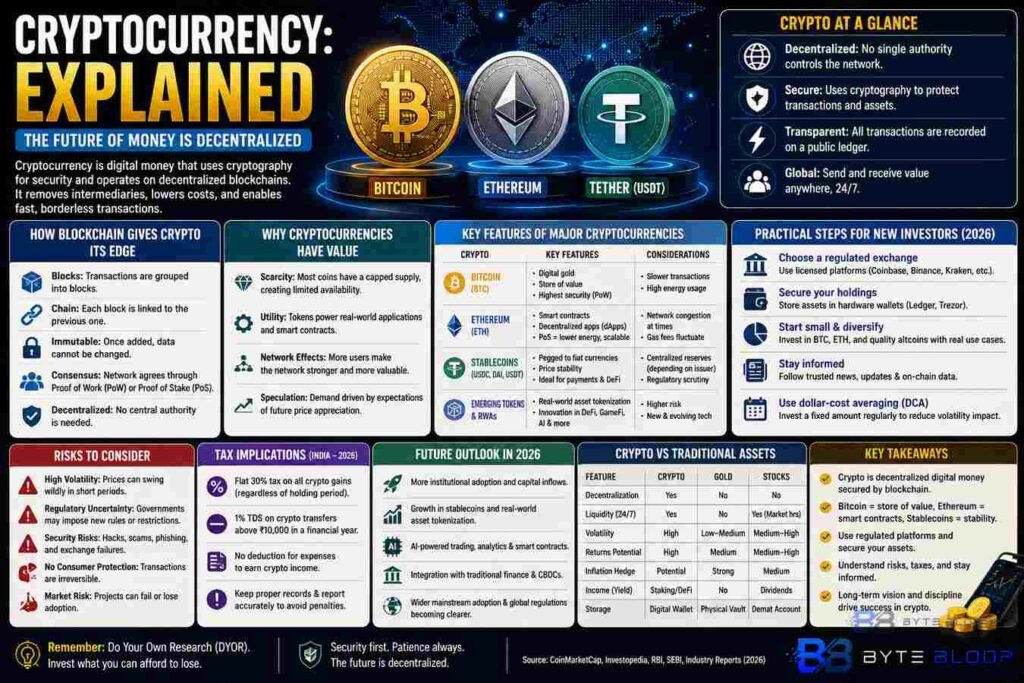
Cryptocurrency: Explained
Introduction
Cryptocurrency has evolved from a niche digital curiosity into a mainstream financial phenomenon. At its core, it is a form of digital money that relies on cryptographic protocols to secure transactions, control new units, and verify asset transfers. Unlike traditional currencies issued by central banks, cryptocurrencies operate on distributed ledgers—blockchains—where every participant holds a copy of the transaction history. This decentralization eliminates the need for intermediaries, potentially reducing costs and speeding up cross‑border payments. The surge in popularity of Bitcoin, Ethereum, and thousands of altcoins has sparked debates about regulation, volatility, and the future of money. Understanding these dynamics is crucial for anyone looking to navigate the crypto landscape, whether as a casual observer or a serious investor. This guide demystifies the technology, explains why crypto has value, and offers practical steps for getting started in 2026.
How Blockchain Gives Crypto Its Edge
Blockchains are the backbone of all cryptocurrencies. They are tamper‑evident chains of blocks, each containing a batch of transactions. When a new block is added, it is cryptographically linked to the previous one, making it computationally infeasible to alter past records. This immutability ensures trust without a central authority. The consensus mechanism—proof of work for Bitcoin, proof of stake for Ethereum—verifies that participants agree on the state of the ledger. These mechanisms also control the issuance of new coins, creating scarcity and influencing price.
Why Cryptocurrencies Have Value
Value in crypto stems from several factors. First, scarcity: most coins have a capped supply, like Bitcoin’s 21 million limit, which can drive demand as adoption grows. Second, utility: tokens like Ethereum’s Ether enable smart contracts that power decentralized applications, adding functional value beyond mere store of value. Third, network effects: the larger the user base, the more secure and useful the network becomes. Finally, speculation: investors often buy crypto anticipating future price appreciation, which can create self‑fulfilling cycles of demand.
Key Features of Major Cryptocurrencies
Bitcoin is the original digital gold, designed for peer‑to‑peer payments and a hedge against inflation. Its security comes from a massive proof‑of‑work network, but this also leads to high energy consumption and slower transaction times. Ethereum introduced smart contracts, allowing developers to build decentralized apps. Its transition to proof‑of‑stake in 2022 has reduced energy use and increased scalability. Stablecoins like USDC and DAI peg their value to fiat currencies, offering price stability while retaining blockchain benefits. Emerging tokens are experimenting with real‑world asset tokenization, bringing traditional securities onto the blockchain.
Practical Steps for New Investors in 2026
1. Choose a regulated exchange. In 2026, platforms such as Coinbase, Binance, and Kraken are licensed in major jurisdictions, offering investor protection and compliance with anti‑money‑laundering rules. 2. Secure your holdings. Use hardware wallets (Ledger, Trezor) to store private keys offline, reducing the risk of hacks. 3. Start small and diversify. Allocate a modest portion of your portfolio to Bitcoin and Ethereum, then explore altcoins with clear use cases. 4. Stay informed. Follow reputable news sources, regulatory updates, and market research to avoid scams and make data‑driven decisions. 5. Consider dollar‑cost averaging. Regularly invest a fixed amount, smoothing out price volatility over time.
Risks and Regulatory Landscape
Cryptocurrencies remain highly volatile; prices can swing dramatically within hours. Regulatory uncertainty also poses a risk: governments may impose stricter controls on trading, taxation, or use of stablecoins. Additionally, security breaches at exchanges can lead to significant losses. Investors should conduct thorough due diligence, use reputable custodians, and maintain a diversified portfolio to mitigate these risks.
Future Outlook in 2026
Industry analysts predict continued institutional capital inflow, record mergers and acquisitions, and growth in stablecoins and real‑world asset tokenization. Artificial intelligence is expected to enhance trading strategies and smart contract development, further expanding the ecosystem. As central bank digital currencies (CBDCs) mature, the crypto space may see increased integration with traditional finance, potentially reshaping payment systems worldwide.
Key Takeaways
- Cryptocurrencies rely on decentralized blockchains for security and trust.
- Bitcoin and Ethereum remain the most widely adopted tokens, each with distinct use cases.
- Investing in crypto requires choosing regulated exchanges, securing wallets, and diversifying holdings.
- Regulatory changes and market volatility pose significant risks to investors.
- The industry is poised for growth with institutional adoption, stablecoin expansion, and AI integration.
Frequently Asked Questions
What is cryptocurrency explained?
Cryptocurrency is digital money that uses cryptographic techniques to secure transactions, control the creation of new units, and verify asset transfers on a decentralized ledger known as a blockchain.
What are the key features of major cryptocurrencies?
Bitcoin offers scarcity and security through proof‑of‑work; Ethereum enables smart contracts via proof‑of‑stake; stablecoins provide price stability by pegging to fiat; newer tokens explore real‑world asset tokenization.
What are the best use cases for cryptocurrency?
Use cases include peer‑to‑peer payments, decentralized finance (DeFi) services, smart contract execution, tokenized real‑world assets, and as a hedge against inflation.
What are the pros and cons of investing in cryptocurrency?
Pros include potential high returns, diversification, and exposure to emerging technology. Cons involve high volatility, regulatory uncertainty, security risks, and lack of consumer protections.
Conclusion
Based on the available information and industry analysis, cryptocurrency offers a blend of technological innovation and financial opportunity that continues to reshape global markets. Its decentralized nature, combined with evolving regulatory frameworks and institutional interest, positions it as a pivotal component of the future financial ecosystem. Investors who approach the space with informed strategies, risk awareness, and a long‑term perspective stand to benefit from its dynamic growth while mitigating potential pitfalls.
Related Reading
- Understanding Stablecoins: The Future of Digital Payments
This article is for informational and educational purposes only and should not be considered financial, investment, or trading advice.
This article is for informational and educational purposes only and should not be considered financial, investment, or trading advice.
