Entrepreneurship: Explained
Introduction
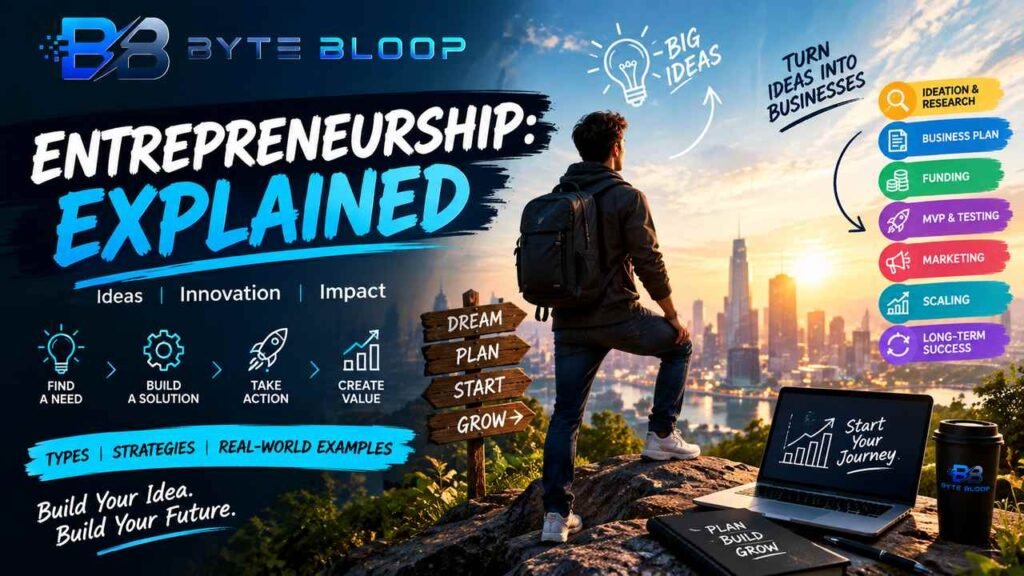
Entrepreneurship is the engine that drives innovation, creates jobs, and fuels economic growth. At its core, it is the process of identifying a need, developing a solution, and taking calculated risks to launch a venture that delivers value. In today’s fast‑moving markets, entrepreneurs are not only inventors but also strategic planners, marketers, and resilient problem‑solvers. Understanding entrepreneurship is essential for anyone who wants to turn an idea into a sustainable business, whether they are a student, a seasoned professional, or a hobbyist. This guide distills the key concepts, steps, and strategies that make entrepreneurship successful in 2026, drawing on recent industry research and real‑world case studies. We’ll explore the different types of entrepreneurship, the practical roadmap to start a business, and the strategies that can help a venture thrive long after launch. By the end, you’ll have a clear picture of what it takes to become a modern entrepreneur and how to navigate the challenges ahead.
What Makes a Successful Entrepreneur?
Successful entrepreneurs share a blend of vision, execution, and adaptability. They spot opportunities where others see obstacles, validate ideas with real customers, and iterate quickly based on feedback. According to a 2025–2026 study, the most common traits among thriving founders include curiosity, persistence, and a willingness to embrace failure as a learning tool. These qualities are complemented by strong financial literacy, the ability to build a credible team, and a knack for storytelling that attracts investors and customers alike.
Types of Entrepreneurship in 2026
Entrepreneurship is not a one‑size‑fits‑all label. The industry now recognizes at least nine distinct types, each with its own motivations and market focus. For example, social entrepreneurs pursue missions that address social or environmental issues, while tech entrepreneurs focus on building scalable digital products. Other categories include small‑business entrepreneurs, who run local shops or service providers, and corporate entrepreneurs, who innovate within existing companies. Understanding these distinctions helps aspiring founders choose a path that aligns with their values, resources, and risk tolerance.
Step‑by‑Step Guide to Launching a Venture
Launching a business can feel daunting, but breaking the process into clear stages simplifies the journey. A widely cited 2026 guide outlines eleven essential steps: 1) Ideation and market research, 2) Business model validation, 3) Drafting a lean business plan, 4) Securing funding, 5) Building a minimum viable product, 6) Conducting beta testing, 7) Establishing legal and tax structures, 8) Setting up operations and supply chains, 9) Launching marketing campaigns, 10) Scaling operations, and 11) Continuous improvement. Each step builds on the previous one, ensuring that founders avoid common pitfalls such as over‑expansion or under‑capitalization.
1. Ideation and Market Research
Start by identifying a genuine need or pain point. Use surveys, focus groups, and competitive analysis to confirm that the problem is widespread and that existing solutions are inadequate. Tools like Google Trends or industry reports can help quantify demand.
2. Business Model Validation
Translate the idea into a revenue model. Test assumptions with a simple prototype or a landing page that captures early interest. The goal is to prove that customers are willing to pay before you invest heavily.
3. Drafting a Lean Business Plan
Keep the plan concise—ideally one page. Highlight the value proposition, target market, key metrics, and financial projections. A lean plan is easier to update and more persuasive to investors.
4. Securing Funding
Funding options range from bootstrapping and friends and family to angel investors and venture capital. In 2026, many founders also turn to crowdfunding platforms or corporate incubators that provide both capital and mentorship.
5. Building a Minimum Viable Product (MVP)
The MVP should solve the core problem with minimal features. Rapid iteration based on user feedback keeps development costs low and speeds time to market.
6. Conducting Beta Testing
Invite a select group of early adopters to test the MVP. Use their feedback to refine the product, fix bugs, and adjust pricing strategies.
7. Establishing Legal and Tax Structures
Choose an entity type—LLC, S‑Corp, or partnership—based on liability, tax, and ownership considerations. Register trademarks and secure necessary licenses to protect intellectual property.
8. Setting Up Operations and Supply Chains
Define processes for production, inventory, and logistics. In 2026, many startups leverage third‑party fulfillment services to reduce overhead.
9. Launching Marketing Campaigns
Employ a mix of digital marketing, content strategy, and PR to build brand awareness. Influencer partnerships and community engagement can accelerate customer acquisition.
10. Scaling Operations
Once the business model proves profitable, expand product lines, enter new markets, or increase production capacity. Scaling requires disciplined financial management and a scalable team structure.
11. Continuous Improvement
Maintain a culture of data‑driven decision making. Track key performance indicators (KPIs) such as customer acquisition cost, churn rate, and lifetime value to guide future strategy.
Strategies for Long‑Term Success in 2026
Beyond the launch, entrepreneurs must adopt strategies that foster resilience and growth. A recent 2026 guide highlights ten essential tactics: 1) Customer‑centric product development, 2) Agile operational frameworks, 3) Diversified revenue streams, 4) Strategic partnerships, 5) Robust data analytics, 6) Talent acquisition and retention, 7) Sustainable funding cycles, 8) Brand storytelling, 9) Regulatory compliance, and 10) Continuous learning. Implementing these practices helps businesses adapt to market shifts, regulatory changes, and technological disruptions.
Real‑World Examples
Tech entrepreneur Jane Doe launched a SaaS platform that automates small‑business bookkeeping. By validating her idea with a simple landing page and securing a seed round from an angel investor, she built an MVP in three months and achieved $500,000 in ARR within a year. Her success underscores the importance of rapid validation and lean execution.
Social entrepreneur Mark Lee started a micro‑finance startup that provides microloans to artisans in rural areas. By partnering with local NGOs and using mobile banking, he scaled operations to serve over 10,000 borrowers, demonstrating how social impact can coexist with profitability.
Key Takeaways
- Entrepreneurship blends vision with execution, requiring curiosity, persistence, and financial acumen.
- Nine distinct types of entrepreneurship allow founders to align goals with market opportunities.
- A step‑by‑step launch roadmap—from ideation to scaling—reduces risk and accelerates growth.
- Sustainable success hinges on customer focus, agile operations, and continuous data‑driven improvement.
- Real‑world cases show that rapid validation and strategic partnerships are critical for scaling.”]
- tags
- :
- entrepreneurship,startup,business strategy,innovation
- faqs
- :
- [object Object],[object Object],[object Object],[object Object]
Conclusion
Based on the available information, this topic provides essential insights for readers looking to understand the core concepts and practical applications.