Tournament Formats Explained
Introduction
When a group of teams or players converge to compete, the structure of that competition shapes every match, the suspense for fans, and the logistics for organizers. Whether it’s a local soccer league, an international cricket series, or a corporate hackathon, the chosen format determines how many games are played, how long the event lasts, and what the stakes are at each stage. Understanding the core types—round‑robin, knockout, and hybrid—lets teams prepare strategically and fans anticipate the drama that unfolds. It also informs budget decisions, venue scheduling, and broadcasting plans, making format selection a critical early decision in event planning. In this guide, we’ll break down the most common tournament structures, illustrate real‑world examples, and offer a practical framework for picking the right format for your next competition. By the end, you’ll know which setup delivers fairness, excitement, and operational efficiency for any sport or game.
Round‑Robin: Everyone Plays Everyone
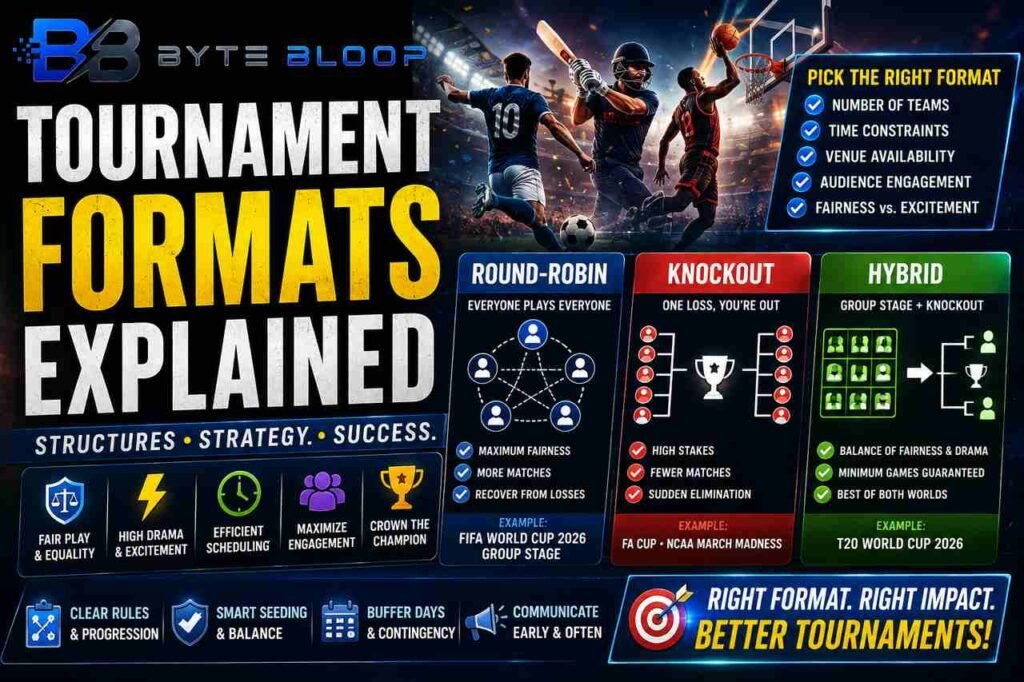
A round‑robin format has each participant face every other participant once (single round) or twice (double round). This structure is prized for its fairness because all teams experience the same opponents, reducing the luck factor of draw. The 2026 FIFA World Cup will use a group stage that follows a round‑robin approach, ensuring each of the 48 teams plays multiple matches before advancing. The advantage is clear: teams can recover from an early loss, and fans get more games to watch. The downside is that it requires many matches, which can strain venues and extend the event’s duration.
Knockout (Elimination): One Loss, One Out
In a knockout or elimination format, a single loss eliminates a team from contention. This high‑stakes structure is common in cup competitions like the FA Cup or the NCAA March Madness tournament. The excitement comes from the do‑or‑die nature of each match, but it can also produce early exits for strong teams due to a single bad performance. Knockouts are efficient; they need fewer games than round‑robin, making them suitable for tight schedules or limited venues. However, organizers must plan for potential tiebreakers, such as extra time or penalty shootouts, to resolve draws.
Hybrid and Multi‑Stage Formats
Many major tournaments blend formats to balance fairness and drama. A common hybrid is a group stage (round‑robin) followed by a knockout phase. The 2026 T20 World Cup, for instance, begins with four groups of five teams each, then moves to a knockout bracket for the top teams. Hybrid formats allow organizers to guarantee a minimum number of games for each team while still culminating in a decisive final. They also enable seeding based on early performance, ensuring that the strongest teams avoid each other until later rounds.
Choosing the Right Format: Practical Criteria
When deciding on a tournament structure, consider these factors:
- Number of participants: Larger fields favor group stages to manage match volume.
- Time constraints: Tight schedules lean toward knockout or single‑round robin.
- Venue availability: Limited venues require efficient formats with fewer games.
- Audience engagement: Knockouts create high‑stakes moments, while round‑robin offers more consistent viewing.
- Fairness vs. excitement: Round‑robin maximizes fairness; knockout maximizes drama.
According to a guide on organizing sports tournaments, effective seeding and clear fixture procedures are essential for any format, ensuring transparency and reducing disputes. Proper planning also involves referee coordination, contingency scheduling, and communication with teams, all of which are covered in step‑by‑step resources for tournament organizers.
Real‑World Examples of Format Success
In the 2026 FIFA World Cup, the expanded 48‑team field uses a group stage to give each team at least three matches, followed by a single‑elimination knockout stage to crown a champion. This structure balances inclusivity with the excitement of knockout play. Meanwhile, the 2026 T20 World Cup’s group‑to‑knockout format allows for a concise tournament that still offers each team multiple games before the high‑stakes knockout rounds. These examples demonstrate how hybrid formats can be tailored to sport, scale, and audience expectations.
Common Pitfalls and How to Avoid Them
Misaligned formats can lead to scheduling chaos, player fatigue, and fan disappointment. Over‑extending a round‑robin can strain resources; conversely, a pure knockout may feel unfair if a top team exits early. To mitigate these risks, organizers should:
- Define clear progression rules before the event.
- Use seeding to balance group strength.
- Plan buffer days for weather or injury delays.
- Communicate format details to teams and fans early.
Key Takeaways
- Round‑robin guarantees fairness but needs many matches
- Knockout formats are fast‑paced and high‑stakes
- Hybrid models blend fairness with excitement
- Choosing a format depends on participants, time, and venue
- Clear seeding and fixture procedures prevent disputes
Frequently Asked Questions
What is a round‑robin tournament?
A competition where each participant plays every other participant at least once, ensuring equal opportunity to compete.
What are the key features of a knockout format?
Single‑elimination matches where a loss results in immediate exit, creating high‑stakes games and a clear winner at the end.
What are the best use cases for hybrid tournament structures?
Events with many teams that need both fairness in early stages and excitement in later stages, such as world cups or large regional cups.
What are the pros and cons of a pure knockout tournament?
Pros: fewer matches, faster conclusion, high drama. Cons: less fairness, potential early exit for strong teams, limited game time for participants.
Conclusion
Based on the available information and industry analysis, tournament formats play a pivotal role in shaping competition fairness, excitement, and logistical feasibility. By aligning format choice with participant numbers, time constraints, and audience expectations, organizers can deliver engaging events that balance opportunity and drama.
Related Reading
- How to Seed Teams in a Knockout Tournament
Sources & References