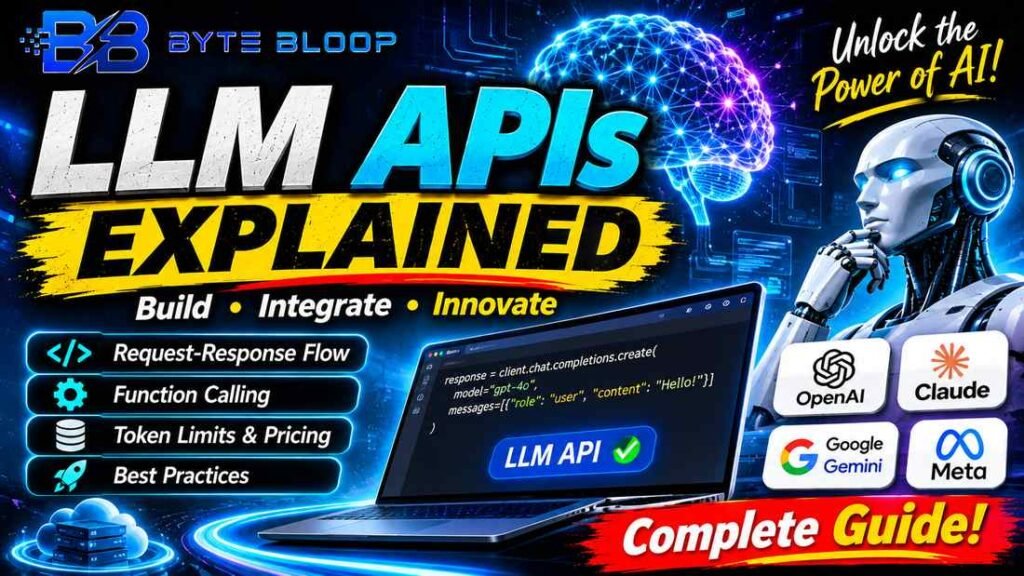
LLM APIs: Explained
Introduction (Llm Apis Explained)
Llm Apis Explained is a topic worth understanding well. Large‑language‑model APIs are the gateway that lets developers harness the power of AI without owning a model. They expose a simple HTTP or gRPC endpoint where a prompt, a series of messages, or even multimodal data is sent and a response is returned in seconds. The promise is clear: plug a single line of code into your stack and unlock natural language understanding, code generation, or conversational agents.
Yet the surface simplicity hides a complex ecosystem of token limits, context windows, and function‑calling hooks that shape how an application behaves. Understanding the request‑response flow, how prompts are structured, and the nuances of function calling is essential for building reliable, cost‑effective AI features. In this guide we break down the core architecture of LLM APIs, walk through a practical example in Python, highlight common pitfalls, and outline best practices that align with the latest industry trends.
What an LLM API Looks Like
According to FutureAGI Guide (2026), an LLM API is the interface that accepts prompts, messages, tool schemas, or multimodal inputs and returns generated text. The typical flow follows a request‑response pattern: the client sends an HTTP POST with a JSON payload, the server processes the prompt through a model, and the response arrives as JSON containing text, token usage, and optional metadata. This pattern is mirrored in major providers like OpenAI, Anthropic, and Azure, making the learning curve largely uniform across platforms.
Key Components of the Request
1. Prompt or Messages: A plain string or an array of message objects. The array format supports conversational context, where each message has a role (system, user, assistant).
2. Model Identifier: A string such as “gpt‑4o” or “claude‑3‑haiku” that selects the underlying architecture.
3. Parameters: Temperature, top‑p, max‑tokens, stop sequences, and presence penalty control the creativity and length of the output.
4. Function Calling: A JSON schema that tells the model to invoke a tool or API. The model returns a structured response that the client can dispatch to an external function.
This matters directly for anyone exploring llm apis explained.
Function Calling in Practice
Function calling transforms an LLM from a text generator into an intelligent agent. The model returns a JSON object with the function name and arguments, allowing the application to execute real‑world actions. A simple example in Python demonstrates the flow:
Getting llm apis explained right can make a real difference.
import requests, json
url = "https://api.openai.com/v1/chat/completions"
headers = {
    "Authorization": "Bearer YOUR_KEY",
    "Content-Type": "application/json"
}
payload = {
    "model": "gpt-4o",
    "messages": [
        {"role": "system", "content": "You are a weather assistant."},
        {"role": "user", "content": "What's the forecast for Berlin tomorrow?"}
    ],
    "functions": [
        {
            "name": "get_weather",
            "parameters": {
                "type": "object",
                "properties": {
                    "location": {"type": "string"},
                    "date": {"type": "string", "format": "date"}
                },
                "required": ["location", "date"]
            }
        }
    ],
    "function_call": "auto"
}
response = requests.post(url, headers=headers, data=json.dumps(payload))
print(response.json()["choices"][0]["message"]["function_call"])
The returned function_call payload can be passed to a weather API, and the assistant can then reply with a natural language summary. This pattern is highlighted in the 2026 guide on unified APIs for function calling, which compares providers such as Composio and Truto.
That is a core part of understanding llm apis explained.
Common Errors and How to Avoid Them
- Token Overflow: Exceeding the model’s context window truncates earlier messages. Keep the cumulative token count under the model’s limit and trim old context when necessary.
- Mis‑formatted Function Schema: The function definition must be a valid JSON schema. Validation tools or provider SDKs can catch errors before the request is sent.
- Rate Limits: Exceeding the provider’s request quota triggers throttling. Implement exponential back‑off and monitor usage via dashboards.
- Security of Prompt Injection: Never trust user input directly; sanitize or encode prompts to prevent malicious manipulation of the model’s behavior.
Best Practices for Production Deployments
1. Batch Requests: Group multiple prompts into a single request when possible to reduce latency and cost.
2. Cache Responses: Store frequent queries in a Redis or in‑memory cache to avoid redundant API calls.
3. Observability: Log token usage, latency, and error codes. Use distributed tracing to pinpoint bottlenecks.
4. Cost Controls: Set hard limits on max‑tokens and monitor spend per user or per feature.
5. Versioning: Pin the model version in your code to prevent unexpected behavior when providers update models.
Many readers look into llm apis explained for exactly this reason.
Choosing the Right LLM for Your Use Case
According to the 2026 blog on LLM selection, factors such as coding ability, reasoning, cost, and privacy dictate which model to use. For example, a developer building a code‑generation tool might prefer a model with strong syntax awareness, while a customer‑service bot could prioritize fast inference and low latency. Providers often offer specialized models with reduced token costs or higher throughput, which can be critical for high‑volume applications.
It is worth revisiting llm apis explained as things develop.
Future Directions
LLM APIs are evolving beyond simple text generation. Multi‑modal endpoints that accept images, audio, or structured data are becoming standard, and providers are adding advanced safety controls and fine‑tuning options. The trend toward unified APIs that bundle function calling, agent orchestration, and tool integration—highlighted in the 2026 Truto blog—suggests that developers will soon be able to compose complex workflows with a single endpoint.
Llm Apis Explained remains highly relevant here.
Key Takeaways
- LLM APIs use a request‑response model that accepts prompts and returns text or structured data.
- Function calling turns the model into an intelligent agent capable of executing external tools.
- Token limits and context windows are critical constraints that must be managed in production.
- Caching, batching, and observability are essential for cost‑effective, reliable deployments.
- Choosing the right model depends on use‑case, cost, and privacy requirements.
- Unified APIs are emerging to simplify agent orchestration and tool integration.
Frequently Asked Questions
What is an LLM API?
An LLM API is a web‑based interface that lets developers send prompts, messages, or multimodal inputs to a large language model and receive generated text or structured responses.
This is a key consideration when it comes to llm apis explained.
What are the key features of LLM APIs?
Key features include a request‑response architecture, support for conversational context, temperature and top‑p tuning, function calling for tool integration, and token‑based billing.
This matters directly for anyone exploring llm apis explained.
What are the best use cases for LLM APIs?
Common use cases are content generation, customer support bots, code assistants, data analysis, and any scenario that benefits from natural language understanding or generation.
Getting llm apis explained right can make a real difference.
What are the pros and cons of using LLM APIs?
Pros: rapid deployment, no infrastructure overhead, continuous model updates. Cons: cost per token, dependency on provider uptime, potential privacy concerns with data sent to external services.
That is a core part of understanding llm apis explained.
Conclusion
Based on the available information and industry analysis, LLM APIs provide a flexible, scalable way to embed advanced language capabilities into applications, enabling developers to focus on business logic rather than model training. By understanding the request‑response flow, managing token limits, and adopting best practices such as caching and observability, teams can build robust, cost‑effective AI features that meet modern user expectations.
Related Reading
- Building AI Agents with Function Calling
Sources & References
- LLM APIs: Tips for Bridging the Gap
- What Is an LLM API? Definition & FutureAGI Guide (2026)
- Best Unified API for LLM Function Calling & AI Agents (2026)
Related Articles