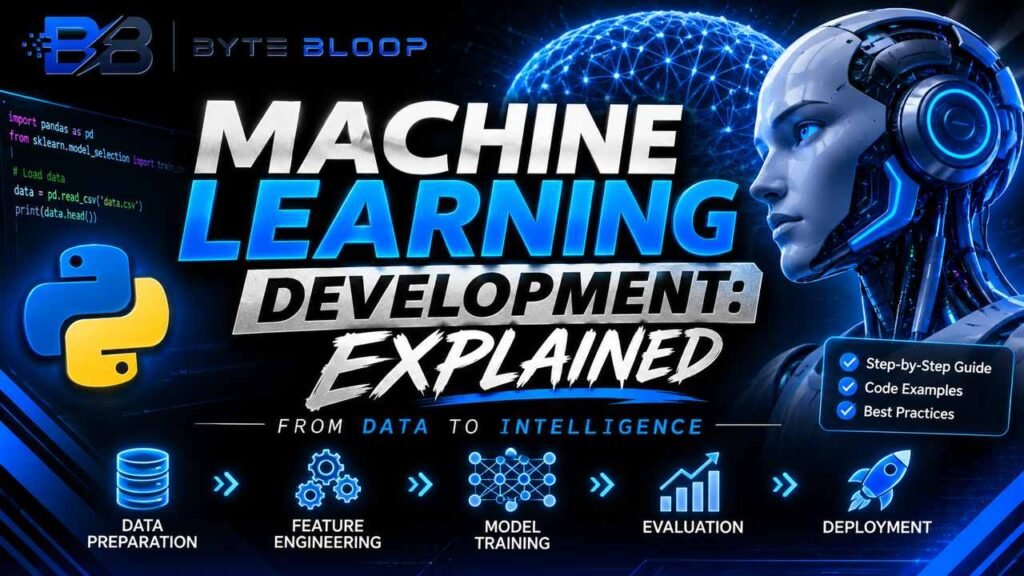
Machine Learning Development: Explained
Introduction
Machine Learning Development Explained is a topic worth understanding well. Machine learning has moved from academic curiosity to a core technology powering everything from recommendation engines to autonomous vehicles. At its heart, machine learning development is the systematic process of turning raw data into predictive models that can be deployed at scale. This journey involves a blend of mathematics, programming, and domain expertise, demanding a clear roadmap to avoid common pitfalls.
Whether you’re a data scientist, software engineer, or product manager, understanding the stages of model creation—from data ingestion to production monitoring—enables you to build reliable, ethical AI solutions. In this guide we’ll walk through the key phases, illustrate each with concise code snippets, and highlight best practices that align with industry standards. By the end, you’ll have a practical framework to start or refine your own machine learning projects.
1. Foundations: Math, Data, and Python
Before diving into code, a solid grasp of linear algebra, probability, and statistics is essential. According to the 2026 Guide to Machine Learning by IBM, mastering these concepts helps you interpret model behavior and diagnose errors. Most practitioners start with Python, leveraging libraries such as NumPy, pandas, and scikit‑learn. A simple data loading example:
import pandas as pd
from sklearn.model_selection import train_test_split

data = pd.read_csv('data.csv')
X = data.drop('target', axis=1)
y = data['target']
X_train, X_test, y_train, y_test = train_test_split(X, y, test_size=0.2, random_state=42)
2. Feature Engineering and Model Selection
Feature engineering transforms raw inputs into meaningful signals. Techniques such as one‑hot encoding, scaling, and dimensionality reduction (e.g., PCA) are common. After preprocessing, you select an algorithm that balances bias and variance. The Coursera roadmap emphasizes starting with interpretable models like logistic regression or decision trees before moving to complex ensembles. A quick logistic regression example:
This matters directly for anyone exploring machine learning development explained.
from sklearn.linear_model import LogisticRegression
from sklearn.metrics import accuracy_score

model = LogisticRegression(max_iter=200)
model.fit(X_train, y_train)
pred = model.predict(X_test)
print('Accuracy:', accuracy_score(y_test, pred))
3. Training, Validation, and Hyperparameter Tuning
Robust training requires cross‑validation to estimate generalization performance. Grid search or Bayesian optimization can fine‑tune hyperparameters. The Yotec guide recommends using scikit‑learn’s GridSearchCV for systematic exploration. Example:
Getting machine learning development explained right can make a real difference.
from sklearn.model_selection import GridSearchCV
param_grid = {'C': [0.1, 1, 10], 'penalty': ['l1', 'l2']}
search = GridSearchCV(LogisticRegression(), param_grid, cv=5)
search.fit(X_train, y_train)
print('Best params:', search.best_params_)
4. Model Evaluation and Explainability
Beyond accuracy, evaluate metrics relevant to the problem—precision, recall, F1, ROC‑AUC. Explainability tools like SHAP or LIME help stakeholders trust model decisions. The 2026 Guide to Machine Learning highlights the importance of fairness audits to detect bias before deployment.
That is a core part of understanding machine learning development explained.
5. Deployment and Monitoring
Deploying a model involves packaging code, creating APIs, and setting up monitoring. Containerization with Docker and orchestration via Kubernetes are industry standards. A minimal Flask API:
Many readers look into machine learning development explained for exactly this reason.
from flask import Flask, request, jsonify
app = Flask(__name__)

@app.route('/predict', methods=['POST'])
def predict():
    data = request.json
    features = pd.DataFrame([data])
    pred = model.predict(features)
    return jsonify({'prediction': int(pred[0])})

if __name__ == '__main__':
    app.run(host='0.0.0.0', port=5000)
Once live, continuous monitoring of latency, error rates, and drift ensures the model remains reliable. Tools like Prometheus and Grafana visualize key metrics.
It is worth revisiting machine learning development explained as things develop.
6. Common Pitfalls and How to Avoid Them
- Data leakage: Ensure training and test sets are completely separate.
- Overfitting: Use regularization and cross‑validation.
- Ignoring ethics: Conduct fairness and privacy assessments early.
- Neglecting documentation: Maintain clear versioning and experiment logs.
Best Practices for a Smooth ML Pipeline
- Automate data pipelines with Airflow or Prefect.
- Use experiment tracking tools like MLflow.
- Adopt CI/CD for model deployments.
- Plan for model retraining schedules.
Key Takeaways
- Start with solid math and Python fundamentals
- Iteratively engineer features and validate models
- Use explainability tools to build trust
- Automate pipelines and monitor in production
Frequently Asked Questions
What is machine learning development explained?
It refers to the end‑to‑end process of building, validating, and deploying predictive models using data and algorithms.
Machine Learning Development Explained remains highly relevant here.
What are the key features of a machine learning pipeline?
Data ingestion, preprocessing, feature engineering, model training, hyperparameter tuning, evaluation, deployment, and monitoring.
This is a key consideration when it comes to machine learning development explained.
What are the best use cases for machine learning development?
Recommendation systems, fraud detection, predictive maintenance, natural language processing, and computer vision applications.
What are the pros and cons of deploying models with Docker and Kubernetes?
Pros include portability and scalability; cons involve added complexity and operational overhead.
Conclusion
Based on the available information and industry analysis, machine learning development provides a structured framework that transforms raw data into actionable insights, enabling businesses to innovate and compete. By following a disciplined pipeline—from foundational math and data preparation to rigorous validation and continuous monitoring—developers can deliver reliable, ethical, and high‑performance AI solutions that scale across diverse domains.
Related Reading
- Data Preprocessing Techniques for ML
- Deploying ML Models with Kubernetes
Sources & References
- The 2026 Guide to Machine Learning – IBM
- Machine Learning Roadmap: Beginner to Expert (2026) – Coursera
- How to Learn Machine Learning in 2026 Without Wasting Months
- Complete Guide to Machine Learning in 2026 | Skills, Sala…
- Machine Learning Roadmap 2026: A Step-by-Step Guide … – Scaler
Related Articles