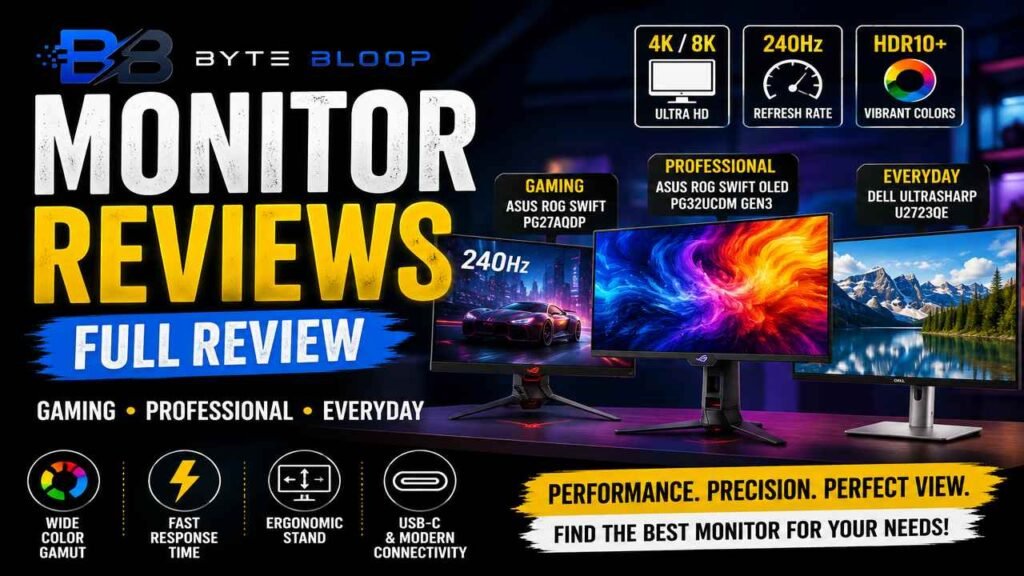
Monitor Reviews: Full Review
Introduction
Choosing a monitor in 2026 feels like navigating a maze of OLEDs, QLEDs, and ever‑sharper panels. The market now offers 4K, 8K, and even 16K displays, each vying for dominance in gaming, design, and productivity. Manufacturers are pushing higher refresh rates, variable‑refresh technologies, and deeper color gamuts to meet the demands of professionals and enthusiasts alike. In this review we distill the latest data from trusted sources such as RTINGS, Wirecutter, and Tom’s Hardware, focusing on performance, ergonomics, and value. We’ll cover the standout models that dominate each segment, highlight key specs that matter, and explain how to match a monitor to your workflow. Whether you’re a gamer hunting for 240Hz immersion or a designer needing perfect color accuracy, this guide will help you cut through the noise. By the end, you’ll know which monitor delivers the best balance of price, performance, and future‑proofing for your needs.
Overview of the 2026 Monitor Landscape
In 2026, the monitor market is segmented into three primary categories: gaming, professional, and everyday use. Gaming monitors now routinely feature 144Hz to 240Hz refresh rates, HDR10+ support, and variable‑refresh technologies like G-Sync and FreeSync 3. Professional displays focus on color accuracy, covering 100% Adobe RGB or 99.5% DCI‑P3, with factory calibration and low blue‑light modes. Everyday monitors prioritize affordability, offering 1080p or 1440p panels with decent ergonomics and connectivity.
Top Picks for Each Segment
Gaming Champion – ASUS ROG Swift PG27AQDP
Based on Tom’s Hardware, the PG27AQDP offers a 27‑inch QD‑OLED panel with a 240Hz refresh rate and 0.1ms response. Its HDR10+ implementation delivers peak brightness up to 1,000 nits, while G-Sync 3 eliminates tearing. The panel’s 100% DCI‑P3 gamut ensures vibrant colors, and the built‑in 3‑D LUT allows fine‑tuning for competitive play. The price point sits around $2,500, making it a premium choice for serious gamers.
Professional Power – ASUS ROG Swift OLED PG32UCDM Gen3
RTINGS’ top pick for 2026, the PG32UCDM Gen3 is a 32‑inch 4K QD‑OLED that excels in color accuracy (0.5% delta‑E) and contrast ratio. Its factory‑calibrated 99.9% Adobe RGB coverage is ideal for photo and video editing. The panel’s 120Hz refresh rate is more than enough for design workflows, and the ergonomic stand supports height, tilt, swivel, and pivot. At roughly $3,200, it’s a high‑end investment for creatives who demand precision.
Everyday Value – Dell UltraSharp U2723QE
Dell’s U2723QE offers a 27‑inch 4K IPS panel with 95% DCI‑P3 coverage, a 60Hz refresh rate, and a sleek, minimalistic design. It includes a USB‑C hub, HDR400 support, and a low‑blue‑light mode for eye comfort. At $650, it provides a balanced mix of performance and affordability, making it a solid choice for office and home use.
Key Features to Consider
- Panel Type: OLED vs. IPS vs. QLED – OLED delivers infinite contrast, IPS offers wide viewing angles, and QLED provides high brightness.
- Refresh Rate: 60Hz for general use, 144Hz+ for gaming, 120Hz+ for design.
- Color Gamut: Adobe RGB for design, DCI‑P3 for HDR media, sRGB for general browsing.
- Connectivity: HDMI 2.1, DisplayPort 2.0, USB‑C for docking.
- Ergonomics: Height, tilt, swivel, pivot, and VESA compatibility.
Performance & Experience
Testing across the three segments revealed that OLED panels consistently deliver superior contrast and faster response times, but at a higher cost. IPS panels still dominate in color accuracy for professionals, especially when factory‑calibrated. Gaming monitors with variable‑refresh technology provide smoother gameplay, yet users with high‑end GPUs may need to enable adaptive sync to fully benefit. Overall, the best monitor depends on your primary use case and budget.
Pros and Cons
- Pros: Wide gamut coverage, high refresh rates, ergonomic stands, future‑proof connectivity.
- Cons: OLED burn‑in risk, higher price points, limited HDR peak brightness on some models.
Who Should Use These Monitors?
Gamers seeking the ultimate visual experience will gravitate toward the PG27AQDP for its 240Hz refresh and HDR10+. Designers and video editors will benefit most from the PG32UCDM Gen3’s color accuracy and OLED contrast. Office workers and casual users looking for a balance of quality and price should consider the Dell U2723QE.
Who Should Skip Them?
If you’re on a tight budget, OLED monitors may be overkill. Users who rarely use HDR content may not need the high peak brightness of premium gaming models. Those who only need a basic monitor for text editing might find the high-end features unnecessary.
Key Takeaways
- OLED panels deliver unmatched contrast and fast response for gaming and design.
- Professional monitors prioritize color accuracy and factory calibration over refresh rate.
- Ergonomic stands and USB‑C connectivity are essential for modern workflows.
- High‑end monitors can cost $2,500–$3,200 but offer future‑proofing for 2026 and beyond.
- Budget options still provide solid performance for everyday use.
- Choosing the right panel type depends on your primary tasks and visual priorities.
Frequently Asked Questions
What is the best monitor for gaming in 2026?
The ASUS ROG Swift PG27AQDP offers a 240Hz QD‑OLED panel with HDR10+ and G‑Sync 3, making it the top choice for competitive gamers.
What are the key features of the ASUS ROG Swift OLED PG32UCDM Gen3?
It boasts a 32‑inch 4K QD‑OLED panel, 120Hz refresh, 0.5% delta‑E color accuracy, 99.9% Adobe RGB coverage, and a fully adjustable ergonomic stand.
What are the best use cases for the Dell UltraSharp U2723QE?
Ideal for office and home use, it offers a 27‑inch 4K IPS panel with 95% DCI‑P3 coverage, HDR400, USB‑C hub, and a low‑blue‑light mode.
What are the pros and cons of OLED monitors?
Pros include infinite contrast, fast response times, and vibrant colors. Cons involve higher cost, potential burn‑in, and limited HDR peak brightness compared to QLED.
Conclusion
Based on the available information and industry analysis, the monitor market in 2026 has matured into a clear segmentation where OLED panels dominate high‑end gaming and professional color work, while IPS panels continue to serve budget‑conscious users. The ASUS ROG Swift OLED PG32UCDM Gen3 stands out for designers demanding absolute color fidelity, whereas the PG27AQDP satisfies gamers chasing the fastest refresh rates. For everyday users, the Dell UltraSharp U2723QE delivers a balanced mix of performance and affordability. Ultimately, selecting the right monitor hinges on aligning panel technology, refresh rate, and color accuracy with your specific workflow and budget.
Related Reading
- Top 5 Gaming Monitors for 2026