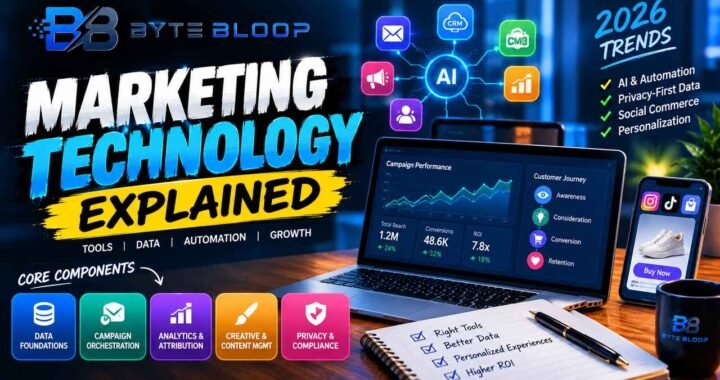
Privacy Technology: Explained
Introduction
In an era where data is the new oil, privacy technology has become the frontline defense against misuse, surveillance, and cybercrime. Privacy technology encompasses a suite of tools and protocols that enable individuals and organizations to control, protect, and anonymize personal information while still benefiting from digital services. From cryptographic primitives that allow computations on encrypted data to policy‑driven frameworks that enforce consent, these technologies are reshaping how we think about security and trust online. They are not just buzzwords; they are practical solutions that empower users to reclaim agency over their data and help businesses stay compliant with increasingly stringent regulations. As privacy regulations like the EU’s GDPR, California’s CCPA, and emerging U.S. federal laws tighten, the demand for robust privacy tech has surged. This guide breaks down the core concepts, highlights leading solutions, and offers actionable insights for both tech professionals and everyday users.
At its heart, privacy technology is about balancing data utility with confidentiality. It provides mechanisms for secure data sharing, anonymous analytics, and verifiable compliance, all while preserving the user experience. Understanding these tools is essential for anyone navigating the digital landscape—whether you’re a developer building privacy‑first apps, a business leader ensuring regulatory adherence, or a consumer concerned about data exposure. Below, we explore the most influential privacy technologies of 2026, the trends driving their adoption, and practical ways to integrate them into your workflow.
Key Privacy Technologies of 2026
Research from StarAgile identifies the top ten privacy‑enhancing technologies (PETs) that are shaping the industry this year:
- Homomorphic Encryption – Enables computations on encrypted data without decryption, allowing secure cloud processing.
- Zero‑Knowledge Proofs – Lets one party prove to another that a statement is true without revealing any underlying data.
- Differential Privacy – Adds noise to datasets to mask individual contributions while preserving aggregate insights.
- Secure Multi‑Party Computation (SMPC) – Multiple parties compute a function over their inputs while keeping those inputs private.
- Trusted Execution Environments (TEEs) – Hardware‑based secure enclaves that isolate sensitive code and data.
- Privacy‑by‑Design Frameworks – Embed privacy controls into product lifecycles from the outset.
- Decentralized Identity (DID) – Self‑managed digital identities that give users ownership over their credentials.
- Federated Learning – Trains machine learning models across devices without centralizing raw data.
- Encrypted Search – Allows searching encrypted data without exposing the query or results.
- Consent Management Platforms (CMPs) – Centralize user consent collection and enforcement across digital touchpoints.
Emerging Trends Shaping 2026
Several macro trends are accelerating the adoption of privacy tech:
- Regulatory Momentum – New laws in the U.S. and global jurisdictions are mandating stronger data protection, pushing companies to adopt PETs to avoid fines.
- AI & Data Monetization – As AI models require vast datasets, privacy tech ensures that training data can be used without compromising individual privacy.
- Edge Computing & IoT – Devices generate sensitive data locally; edge‑based privacy solutions keep data in situ, reducing exposure.
- Zero Trust Architecture – Security models that assume no implicit trust, relying on continuous verification and data isolation.
- Consumer Demand for Transparency – Users increasingly expect clear explanations of how their data is used, driving adoption of explainable privacy tools.
Practical Use Cases
1. Healthcare Analytics – Hospitals use differential privacy to share patient data for research while keeping identities hidden.
2. Financial Services – Banks employ homomorphic encryption to process credit risk models on encrypted customer data.
3. Smart Cities – Federated learning trains traffic‑optimization algorithms on city sensors without centralizing location data.
4. Social Platforms – Decentralized identity lets users control profile data, reducing reliance on platform custodians.
Integrating Privacy Tech into Your Stack
Start by mapping data flows and identifying high‑risk touchpoints. Next, select a PET that aligns with your threat model:
- For data sharing with third parties, consider SMPC or homomorphic encryption.
- For analytics, differential privacy or federated learning may be appropriate.
- For user authentication, DID and TEEs provide strong identity guarantees.
Adopt a privacy‑by‑design mindset: embed controls early, conduct regular privacy impact assessments, and maintain clear documentation for auditors. Finally, leverage CMPs to manage consent lifecycle and ensure that all downstream systems honor user preferences.
Challenges & Mitigation
While privacy tech offers powerful safeguards, it also introduces complexity. Performance overhead can be significant, especially with homomorphic encryption, and implementation requires specialized expertise. To mitigate these challenges, organizations should:
- Invest in training for security architects.
- Use managed services that abstract cryptographic operations.
- Prioritize incremental adoption, starting with low‑risk data.
Key Takeaways
- Homomorphic encryption enables secure cloud computation without decryption.
- Zero‑knowledge proofs allow verification without revealing data.
- Differential privacy protects individuals while enabling aggregate analytics.
- Regulatory pressure is driving widespread adoption of privacy tech.
- Integrating PETs early in product design reduces compliance risk.
- Performance trade‑offs can be managed with managed services and incremental rollout.
Frequently Asked Questions
What is privacy technology explained?
Privacy technology refers to tools, protocols, and frameworks that protect personal data by ensuring confidentiality, integrity, and user control while still allowing useful data processing.
What are the key features of homomorphic encryption?
It allows mathematical operations to be performed on ciphertexts, producing an encrypted result that, when decrypted, matches the result of operations on the plaintext.
What are the best use cases for differential privacy?
Sharing aggregated statistics for research, marketing, or public policy without exposing individual records, such as census data or health surveys.
What are the pros and cons of zero‑knowledge proofs?
Pros: strong privacy guarantees, auditability. Cons: computationally intensive, complex implementation.
How can businesses start adopting privacy tech?
Begin with a data‑flow audit, select appropriate PETs, integrate them via APIs or managed services, and enforce consent through CMPs.
Conclusion
Based on the available information and industry analysis, privacy technology is evolving from niche cryptographic research to mainstream business practice, driven by regulatory mandates, AI data needs, and consumer demand for transparency. By adopting privacy‑enhancing technologies such as homomorphic encryption, zero‑knowledge proofs, and differential privacy, organizations can secure data, satisfy compliance, and build consumer trust—creating a competitive advantage in the data‑centric economy of 2026.
Related Reading
- Understanding Zero‑Knowledge Proofs: A Practical Guide
- Homomorphic Encryption in Cloud Computing: What You Need to Know