Business Technology Explained
Introduction
Business Technology Explained is a topic worth understanding well. In today’s fast‑moving marketplace, the term business technology is more than a buzzword—it’s the engine that drives competitive advantage, operational efficiency, and customer engagement. Over the past decade, companies have shifted from isolated IT projects to integrated digital ecosystems that span data, analytics, and automation. This transformation is not just about adopting new tools; it’s about rethinking processes, culture, and decision‑making frameworks.
Recent industry reports highlight that successful organizations are moving from experimentation to measurable impact, leveraging AI, edge computing, and zero‑trust security to stay ahead. As a result, leaders must understand the core components of business technology, the trends shaping it, and how to align technology initiatives with strategic goals. By mastering these concepts, executives can turn technology from a cost center into a growth engine. Below we unpack the essential elements, practical examples, and strategic considerations that define business technology today.
Core Pillars of Business Technology
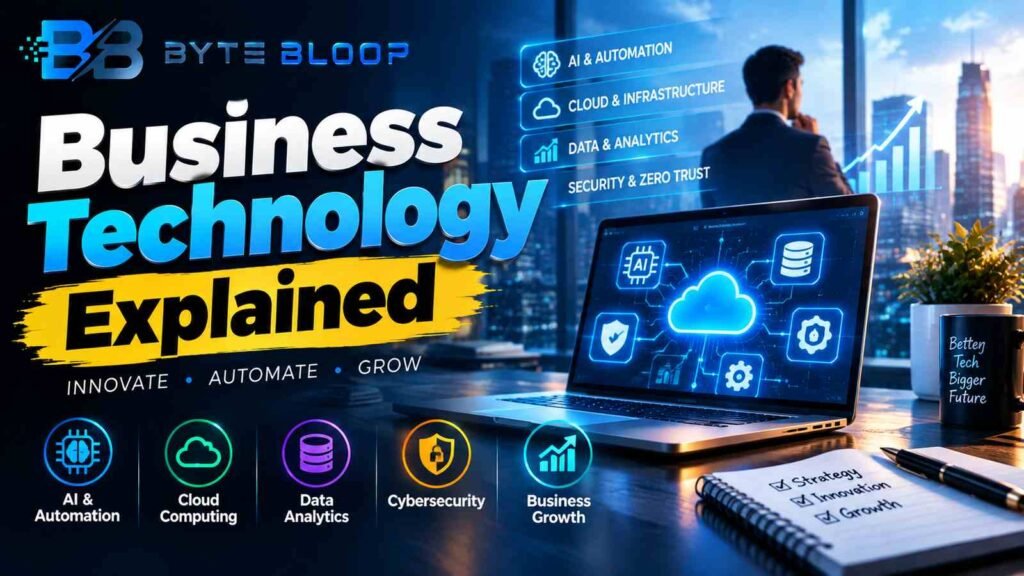
Business technology typically rests on three interlocking pillars: data infrastructure, application platforms, and security frameworks. Data infrastructure—cloud storage, data lakes, and real‑time streams—provides the raw material for insight generation. Application platforms—low‑code, cloud‑native, and AI‑powered tools—enable rapid development and deployment. Security frameworks—zero‑trust, identity‑centric controls, and continuous monitoring—protect the entire ecosystem. Together, these pillars create a resilient foundation that supports automation, personalization, and scalable growth.
Key Trends Shaping 2026
According to Tech Trends 2026 | Deloitte Insights, five major trends are guiding organizations toward high‑impact outcomes. AI is shifting from a “tooling” role to operational decision support, enabling real‑time predictive analytics that inform pricing, inventory, and customer experience. Automation is becoming a margin driver, reducing manual effort in finance, HR, and supply chain operations. Edge computing is extending processing power closer to data sources, improving latency for IoT and real‑time analytics. Low‑code platforms accelerate application delivery, allowing business units to prototype and iterate without deep developer involvement. Finally, zero‑trust security models are becoming the default, ensuring that every access request is authenticated and authorized in real time.
This matters directly for anyone exploring business technology explained.
Gartner’s Top Strategic Technology Trends for 2026 echo these insights, emphasizing resilience, trust, and innovation. The report highlights the importance of hybrid cloud architectures that balance agility with compliance, and the rise of AI‑driven governance tools that automate policy enforcement. These trends underscore that technology strategy must be tightly coupled with risk management and regulatory compliance.
Getting business technology explained right can make a real difference.
Digital Transformation: More Than Just Tech Adoption
As What is Digital Transformation? A Complete Guide for 2026 explains, digital transformation is not solely about the technology a business adopts. It is about how that business thinks, operates, and adapts. A successful transformation requires a cultural shift toward data‑driven decision making, cross‑functional collaboration, and continuous experimentation. The Complete Guide to Digital Transformation in 2026 outlines a practical checklist that includes setting clear business priorities, creating a governance framework, and measuring impact through key performance indicators.
That is a core part of understanding business technology explained.
Practical Use Cases
1. Retail: AI‑powered recommendation engines analyze purchase history and browsing behavior to deliver personalized offers, boosting conversion rates. 2. Manufacturing: Edge sensors monitor equipment health in real time, enabling predictive maintenance that reduces downtime. 3. Finance: Low‑code platforms automate compliance reporting, cutting cycle times from weeks to days. 4. Healthcare: Cloud‑native applications integrate patient data across providers, improving care coordination and outcomes.
Many readers look into business technology explained for exactly this reason.
Pros and Cons of Business Technology Adoption
Pros include increased agility, improved customer insights, and cost efficiencies through automation. Cons often involve upfront investment, skill gaps, and the risk of data breaches if security is overlooked. Balancing these factors requires a phased approach, starting with high‑impact pilots and scaling based on measurable results.
It is worth revisiting business technology explained as things develop.
Key Takeaways
- AI shifts from tooling to decision support, driving real‑time insights.
- Automation now serves as a margin driver across core functions.
- Edge computing reduces latency for IoT and real‑time analytics.
- Low‑code platforms accelerate application delivery and innovation.
- Zero‑trust security is becoming the default model for enterprise resilience.
Frequently Asked Questions
What is business technology explained?
Business technology refers to the integrated use of data infrastructure, application platforms, and security frameworks that enable organizations to innovate, optimize operations, and deliver value to customers.
Business Technology Explained remains highly relevant here.
What are the key features of modern business technology?
Key features include AI‑driven decision support, low‑code development, edge computing for low latency, hybrid cloud architectures, and zero‑trust security models.
This is a key consideration when it comes to business technology explained.
What are the best use cases for AI in business technology?
AI excels in predictive analytics, personalized marketing, fraud detection, supply chain optimization, and automated customer support.
What are the pros and cons of adopting business technology?
Pros: agility, cost savings, data‑driven insights. Cons: upfront costs, skill shortages, potential security risks if not managed properly.
Conclusion
Based on the available information and industry analysis, business technology provides a strategic framework that transforms data into insight, processes into automation, and security into trust. By aligning technology investments with clear business outcomes, organizations can unlock new revenue streams, improve operational resilience, and create differentiated customer experiences. The convergence of AI, low‑code platforms, edge computing, and zero‑trust security is redefining what it means to be competitive in the digital age.
Related Reading
- AI in Business: From Tooling to Decision Support
Sources & References
- Tech Trends 2026 | Deloitte Insights
- Why You Should NOT Begin a Digital Transformation in 2026
- Top Strategic Technology Trends for 2026
- A complete guide to digital transformation in 2026 – IWIS
Related Articles