
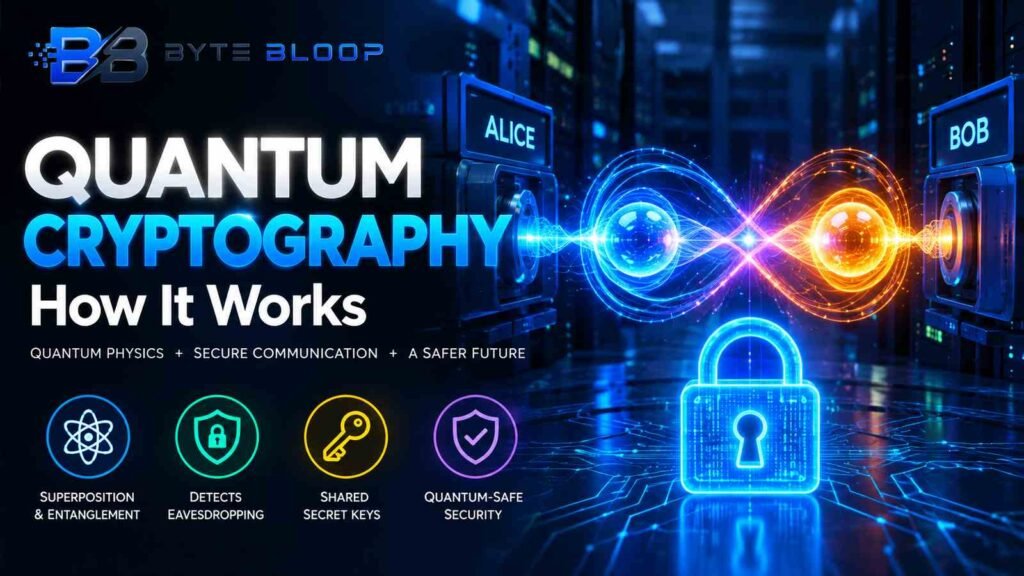
Quantum Cryptography: How It Works
Introduction (Quantum Cryptography How It Works)
Quantum Cryptography How It Works is a topic worth understanding well. Quantum cryptography harnesses the immutable laws of quantum mechanics to create communication channels that are theoretically immune to eavesdropping. Unlike classical encryption, which relies on mathematical complexity, quantum methods depend on the behavior of particles at the smallest scales, making any interception detectable. The technology has evolved from early theoretical proposals in the 1980s to commercial quantum key distribution (QKD) systems that are now deployed in secure government and financial networks.
By exploiting phenomena such as superposition and entanglement, quantum cryptography can generate truly random keys that are shared only between legitimate parties. These keys are then used to encrypt data in a way that any attempt to measure them alters the system, revealing the intrusion. The practical implications are profound: secure banking, defense communications, and protection of intellectual property can all benefit from quantum‑safe channels. However, the technology faces challenges in cost, distance limits, and integration with existing infrastructure.
Understanding how quantum cryptography works is essential for IT professionals and security teams preparing for a post‑quantum world.
Core Principles of Quantum Cryptography
At its heart, quantum cryptography relies on two key principles: the no‑cloning theorem and the observer effect. The no‑cloning theorem states that an unknown quantum state cannot be copied perfectly, which prevents an eavesdropper from duplicating a transmitted key. The observer effect means that measuring a quantum state inevitably disturbs it, allowing legitimate users to detect any interception. These principles are operationalized through protocols such as BB84, where photons are polarized in one of two bases and measured by the receiver. If a third party attempts to intercept, the polarization states become randomized, and the error rate rises above a threshold that signals a breach.
Quantum Key Distribution (QKD) in Practice
QKD is the most mature application of quantum cryptography. In a typical QKD link, a sender (Alice) transmits a stream of polarized photons to a receiver (Bob). Both parties then publicly compare a subset of their measurements over an authenticated classical channel. Discrepancies reveal the presence of an eavesdropper, and the remaining bits are distilled into a shared secret key through error correction and privacy amplification. According to IBM’s overview, QKD can operate over fiber optic cables up to several hundred kilometers with the help of quantum repeaters, which extend the range by entanglement swapping.
This matters directly for anyone exploring quantum cryptography how it works.
Beyond QKD: Post‑Quantum Cryptography and Hybrid Approaches
While QKD offers unparalleled security, it is not a silver bullet. Post‑quantum cryptography (PQC) focuses on algorithmic solutions that resist quantum attacks, such as lattice‑based or hash‑based schemes. NIST’s recent standardization process has identified several PQC algorithms suitable for widespread deployment. Hybrid systems combine QKD’s key generation with PQC’s encryption algorithms, providing layered defense. As noted in a 2026 Frontiers article, integrating cryptographic agility and zero‑trust architectures with physical quantum layers can help networks survive the advent of fault‑tolerant quantum computers.
Getting quantum cryptography how it works right can make a real difference.
Practical Considerations for Adoption
Implementing quantum cryptography requires careful planning. Organizations must assess their threat models, existing infrastructure, and budget constraints. VTT Research’s playbook outlines a transition roadmap, emphasizing the need for quantum‑safe cybersecurity policies and staff training. Key steps include selecting a QKD vendor, establishing secure fiber links or satellite links for long distances, and integrating QKD key management with current PKI systems. Additionally, regulatory compliance—such as adhering to CISA’s guidance on quantum readiness—must be factored into the deployment strategy.
That is a core part of understanding quantum cryptography how it works.
Use Cases and Industry Adoption
Financial institutions are leading the way, using QKD to protect inter‑bank settlements and high‑frequency trading data. Government agencies deploy quantum links for secure diplomatic communications. Healthcare providers leverage quantum‑safe channels to transmit patient records, ensuring compliance with privacy regulations. Even emerging sectors like autonomous vehicle networks are exploring quantum key distribution to safeguard vehicle-to-vehicle communication against future cyber threats.
Many readers look into quantum cryptography how it works for exactly this reason.
Challenges and Limitations
Despite its promise, quantum cryptography faces technical hurdles. Photon loss in optical fibers limits distance, and environmental factors can degrade signal quality. The cost of QKD hardware remains high, and scaling to enterprise‑wide networks requires significant investment. Moreover, the standardization of quantum protocols is still evolving, which can create interoperability issues between vendors.
It is worth revisiting quantum cryptography how it works as things develop.
Key Takeaways
- Quantum cryptography uses quantum physics, not math, to secure data.
- BB84 protocol relies on photon polarization and the observer effect.
- QKD generates truly random keys, detectable if intercepted.
- Hybrid PQC–QKD systems offer layered security against quantum attacks.
- Adoption requires infrastructure upgrades, policy changes, and regulatory alignment.
Frequently Asked Questions
What is quantum cryptography?
Quantum cryptography applies principles of quantum mechanics, such as superposition and entanglement, to create secure communication channels that detect eavesdropping.
Quantum Cryptography How It Works remains highly relevant here.
What are the key features of quantum key distribution?
QKD uses polarized photons, the no‑cloning theorem, and the observer effect to generate shared secret keys that are provably secure against interception.
This is a key consideration when it comes to quantum cryptography how it works.
What are the best use cases for quantum cryptography?
High‑value sectors like finance, defense, healthcare, and emerging autonomous networks use QKD to protect sensitive data and ensure compliance with strict privacy standards.
This matters directly for anyone exploring quantum cryptography how it works.
What are the pros and cons of quantum cryptography?
Pros include theoretically unbreakable security and early detection of attacks; cons involve high costs, limited transmission distance, and the need for specialized infrastructure.
Getting quantum cryptography how it works right can make a real difference.
Conclusion
Based on the available information and industry analysis, quantum cryptography provides a fundamentally new layer of security that leverages immutable quantum laws, offering protection against both classical and future quantum attacks. While practical challenges such as cost, distance limits, and standardization remain, the technology’s rapid maturation and growing adoption in critical sectors signal a clear shift toward quantum‑safe communications. Organizations that proactively integrate quantum cryptographic solutions alongside post‑quantum algorithms will be better positioned to defend against emerging cyber threats and maintain regulatory compliance.
Related Reading
- Post‑Quantum Cryptography: Preparing Your Infrastructure
Sources & References
- What Is Quantum Cryptography?
- What Is Post-Quantum Cryptography? | NIST
- Beyond encryption: post-quantum cryptography and the …
- How to prepare for post-quantum cryptography | VTT Research
- What Is Quantum Cryptography And How it Works
- How Will Quantum Technologies Change Cryptography?
Related Articles


