Risk Management: Explained
Introduction
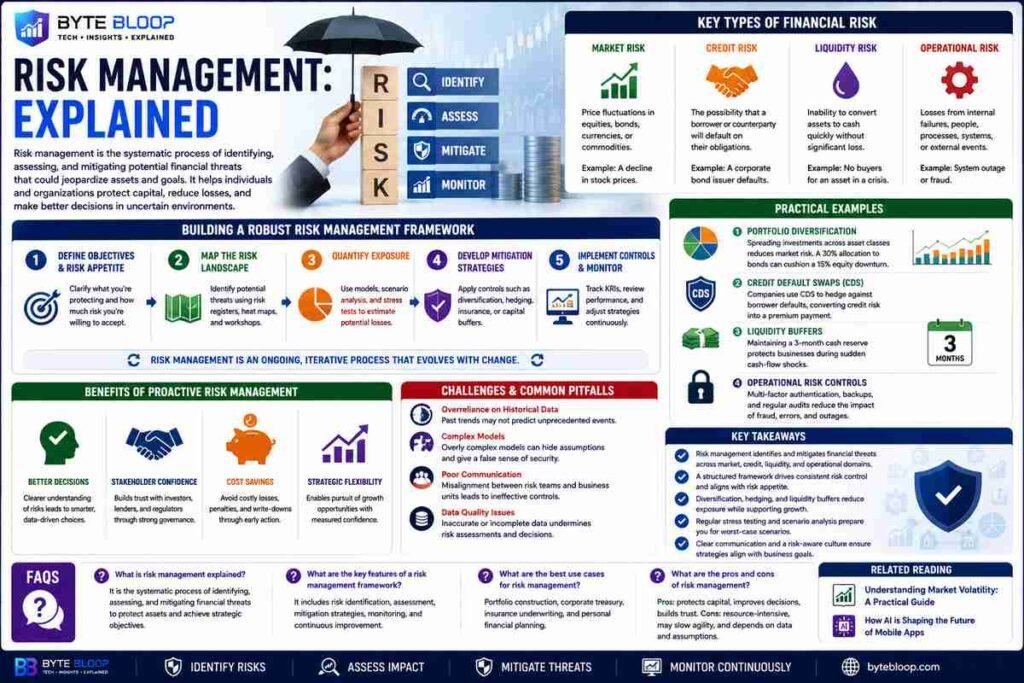
Risk management is the systematic process of identifying, assessing, and mitigating potential financial threats that could jeopardize an individual’s or organization’s assets and goals. In today’s volatile markets, it is no longer optional; it is a cornerstone of sound investment strategy, corporate governance, and personal financial planning. By anticipating adverse events—from market swings to credit defaults—risk managers can design safeguards that preserve capital and sustain growth. This discipline blends quantitative analysis with strategic foresight, ensuring that every decision is backed by a clear understanding of possible downsides. Whether you’re a portfolio manager, a small business owner, or a retiree planning for the future, grasping the fundamentals of risk management is essential for making informed choices. In this guide, we break down the core concepts, illustrate real‑world applications, and provide actionable steps you can start using today.
What Is Risk Management?
Risk management is a framework that helps stakeholders recognize financial uncertainties and implement controls to reduce their impact. The process typically follows four stages: identification, assessment, mitigation, and monitoring. According to Investopedia, the goal is to “reduce potential financial losses that could affect an individual, business, or investment.” This framework is universal—applied in banking, insurance, corporate treasury, and personal budgeting.
Key Types of Financial Risk
Financial risk can be grouped into four main categories:
- Market risk – price fluctuations in equities, bonds, or commodities.
- Credit risk – the possibility that a counterparty will default.
- Liquidity risk – the inability to convert assets to cash without significant loss.
- Operational risk – internal failures such as fraud, technology outages, or regulatory breaches.
Each type requires tailored strategies, but the overarching principle remains the same: quantify exposure, set tolerance limits, and deploy controls.
Building a Robust Risk Management Framework
Creating an effective framework involves several practical steps:
- Define objectives and risk appetite – Clarify what you’re protecting (e.g., capital preservation, growth, or liquidity) and how much volatility you can tolerate.
- Map the risk landscape – Use tools like risk registers or heat maps to catalog potential threats.
- Quantify exposure – Apply statistical models, scenario analysis, or stress tests to estimate potential losses.
- Develop mitigation strategies – Options include diversification, hedging instruments (options, futures), insurance, or capital buffers.
- Implement controls and monitoring – Set up key risk indicators (KRIs), dashboards, and regular review cycles.
MetricStream’s guide emphasizes that a robust framework is iterative; it must evolve with market conditions and organizational changes.
Practical Examples
1. Portfolio diversification – Spreading investments across asset classes reduces market risk. A 30% allocation to bonds can cushion a 15% equity downturn.
2. Credit default swaps (CDS) – Companies use CDS to hedge against borrower defaults, converting credit risk into a premium payment.
3. Liquidity buffers – Maintaining a 3‑month cash reserve protects businesses during sudden cash‑flow shocks.
4. Operational risk controls – Multi‑factor authentication and regular audits mitigate cyber‑fraud risks.
Benefits of Proactive Risk Management
When executed well, risk management delivers:
- Enhanced decision‑making with clearer cost‑benefit analyses.
- Improved stakeholder confidence, especially for investors and regulators.
- Cost savings by avoiding costly write‑downs or penalties.
- Strategic flexibility, allowing firms to pursue growth opportunities with measured confidence.
Challenges and Common Pitfalls
Despite its advantages, risk management faces obstacles:
- Overreliance on historical data can mislead during unprecedented events.
- Complex models may obscure underlying assumptions, leading to false security.
- Inadequate communication can cause misalignment between risk managers and business units.
Addressing these issues requires continuous learning, transparent reporting, and a culture that values risk awareness.
Key Takeaways
- Risk management identifies and mitigates financial threats across market, credit, liquidity, and operational domains.
- A structured framework—objective setting, mapping, quantification, mitigation, monitoring—drives consistent risk control.
- Diversification, hedging, and liquidity buffers are practical tools that reduce exposure without sacrificing growth.
- Regular stress testing and scenario analysis reveal hidden vulnerabilities and prepare for worst‑case scenarios.
- Clear communication and a risk‑aware culture ensure that mitigation strategies align with business goals.
Frequently Asked Questions
What is risk management explained?
Risk management is a systematic process of identifying, assessing, and mitigating financial threats to protect assets and achieve strategic objectives.
What are the key features of a risk management framework?
It includes risk identification, assessment, mitigation strategies, monitoring, and continuous improvement, all tailored to an organization’s risk appetite.
What are the best use cases for risk management?
It applies to portfolio construction, corporate treasury, insurance underwriting, and personal financial planning—any scenario where uncertainty can erode value.
What are the pros and cons of risk management?
Pros: protects capital, improves decision‑making, and builds stakeholder trust. Cons: can be resource‑intensive, may slow agility, and relies on accurate data and assumptions.
Conclusion
Based on the available information and industry analysis, risk management provides a structured approach to safeguard financial assets, enabling individuals and organizations to navigate uncertainty with confidence. By systematically identifying threats, quantifying exposure, and deploying targeted controls, stakeholders can reduce potential losses, enhance decision‑making, and maintain resilience in volatile markets.
Related Reading
- Understanding Market Volatility: A Practical Guide
This article is for informational and educational purposes only and should not be considered financial, investment, or trading advice.
This article is for informational and educational purposes only and should not be considered financial, investment, or trading advice.