RTX vs Radeon: Key Differences
Introduction
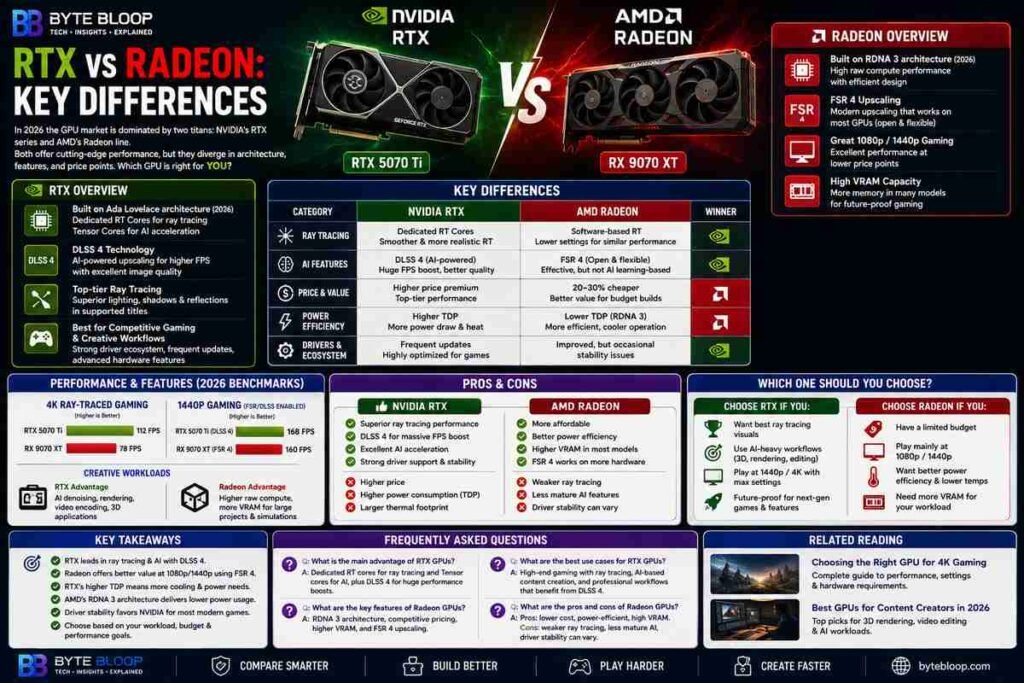
In 2026 the GPU market is dominated by two titans: NVIDIA’s RTX series and AMD’s Radeon line. Both offer cutting‑edge performance, but they diverge in architecture, feature sets, and price points. Understanding the core distinctions—especially in ray tracing, AI acceleration, and power efficiency—helps gamers, content creators, and professionals make informed choices. NVIDIA’s RTX cards lead with DLSS 4 and superior RT cores, while AMD’s Radeon GPUs shine with competitive pricing, higher raw compute, and the flexible FSR 4 upscaling. This guide breaks down those differences, compares performance benchmarks, and weighs the pros and cons of each brand to answer the question: which GPU should you choose for your workload?
RTX Overview
NVIDIA’s RTX lineup builds on the Ampere and Ada Lovelace architectures, featuring dedicated RT cores for ray tracing and Tensor cores for AI tasks. The RTX 5070 Ti, for example, delivers top‑tier RT performance, outperforming AMD’s Radeon RX 9070 XT in most ray‑traced titles. RTX cards also support DLSS 4, a deep‑learning super‑resolution technology that boosts frame rates while preserving visual fidelity. Power consumption is higher, but the brand’s driver ecosystem and hardware‑accelerated features make it the go‑to for competitive gaming and creative workflows that rely on AI rendering.
Radeon Overview
AMD’s Radeon series, including the RX 9070 XT and RX 9060 XT, offers a more affordable entry point. Radeon GPUs feature the latest RDNA 3 architecture, delivering strong raw compute performance and excellent 1080p gaming at lower price points. AMD’s FSR 4 upscaling competes with DLSS, providing a software‑based solution that works across all GPUs. While Radeon cards lag behind RTX in dedicated ray‑tracing cores, they compensate with higher VRAM capacities and a more power‑efficient design in many models.
Key Differences
Ray Tracing: RTX’s RT cores provide smoother lighting and reflections, especially in titles that fully support hardware‑accelerated tracing. Radeon’s ray tracing is software‑based and often requires lower settings to maintain performance.
AI Features: DLSS 4 on RTX offers significant frame‑rate boosts with minimal visual loss. Radeon’s AI capabilities are limited to FSR 4, which, while effective, does not match DLSS’s learning‑based approach.
Price & Value: The Radeon RX 9070 XT is typically 20–30% cheaper than the RTX 5070 Ti, making it attractive for budget builds. However, RTX cards may offer better long‑term value for users who prioritize ray tracing and AI workloads.
Power Efficiency: AMD’s RDNA 3 architecture delivers lower TDP in many cases, reducing heat and fan noise. NVIDIA’s higher TDP can lead to increased power draw and cooling requirements.
Driver & Ecosystem: NVIDIA’s driver updates are frequent and highly optimized for games, while AMD’s drivers have improved but still lag slightly behind in stability for certain titles.
Performance & Features
Benchmark comparisons show the RTX 5070 Ti leading in 4K ray‑traced gaming, while the Radeon RX 9070 XT matches or surpasses it at 1080p and 1440p with FSR 4. In creative applications like 3D rendering and video editing, NVIDIA’s Tensor cores accelerate AI‑based denoising and upscaling, giving professionals a clear advantage. AMD’s GPUs excel in raw compute tasks such as scientific simulations, thanks to higher shader counts and larger VRAM buffers.
Pros and Cons
RTX Pros: Superior ray tracing, DLSS 4, strong AI acceleration, robust driver support.
RTX Cons: Higher price, greater power consumption, larger thermal footprint.
Radeon Pros: Competitive pricing, better power efficiency, larger VRAM, flexible upscaling.
Radeon Cons: Weaker ray tracing, less mature AI features, driver stability can vary.
Which One Should You Choose?
If your priority is high‑fidelity ray tracing, AI‑driven workloads, or you plan to future‑proof your system for upcoming titles, the RTX line is the logical choice. If budget, power efficiency, or 1080p gaming are your main concerns, Radeon offers a compelling balance of performance and cost.
Key Takeaways
- RTX dominates in ray tracing and AI with DLSS 4.
- Radeon offers better value at 1080p/1440p using FSR 4.
- RTX’s higher TDP means more cooling and power needs.
- AMD’s RDNA 3 architecture delivers lower power consumption.
- Driver stability favors NVIDIA for most modern games.
- Both brands excel in different workloads—gaming vs. creative compute.
Frequently Asked Questions
What is the main advantage of NVIDIA’s RTX GPUs?
RTX GPUs feature dedicated RT cores for ray tracing and Tensor cores for AI, delivering superior visual fidelity and AI acceleration.
What are the key features of AMD Radeon GPUs?
Radeon cards use RDNA 3 architecture, offer competitive pricing, larger VRAM, and FSR 4 upscaling for performance boosts.
What are the best use cases for RTX GPUs?
Ideal for gamers who want cutting‑edge ray tracing, creators needing AI‑based denoising, and professionals who rely on DLSS 4 for workflow efficiency.
What are the pros and cons of Radeon GPUs?
Pros: lower cost, power‑efficient, high VRAM. Cons: weaker ray tracing, less mature AI features, occasional driver instability.
Conclusion
Based on the available information and industry analysis, the RTX series provides unmatched ray‑tracing performance and AI acceleration, making it the preferred choice for high‑end gaming and creative workloads, while Radeon GPUs offer a more budget‑friendly and power‑efficient alternative for 1080p gaming and general-purpose use.
Related Reading
- Choosing the Right GPU for 4K Gaming