Robotics: How It Works
Introduction (Robotics How It Works)
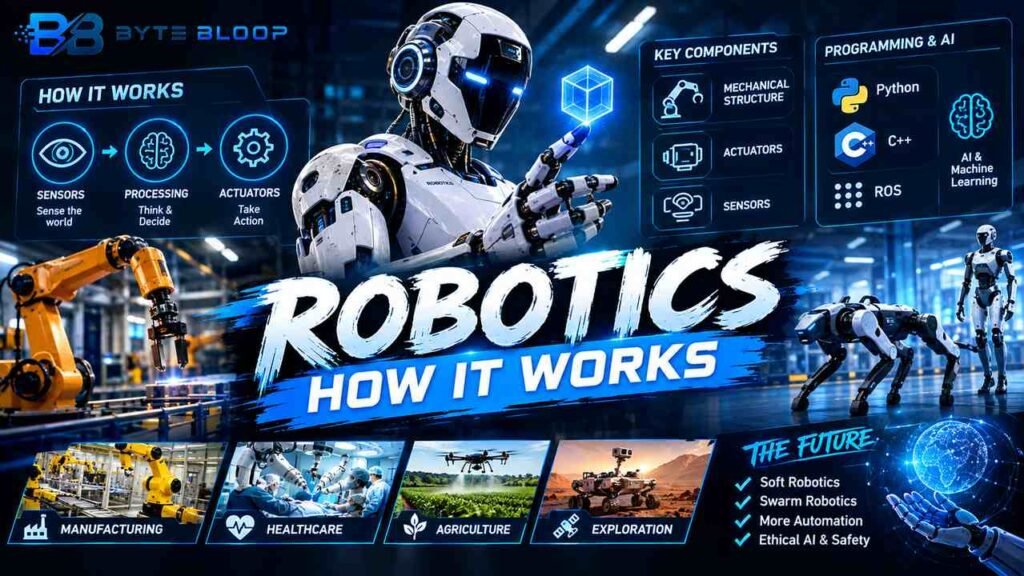
Robotics How It Works is a topic worth understanding well. Robotics blends mechanical engineering, electrical circuits, and computer science to create machines that can sense, decide, and act. At its core, a robot is a system that receives input from sensors, processes that data through algorithms, and produces motion via actuators. The field has evolved from simple, preprogrammed devices to autonomous agents that learn from their environment. Modern robots use a layered architecture: a perception layer for sensing, a planning layer for decision-making, and an execution layer for movement.
This structure allows robots to adapt to changing conditions, making them useful in manufacturing, healthcare, and exploration. Understanding how these layers interact is key to grasping why robotics is reshaping industry and daily life. By exploring the components, software, and AI that power robots, we can appreciate both their current capabilities and future potential.
Core Components of a Robot
Robots consist of three primary hardware elements: mechanical structure, actuators, and sensors. The mechanical structure provides the frame and joints, often built from lightweight alloys or composites. Actuators—electric motors, hydraulics, or pneumatics—translate electrical signals into motion. Sensors, ranging from cameras and LIDAR to force and temperature probes, gather data about the robot’s surroundings and internal state. Together, these components form the robot’s physical interface with the world.
Software and Algorithms: Turning Data into Action
Software orchestrates the robot’s behavior. At the lowest level, firmware controls hardware drivers, ensuring precise motor control. Higher-level software implements perception algorithms that interpret sensor data, such as image recognition or depth mapping. Planning algorithms then generate trajectories that avoid obstacles and optimize task efficiency. Finally, control loops translate planned trajectories into real-time motor commands, often using feedback from encoders or gyros. According to Trossen Robotics, this layered approach enables modularity and scalability across robot designs.
This matters directly for anyone exploring robotics how it works.
The Role of Artificial Intelligence
AI elevates robotics from rigid machines to adaptive systems. Machine learning models, particularly deep neural networks, process raw sensor inputs to detect objects, predict motion, or classify sounds. Reinforcement learning allows robots to refine their policies through trial and error, improving performance over time. In 2026, AI integration has enabled autonomous factory workers to adjust to new products without reprogramming, as highlighted in a National Science Foundation overview. AI also powers medical assistants that can perform delicate surgeries with higher precision than human hands.
Getting robotics how it works right can make a real difference.
Programming Languages and Development Environments
Robotics software is typically written in C++, Python, or ROS (Robot Operating System). ROS provides a middleware layer that facilitates communication between sensors, actuators, and control modules. Python’s simplicity makes it popular for rapid prototyping, while C++ offers the performance needed for real-time control. According to PlaytO Labs, beginners often start with Python scripts that interface with ROS nodes, gradually moving to C++ for latency-critical components.
That is a core part of understanding robotics how it works.
Applications Across Industries
Manufacturing: Collaborative robots, or cobots, work alongside humans to assemble electronics, reducing injury risk and increasing throughput. Healthcare: Surgical robots perform minimally invasive procedures, while exoskeletons assist patients with mobility. Agriculture: Autonomous tractors and drones monitor crop health, optimizing yield. Exploration: Space rovers and underwater drones collect data in hostile environments, expanding scientific knowledge. Each application tailors the robot’s hardware, software, and AI to specific task constraints.
Many readers look into robotics how it works for exactly this reason.
Learning Pathways for Aspiring Roboticists
Educational routes vary from formal degrees to online certifications. A Bachelor’s in Robotics Engineering typically covers mechanics, electronics, and control theory. Professional certifications, such as those offered by Coursera, provide specialized courses in AI and ROS. Self-teaching through maker kits and open-source projects remains a viable entry point, especially for hobbyists eager to experiment with low-cost platforms.
It is worth revisiting robotics how it works as things develop.
Future Trends and Challenges
Emerging trends include soft robotics, which uses compliant materials to mimic biological movement, and swarm robotics, where multiple units coordinate to perform complex tasks. According to a 2025 study by S. Wang, robots are expected to replace nearly 69% of current workload by 2030, underscoring the urgency of addressing workforce displacement and ethical considerations. Energy efficiency, safety standards, and human-robot interaction remain key research areas.
Robotics How It Works remains highly relevant here.
Key Takeaways
- Robots combine sensors, actuators, and software into a layered architecture
- AI transforms robots into adaptive, learning machines
- ROS is the dominant middleware for robotics development
- Robotics spans manufacturing, healthcare, agriculture, and exploration
- Soft and swarm robotics are emerging frontiers
- Workforce impact: up to 69% of tasks could be automated by 2030
Frequently Asked Questions
What is a robot?
A robot is a machine that combines mechanical structure, actuators, sensors, and software to perceive its environment, make decisions, and perform actions.
This is a key consideration when it comes to robotics how it works.
What are the key features of modern robotics?
Modern robots feature layered control architectures, AI-driven perception and planning, real-time feedback loops, and modular hardware design.
This matters directly for anyone exploring robotics how it works.
What are the best use cases for robotics?
Robots excel in repetitive manufacturing, precision medical procedures, autonomous logistics, and hazardous environment exploration.
What are the pros and cons of robotics?
Pros include increased efficiency, precision, and safety; cons involve high upfront costs, potential job displacement, and ethical concerns around autonomy.
Conclusion
Based on the available information and industry analysis, robotics provides a versatile platform that integrates mechanical engineering, electronics, and artificial intelligence to perform tasks ranging from assembly line work to complex surgical procedures. As AI continues to advance, robots are poised to take on more autonomous roles, promising significant productivity gains while also raising important questions about workforce adaptation and ethical deployment.
Related Reading
- AI in Robotics: The Next Frontier
Sources & References
- What Is a Robot? The Ultimate Guide for 2026
- Robotics: Engineering the future of intelligent machines
- Robotics for Beginners – A Comprehensive Guide
- How to Learn Robotics: A 2026 Guide
- What Is Robotics and How Does It Work …
- Working with robots: Trends and future directions
- Next Generation Robotics Guide: Innovations and Insights 2026
Related Articles