Smartwatches: Explained
Introduction
Smartwatches have evolved from novelty gadgets into essential companions that fuse timekeeping with a suite of digital services. At their core, they are wearable computers that sit on the wrist, offering notifications, fitness tracking, and even payment capabilities. Over the past decade, manufacturers have pushed the envelope with brighter displays, longer battery life, and more sophisticated health sensors. Today’s models can monitor heart rate, blood oxygen, sleep stages, and even detect irregular heart rhythms, turning the wrist into a personal health dashboard. For many users, a smartwatch replaces the need to pull out a phone for simple tasks, while still offering the convenience of a traditional watch face. The market now features a spectrum of options—from premium ecosystems like Apple and Google to budget-friendly alternatives that still pack robust functionality. Understanding the key features, performance trade‑offs, and ecosystem lock‑in is essential before making a purchase. This guide breaks down the essentials so you can choose a smartwatch that fits your lifestyle and budget.
What Makes a Smartwatch a Smartwatch?
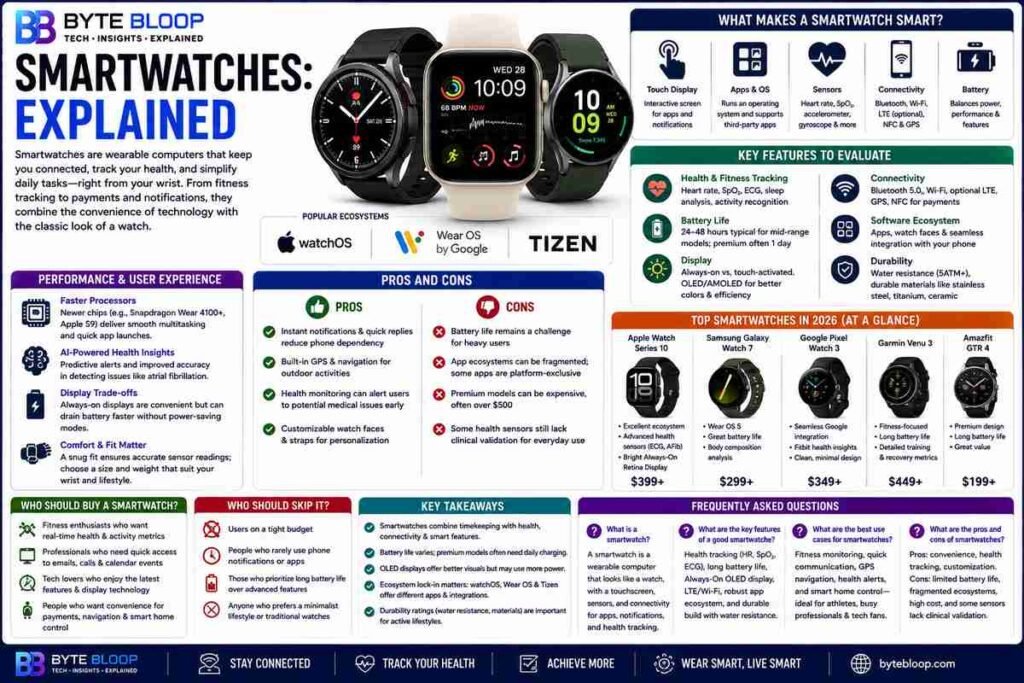
Unlike a conventional watch, a smartwatch runs an operating system, supports third‑party apps, and connects to your phone via Bluetooth or Wi‑Fi. The most common OS platforms are Wear OS, watchOS, and Tizen, each offering a distinct app ecosystem. A true smartwatch will have a touch‑enabled display, a set of sensors (accelerometer, gyroscope, heart‑rate monitor), and a battery that balances performance with longevity. The display technology—LCD, OLED, or AMOLED—impacts battery life, color accuracy, and outdoor readability.
Key Features to Evaluate
When shopping, consider these core capabilities:
- Health & Fitness Tracking: Heart‑rate, SpO₂, ECG, sleep analysis, and activity recognition.
- Battery Life: Typical ranges from 24 to 48 hours for mid‑range models; premium watches often need daily charging.
- Display: Always‑on vs. touch‑activated; OLED offers deeper blacks and lower power use.
- Connectivity: Bluetooth 5.0, LTE optional, Wi‑Fi, and NFC for contactless payments.
- Software Ecosystem: Availability of apps, watch faces, and integration with your phone’s ecosystem.
- Durability: Water resistance ratings (e.g., 5ATM) and build materials (stainless steel, titanium, ceramic).
Performance & User Experience
Benchmarks show that newer processors (e.g., Qualcomm Snapdragon Wear 4100+ or Apple S9) deliver smoother multitasking and faster app launch times. The integration of AI for predictive health alerts has improved accuracy, especially in detecting atrial fibrillation. Users report that always‑on displays, while convenient, can drain the battery faster unless coupled with power‑saving modes. The feel of the watch on the wrist is also critical; a snug fit ensures accurate sensor readings, but a bulky case can be uncomfortable during workouts.
Pros and Cons
Pros:
- Instant notifications and quick replies reduce phone dependency.
- Built‑in GPS and navigation aid outdoor activities.
- Health monitoring can alert users to potential medical issues early.
- Customizable watch faces and straps allow personalization.
Cons:
- Battery life remains a challenge for heavy users.
- App ecosystems can be fragmented; some apps are exclusive to certain platforms.
- Premium models carry a high price tag, often exceeding $500.
- Some health sensors still lack clinical validation for everyday use.
Who Should Buy a Smartwatch?
Fitness enthusiasts who want real‑time metrics, professionals who need quick access to emails and calendar events, and tech lovers who appreciate the latest display technology will find a smartwatch beneficial. If you prefer a minimalist lifestyle with minimal phone interaction, a smartwatch can streamline daily tasks.
Who Should Skip It?
Users on a tight budget, those who rarely use their phone for notifications, or individuals who prioritize long battery life over advanced features may want to consider a traditional watch or a basic fitness band instead.
Key Takeaways
- Smartwatches blend timekeeping with health and connectivity features.
- Battery life varies; premium models often need daily charging.
- Display type (OLED vs. LCD) affects readability and power consumption.
- Ecosystem lock‑in matters: app availability differs across watchOS, Wear OS, and Tizen.
- Durability ratings (water resistance, build material) influence suitability for active use.
Frequently Asked Questions
What is a smartwatch?
A smartwatch is a wearable computer that resembles a wristwatch, equipped with a touchscreen, sensors, and connectivity to provide notifications, health tracking, and app support.
What are the key features of a good smartwatch?
Key features include health and fitness tracking (heart rate, SpO₂, ECG), long battery life, an always‑on OLED display, LTE or Wi‑Fi connectivity, a robust app ecosystem, and durable construction with water resistance.
What are the best use cases for smartwatches?
Smartwatches excel in fitness monitoring, quick communication, navigation with GPS, health alerts, and integrating with smart home devices, making them ideal for athletes, busy professionals, and tech enthusiasts.
What are the pros and cons of smartwatches?
Pros: instant notifications, health monitoring, customization, and convenience. Cons: limited battery life, ecosystem fragmentation, high cost for premium models, and some sensors lacking clinical validation.
Conclusion
Based on the available information and industry analysis, smartwatches represent a convergence of wearable technology and personal health management, offering users real‑time data and seamless connectivity that can enhance daily productivity and wellness. However, buyers must weigh battery longevity, ecosystem compatibility, and price against their specific needs to ensure they choose a device that delivers lasting value.
Related Reading
- Top Fitness Apps for Your Smartwatch
- How to Extend Smartwatch Battery Life