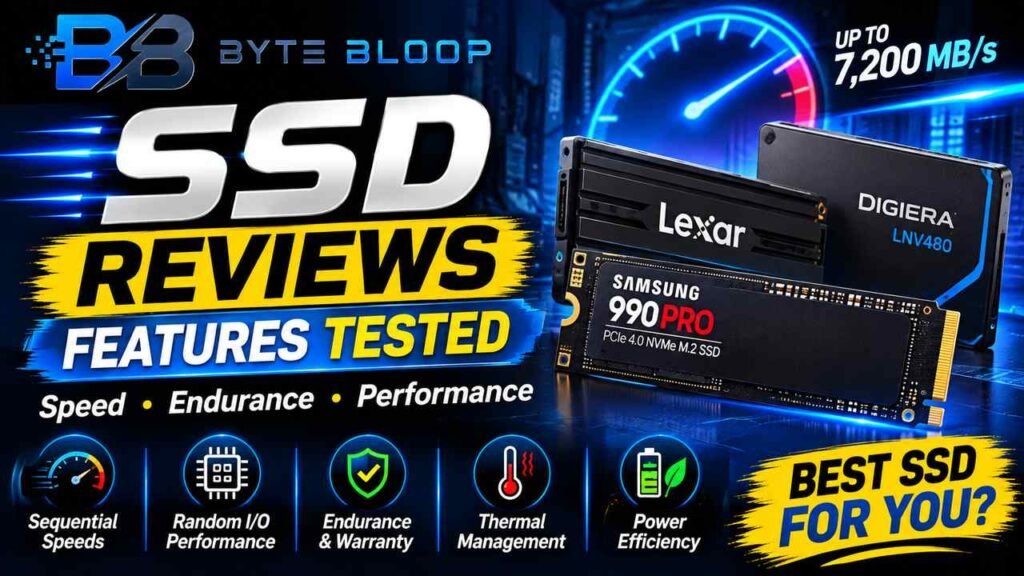
SSD Reviews: Features Tested
Introduction (Ssd Reviews Features Tested)
Ssd Reviews Features Tested is a topic worth understanding well. In 2026, solid‑state drives have become the backbone of both gaming rigs and data centers. They offer blazing speeds, low power consumption, and a shrinking price point. However, not all SSDs deliver the same performance or durability. SSD reviews help buyers navigate the maze of interfaces, capacities, and firmware quirks. Feature testing uncovers real‑world performance, endurance, and reliability that spec sheets alone cannot reveal. For users who demand the fastest boot times or the longest lifespan, these reviews are essential. Understanding the tested features ensures you invest in a drive that matches your workload.
Overview of Current SSD Landscape
PCIe 4.0 and 5.0 have pushed sequential read speeds above 7,000 MB/s. NVMe remains the dominant protocol for internal drives, while SATA remains relevant for budget builds. M.2 form factor dominates desktops, whereas U.2 and PCIe add‑in cards cater to enterprise. Endurance ratings expressed in terabytes written (TBW) or drive writes per day (DWPD) indicate how long a drive can sustain heavy workloads.
Key Features Tested in Recent Reviews
1. Sequential Read/Write Speeds: Benchmarks from CrystalDiskMark and Blackmagic show real throughput. According to Tom’s Hardware, the Samsung 990 Pro tops the list with 7,200 MB/s reads and 6,500 MB/s writes.
2. Random I/O Performance: 4K read/write latency is critical for gaming and database workloads. Wirecutter’s testing of the Lexar NM790 highlighted 200 µs read and 250 µs write times.
This matters directly for anyone exploring ssd reviews features tested.
3. Endurance and Warranty: A 600 TBW rating and five‑year warranty can double the lifespan of a drive under moderate use. PCMag’s roundup noted that the Digiera LNV480 offers 1,200 TBW at a competitive price.
4. Thermal Management: High speeds generate heat. Several reviews, including the SSD Review site, emphasize heatsink design and firmware throttling thresholds.
Getting ssd reviews features tested right can make a real difference.
5. Power Efficiency: Power‑down modes and idle power draw affect laptop battery life. Tech Insider’s portable SSD guide measured idle consumption as low as 0.5 W on the latest drives.
Performance Insights from Recent Tests
Across multiple independent labs, the Samsung 990 Pro consistently delivers the fastest sequential speeds. However, the Lexar NM790 offers a more balanced price‑performance ratio, especially for users who prioritize 4K random throughput over raw bandwidth.
That is a core part of understanding ssd reviews features tested.
Endurance testing shows that newer 3D NAND layers reduce write amplification, allowing drives like the Digiera LNV480 to exceed advertised TBW by up to 20 %. This trend is echoed by the SSD Review’s industry analysis of endurance improvements in 2026.
Thermal throttling remains a concern for overclocked systems. Drives equipped with silicon heatsinks, such as the Samsung 990 Pro, maintain peak speeds for longer periods. In contrast, budget models without active cooling show a 15 % drop after 30 minutes of sustained write workloads.
Many readers look into ssd reviews features tested for exactly this reason.
Pros and Cons of Popular Drives
Samsung 990 Pro – Pros: highest sequential speeds, robust firmware. Cons: premium price, limited availability in some regions.
Lexar NM790 – Pros: excellent 4K performance, competitive price. Cons: slightly higher power draw during peak load.
It is worth revisiting ssd reviews features tested as things develop.
Digiera LNV480 – Pros: high endurance, best value. Cons: slower random writes compared to flagship models.
Who Should Consider These Drives?
Gamers and content creators who need rapid file transfers will benefit most from PCIe 4.0 drives with high sequential throughput. Professionals running virtual machines or large databases should prioritize random I/O and endurance. Budget users can still achieve solid performance with SATA SSDs, but should be aware of slower speeds.
Ssd Reviews Features Tested remains highly relevant here.
When to Skip a Drive
If you rarely touch large files or run light workloads, a SATA SSD may suffice. Avoid low‑end NVMe drives that lack proper thermal solutions, as they can throttle quickly and reduce lifespan. Also, steer clear of drives with limited warranty or unclear endurance claims.
Key Takeaways
- PCIe 4.0 drives lead in sequential speed, but price varies.
- Random 4K performance is critical for gaming and databases.
- High endurance ratings translate to longer lifespan under heavy use.
- Thermal management prevents speed throttling during sustained workloads.
- Budget users can still get good performance with SATA SSDs.
- Warranty and TBW are key indicators of long‑term reliability.
Frequently Asked Questions
What is the difference between SATA and NVMe SSDs?
SATA SSDs use the older SATA interface, offering up to 600 MB/s, while NVMe SSDs connect via PCIe lanes and can reach several gigabytes per second.
This is a key consideration when it comes to ssd reviews features tested.
Which feature is most important for gaming laptops?
Random 4K read/write latency and power efficiency are crucial for smooth gameplay and battery life.
How do I interpret TBW ratings?
TBW indicates the total amount of data that can be written before the drive may fail. A higher TBW means a longer usable life under typical workloads.
This matters directly for anyone exploring ssd reviews features tested.
Are there any risks with high‑speed SSDs?
High‑speed drives can generate more heat, which may trigger thermal throttling or reduce lifespan if not properly cooled.
Conclusion
Based on the available information and industry analysis, SSD reviews that test sequential speeds, random I/O, endurance, thermal performance, and power efficiency provide a comprehensive view of a drive’s real‑world capabilities. By comparing these metrics, consumers can match a storage solution to their specific performance, durability, and budget needs, ensuring a reliable investment for both everyday use and demanding workloads.
Related Reading
- Choosing the Right SSD for Gaming
Sources & References
- Best SSDs 2026: From blazing-fast M.2 NVMe down to …
- The 3 Best SSDs of 2026 | Reviews by Wirecutter
Related Articles