Web Accessibility: Explained
Introduction
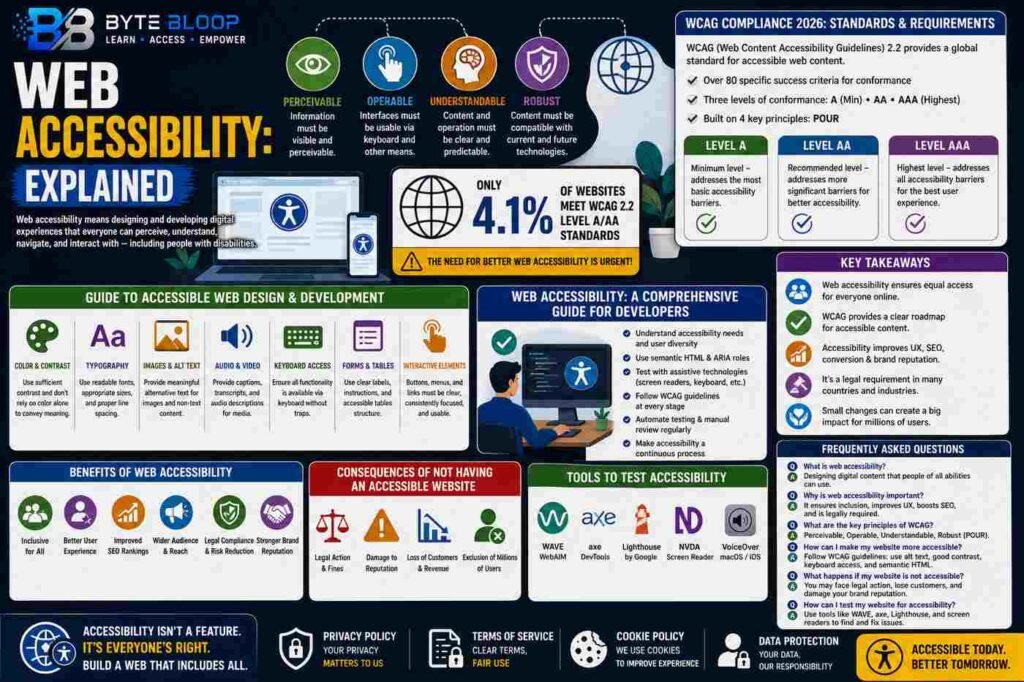
Web accessibility refers to the practice of designing and developing websites, applications, and digital tools that can be used by people of all abilities, including those with disabilities. When websites and web tools are properly designed and coded, people with disabilities can use them, which is the primary goal of web accessibility. The Web Content Accessibility Guidelines (WCAG) provide a set of recommendations for improving web accessibility, primarily for people with disabilities, but also for all user agents, including highly limited devices. Web accessibility allows everyone, including people with disabilities, to perceive, understand, navigate, and interact with the Internet. According to recent studies, only 4.1% of websites meet the WCAG 2.2 Level A/AA standards, highlighting the need for improved web accessibility. Web accessibility is not only a moral imperative, but it is also a legal requirement in many countries, with laws and regulations in place to ensure that digital products and services are accessible to all. The importance of web accessibility cannot be overstated, as it has a significant impact on the lives of people with disabilities, enabling them to participate fully in the digital economy.
The concept of web accessibility is closely tied to the idea of inclusive design, which involves creating products and services that can be used by everyone, regardless of their abilities. Inclusive design is not just about accessibility; it is about creating products and services that are usable, useful, and desirable for all users. The benefits of web accessibility extend beyond people with disabilities, as it can also improve the overall user experience, enhance search engine optimization (SEO), and increase customer satisfaction. Furthermore, web accessibility can help organizations to comply with laws and regulations, reduce the risk of legal action, and enhance their reputation as a socially responsible business.
The WCAG provides a set of guidelines for making web content more accessible to people with disabilities. The guidelines are organized into four main principles: perceivable, operable, understandable, and robust (POUR). The perceivable principle requires that information and user interface components be presentable to users in ways they can perceive, while the operable principle requires that user interface components and navigation be operable. The understandable principle requires that information and the operation of the user interface be understandable, and the robust principle requires that content be robust enough to be interpreted reliably by a wide variety of user agents, including assistive technologies.
WCAG Compliance 2026: Standards and Requirements
The most recent version of WCAG includes over 80 specific criteria for conformance that can be used to evaluate website accessibility. The guidelines provide a comprehensive framework for ensuring that web content is accessible to people with disabilities, including those with visual, auditory, motor, or cognitive disabilities. The guidelines also provide a set of success criteria, which are used to evaluate the accessibility of web content. The success criteria are organized into three levels of conformance: A, AA, and AAA, with Level A being the minimum level of conformance required to meet the guidelines.
Guide to Accessible Web Design & Development
A guide to accessible web design and development provides a comprehensive overview of the considerations that need to be taken into account when designing and developing accessible websites and applications. The guide covers topics such as accessible color schemes, typography, and layout, as well as the use of alternative text for images and the provision of closed captions for audio and video content. The guide also provides information on how to create accessible forms, tables, and interactive elements, such as buttons and menus. By following the guidelines and best practices outlined in the guide, developers can create websites and applications that are accessible to all users, regardless of their abilities.
Web Accessibility: A Comprehensive Guide for Developers
A comprehensive guide for developers provides a detailed overview of the various aspects of web accessibility, from definitions to practical tools and techniques. The guide covers topics such as the importance of web accessibility, the benefits of accessible design, and the role of developers in creating accessible websites and applications. The guide also provides information on how to use accessibility testing tools, such as screen readers and accessibility evaluators, to identify and fix accessibility issues. By following the guidelines and best practices outlined in the guide, developers can create websites and applications that are accessible to all users, regardless of their abilities.
Key Takeaways
- Web accessibility is the practice of designing and developing websites, applications, and digital tools that can be used by people of all abilities.
- The Web Content Accessibility Guidelines (WCAG) provide a set of recommendations for improving web accessibility.
- Only 4.1% of websites meet the WCAG 2.2 Level A/AA standards, highlighting the need for improved web accessibility.
- Web accessibility is not only a moral imperative, but it is also a legal requirement in many countries.
- The benefits of web accessibility extend beyond people with disabilities, as it can also improve the overall user experience, enhance search engine optimization (SEO), and increase customer satisfaction.
Frequently Asked Questions
What is web accessibility?
Web accessibility refers to the practice of designing and developing websites, applications, and digital tools that can be used by people of all abilities, including those with disabilities.
What are the benefits of web accessibility?
The benefits of web accessibility extend beyond people with disabilities, as it can also improve the overall user experience, enhance search engine optimization (SEO), and increase customer satisfaction.
What are the key features of the Web Content Accessibility Guidelines (WCAG)?
The WCAG provides a set of guidelines for making web content more accessible to people with disabilities, including the principles of perceivable, operable, understandable, and robust (POUR).
How can I make my website more accessible?
To make your website more accessible, you can follow the guidelines and best practices outlined in the Web Content Accessibility Guidelines (WCAG), such as providing alternative text for images, using accessible color schemes, and creating accessible forms and tables.
What are the consequences of not having an accessible website?
The consequences of not having an accessible website can include legal action, damage to your reputation, and loss of customers and revenue.
How can I test my website for accessibility?
You can test your website for accessibility using accessibility testing tools, such as screen readers and accessibility evaluators, to identify and fix accessibility issues.
Conclusion
Based on the available information and industry analysis, web accessibility is a critical aspect of creating inclusive digital experiences, and organizations that prioritize accessibility can benefit from improved user experience, enhanced SEO, and increased customer satisfaction. By following the guidelines and best practices outlined in the Web Content Accessibility Guidelines (WCAG), developers can create websites and applications that are accessible to all users, regardless of their abilities.
Related Reading
- Inclusive Design: Creating Products and Services for All Users
- The Importance of Accessibility in Digital Products and Services