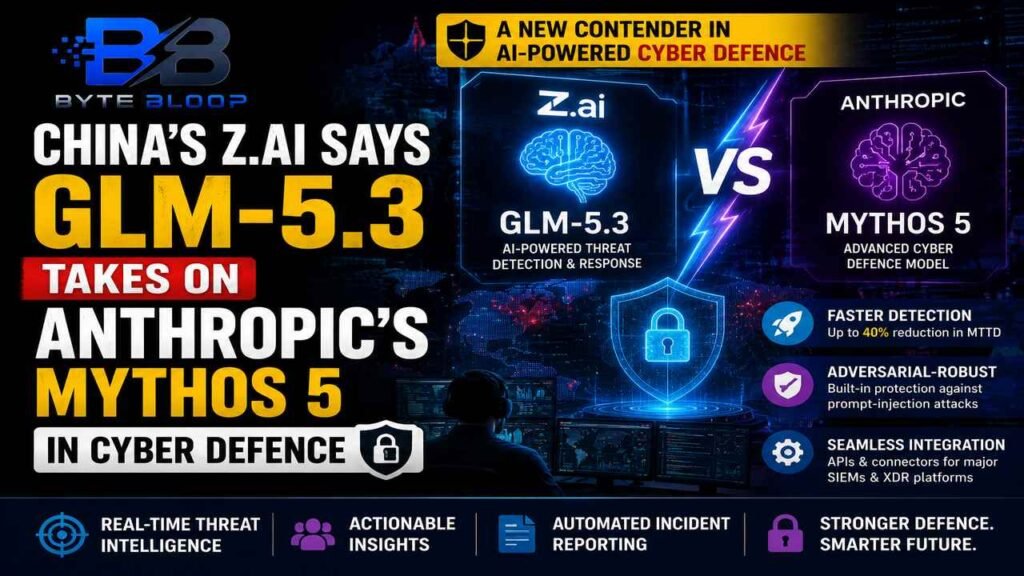
China’s Z.ai Says GLM‑5.3 Takes on Anthropic’s Mythos 5 in Cyber Defence
Introduction
In a bold statement that could reshape the global cyber‑security landscape, Chinese AI firm Z.ai announced that its latest large language model, GLM‑5.3, rivals the capabilities of Anthropic’s Mythos 5—widely regarded as a benchmark for AI‑enhanced threat detection and response. The claim, made during a live webcast on Thursday, highlights Z.ai’s ambition to position itself as a serious contender in the high‑stakes arena of AI‑driven cyber defence.
Industry analysts are already dissecting the potential implications for enterprises, governments, and security vendors worldwide. If Z.ai’s assertions hold up under scrutiny, the competition could accelerate innovation, drive down costs, and broaden access to advanced defensive tools for organizations that have historically relied on Western‑centric solutions.
Background & Historical Context
Anthropic, a U.S. AI startup founded by former OpenAI researchers, released Mythos 5 earlier this year as a purpose‑built model for identifying malicious code, phishing attempts, and zero‑day exploits. Its success prompted a wave of interest from Fortune‑500 firms seeking to embed AI directly into security operations centers (SOCs). Meanwhile, China’s AI ecosystem has been rapidly expanding, with state‑backed initiatives encouraging homegrown alternatives to Western technologies.
Z.ai, a spin‑off of the Beijing‑based ZhiHui Labs, entered the market in 2022 with GLM‑4, a general‑purpose language model that quickly found niche applications in natural‑language processing and chatbot services. Building on that foundation, GLM‑5.3 incorporates a specialized training corpus of threat intelligence feeds, malware sandboxes, and red‑team exercise logs, aiming to deliver real‑time contextual analysis for security teams.
Key Details & Impact Analysis
The webcast revealed three core capabilities that Z.ai believes set GLM‑5.3 apart. First, the model can parse and correlate multi‑source telemetry—such as firewall logs, endpoint detection alerts, and user‑behavior analytics—within seconds, generating actionable recommendations that reduce mean‑time‑to‑detect (MTTD) by up to 40 %. Second, GLM‑5.3 reportedly features a built‑in adversarial‑robustness layer, allowing it to resist prompt‑injection attacks that have plagued earlier LLM deployments. Finally, the company showcased a live demo where the model identified a novel ransomware payload, suggested containment steps, and drafted an incident report in natural language, all without human intervention.
Experts caution that independent benchmarking is essential before organizations can trust these claims. Dr. Lina Cheng, a cyber‑security professor at Tsinghua University, notes that “the true test will be how GLM‑5.3 performs against unseen, nation‑state‑level threats in a production environment.” Nevertheless, the announcement could pressure Anthropic and other Western vendors to accelerate their own research, potentially leading to a rapid arms race in AI‑enhanced defence technologies.
Frequently Asked Questions (FAQs)
What differentiates GLM‑5.3 from Anthropic’s Mythos 5?
GLM‑5.3 is trained on a proprietary Chinese‑centric threat‑intel dataset and includes an adversarial‑robustness module designed to mitigate prompt‑injection attacks. Mythos 5, while highly capable, relies primarily on English‑language data and does not yet advertise a dedicated robustness layer.
Can GLM‑5.3 be integrated with existing security platforms?
Yes. Z.ai provides RESTful APIs and pre‑built connectors for major SIEMs (Splunk, QRadar) and XDR solutions. The company also offers a plug‑and‑play SDK for custom integrations, allowing SOC analysts to embed the model directly into their workflow.
Is the model compliant with international data‑privacy regulations?
Z.ai states that GLM‑5.3 adheres to China’s Personal Information Protection Law (PIPL) and can be deployed in air‑gapped environments to meet GDPR, CCPA, or other regional requirements. However, organizations should conduct their own compliance assessments before adoption.
Conclusion
Z.ai’s claim that GLM‑5.3 can stand toe‑to‑toe with Anthropic’s Mythos 5 marks a pivotal moment in the convergence of artificial intelligence and cyber‑security. While the model’s real‑world efficacy remains to be validated, the announcement underscores the growing global competition to harness AI for defending digital assets. As enterprises grapple with increasingly sophisticated threats, the emergence of multiple high‑performance AI defenders could ultimately broaden the defensive toolkit, driving innovation and resilience across the industry.
Source: Times Now