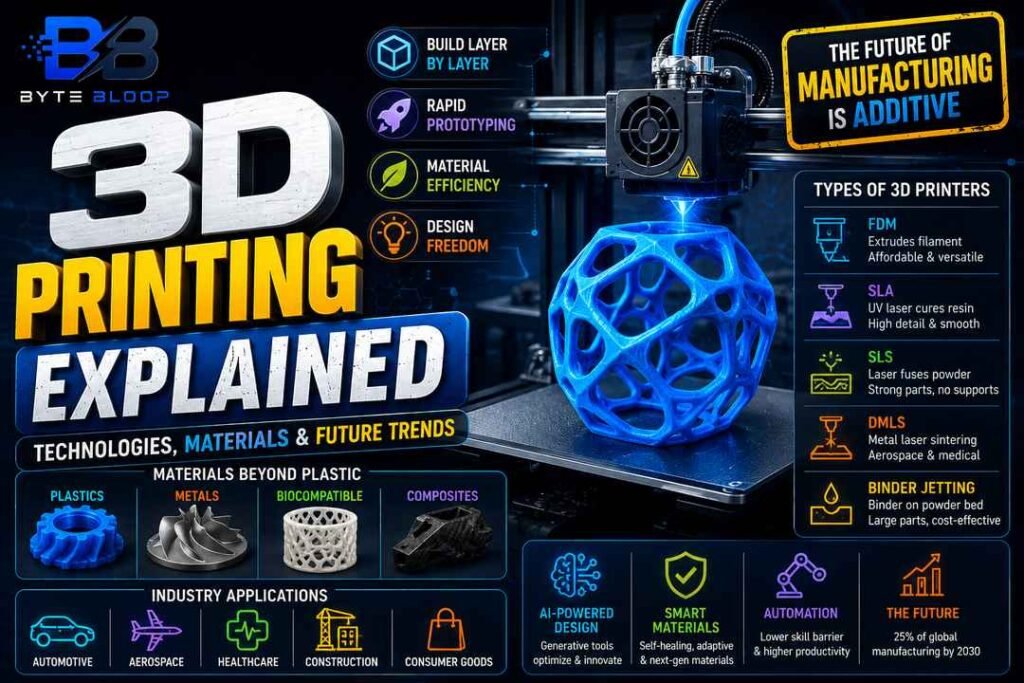
3D Printing Explained: How It Works, Types, Uses and Benefits
Introduction
3D printing, also known as additive manufacturing, is a technology that creates three-dimensional objects by building material layer by layer from a digital design. Unlike many traditional manufacturing methods that cut, drill, or shape material away, additive manufacturing adds material only where it is needed.
The technology has developed from an early prototyping technique into a manufacturing method used across areas such as aerospace, healthcare, automotive engineering, product development, education, and consumer manufacturing. Its ability to produce complex shapes, customized components, and prototypes without conventional tooling makes it useful for both experimentation and production.
In this 3D printing explained guide, we will look at how 3D printing works, the major technologies used today, common materials, design considerations, industry applications, benefits, limitations, and future developments.
How 3D Printing Works
At its core, 3D printing starts with a digital three-dimensional model. The model may be created using computer-aided design (CAD) software or generated from other digital data.
The software then prepares the model for printing by dividing it into many thin layers. The printer follows those instructions to deposit, melt, fuse, or cure material according to the selected printing technology.
Depending on the process, the material may be supplied as filament, liquid resin, powder, wire, or another feedstock. Each layer is formed and joined to the previous layer until the complete object is produced.
This layer-by-layer approach provides designers with considerable freedom. Complex internal structures, customized components, and geometries that can be difficult to manufacture with conventional techniques can often be produced more efficiently using additive manufacturing.
Types of 3D Printing Technologies
There is no single 3D printing process. Different technologies are designed for different materials, performance requirements, surface finishes, accuracy levels, and production volumes.
Fused Deposition Modeling and Material Extrusion
Fused Deposition Modeling, commonly called FDM, is a widely used form of material extrusion.
The printer heats thermoplastic filament and pushes it through a nozzle. The material is deposited layer by layer until the part is complete.
FDM printers are popular for:
- Prototyping
- Educational projects
- Product development
- Hobbyist printing
- Low-volume parts
- Functional plastic components
Material extrusion is also used in professional and industrial environments, although consumer FDM printers are often the most familiar example.
Stereolithography and Vat Photopolymerization
Stereolithography, or SLA, is a form of vat photopolymerization.
Instead of using a filament, the process uses liquid photopolymer resin. Light is used to cure selected areas of resin and create solid layers.
SLA is known for producing detailed parts and smooth surfaces, which makes it useful for:
- Detailed prototypes
- Product design
- Dental applications
- Jewelry patterns
- Small precision components
Different vat-photopolymerization systems use different light sources and process configurations.
Selective Laser Sintering and Powder Bed Fusion
Selective Laser Sintering, or SLS, is a powder-based additive manufacturing process.
A laser selectively processes areas of powdered material according to the digital design. Powder-bed technologies can be used with different material classes, depending on the specific process.
Powder-bed fusion is used for producing functional parts with complex geometries and can reduce the need for conventional support structures in some processes. NIST identifies powder-bed fusion as one of the major additive manufacturing technology families.
Metal Additive Manufacturing
Metal additive manufacturing can produce components using materials such as aluminum, titanium, steel, and other alloys.
Several different processes are used for metal 3D printing, including laser-based and electron-beam powder-bed fusion as well as directed energy deposition.
These technologies are used when manufacturers need complex metal parts, customized components, rapid design iteration, or geometries that are difficult to achieve through conventional manufacturing.
Binder Jetting
Binder jetting works by selectively depositing a liquid binding agent onto layers of powder.
Unlike some laser-based processes, the binder initially joins the powder rather than melting it directly with a laser. Additional processing may be required depending on the material and final application.
Binder jetting can be used for certain metal, ceramic, and other powder-based manufacturing workflows.
Materials Used in 3D Printing
One of the biggest developments in 3D printing is the expanding range of materials available for different applications.
Plastics
Thermoplastics are widely used in material-extrusion systems.
Common examples include:
- PLA
- ABS
- PETG
- Nylon
- TPU
The best material depends on factors such as strength, flexibility, temperature resistance, chemical resistance, cost, and printability.
Resins
Resins are commonly used in vat-photopolymerization technologies.
They can be formulated for different requirements, including:
- High detail
- Engineering properties
- Dental applications
- Casting patterns
- Flexible parts
- Rapid prototyping
Metals
Metal additive manufacturing can use materials including:
- Titanium
- Aluminum
- Stainless steel
- Nickel-based alloys
- Cobalt-chrome alloys
Metal selection depends on the mechanical, thermal, chemical, and manufacturing requirements of the final component.
Ceramics and Composite Materials
Ceramics and composite materials can also be processed using specialized additive manufacturing techniques.
Research and industrial applications continue to expand the range of materials that can be incorporated into additive manufacturing workflows. NIST currently lists metal, plastic, and ceramic materials among major additive manufacturing applications and research areas.
Designing for 3D Printing
A good 3D printed part starts with an appropriate digital design.
Orientation
The orientation of a component can affect:
- Surface quality
- Print time
- Support requirements
- Strength
- Material usage
Changing the orientation of a part can sometimes reduce supports or improve the quality of important surfaces.
Wall Thickness
Very thin walls may be difficult to manufacture depending on the printer and material.
Designers should consider the resolution and capabilities of the selected printing process before finalizing wall thickness.
Support Structures
Some 3D printing technologies require support structures for overhangs and other difficult geometries.
Reducing unnecessary support structures can save material and reduce post-processing work.
Topology Optimization
Topology optimization uses computational methods to identify where material is needed based on defined design requirements.
This approach can help create lightweight structures while maintaining required performance characteristics.
Industry Applications of 3D Printing
3D printing is now used in many industries.
Aerospace
Aerospace organizations use additive manufacturing for research, prototypes, tooling, and selected flight-related components.
The technology can help create complex geometries and reduce material usage in suitable applications. NASA has extensively researched additive manufacturing for aerospace applications and qualification of additively manufactured components.
Healthcare
Healthcare is another major area for additive manufacturing.
3D printing can be used for:
- Patient-specific implants
- Surgical guides
- Prosthetics
- Dental restorations
- Anatomical models
- Medical-device development
The FDA notes that additive manufacturing can produce devices with complex geometry and components matched to individual patient anatomy.
Automotive
Automotive companies can use 3D printing for:
- Prototypes
- Custom tooling
- Fixtures
- Development parts
- Selected production components
Rapid iteration can make it easier for engineering teams to test new designs without creating traditional tooling for every early-stage change.
Construction
Large-scale additive manufacturing systems can be used for experimental and commercial construction applications, including concrete-based structures.
The technology is still subject to practical considerations such as materials, structural requirements, construction regulations, equipment, site conditions, and quality control.
Consumer Products
3D printing can also be used for customized and low-volume products.
Examples include:
- Jewelry
- Product accessories
- Home décor
- Educational models
- Customized components
- Replacement parts
AI and 3D Printing
Artificial intelligence is increasingly being used alongside digital design and engineering workflows.
AI-assisted systems can help designers explore multiple design possibilities, automate parts of the design process, identify patterns in manufacturing data, and assist with optimization.
Generative design can produce alternative geometries based on requirements such as weight, strength, material usage, and manufacturing constraints.
AI does not replace the need for engineering validation. Generated designs still need to be checked for manufacturability, safety, materials, tolerances, and the requirements of the final application.
Benefits of 3D Printing
3D printing offers several potential advantages.
Rapid Prototyping
Developers can produce physical prototypes directly from digital designs and make changes without creating new conventional tooling.
Customization
Additive manufacturing can be useful for customized products and patient-specific medical devices.
Complex Geometries
The layer-by-layer manufacturing approach can enable internal structures and complex geometries that may be difficult to produce using traditional methods.
Reduced Tooling Requirements
For certain low-volume applications, avoiding dedicated tooling can reduce development time and costs.
Efficient Material Use
Because material is added rather than generally removed from a larger block, additive manufacturing can reduce waste in suitable applications. The actual material savings depend on the process and design.
Limitations of 3D Printing
3D printing also has limitations.
Production Speed
Some additive manufacturing processes can be slow when producing large parts or high production volumes.
Material Limitations
Not every material is compatible with every printing technology.
Post-Processing
Many printed parts require additional work such as:
- Removing supports
- Washing
- Curing
- Sanding
- Machining
- Heat treatment
- Surface finishing
Quality Control
Industrial applications may require detailed inspection, process control, material qualification, and testing.
This is especially important for parts used in safety-critical, aerospace, and medical applications.
Equipment and Material Costs
Professional and industrial 3D printing systems can require significant investment in equipment, materials, software, maintenance, and trained operators.
3D Printing in Aerospace and Healthcare
Some of the most demanding applications of additive manufacturing are found in aerospace and healthcare.
In aerospace, organizations are studying how additive manufacturing can produce lightweight and complex parts while developing methods for inspection, qualification, and certification.
In healthcare, additive manufacturing has enabled patient-specific devices and complex medical components. The FDA has published technical guidance covering considerations for medical devices manufactured using additive manufacturing.
These applications demonstrate that 3D printing is not limited to consumer hobbyist machines. However, regulated and safety-critical uses require appropriate testing, quality control, and compliance.
Future of 3D Printing
The future of 3D printing is likely to involve improvements across hardware, software, materials, automation, and quality control.
More Automation
Automation can help reduce manual steps and improve consistency in industrial printing workflows.
Better Materials
Researchers and manufacturers continue to develop new materials and material combinations for demanding applications.
Digital Monitoring
Sensors and software can be used to monitor printing processes and identify problems during production.
Digital Twins and Predictive Maintenance
Digital models and real-time manufacturing information can support process monitoring and equipment maintenance.
More Advanced AI Workflows
AI and generative design may continue to influence how products are designed and optimized for additive manufacturing.
The rate of adoption will vary by industry because factors such as economics, regulation, material performance, production volume, and quality requirements all affect whether additive manufacturing is appropriate for a specific application.
Key Takeaways
- 3D printing is an additive manufacturing process that builds objects layer by layer.
- Digital CAD models can be converted into printable layer instructions.
- Major technologies include material extrusion, vat photopolymerization, powder-bed fusion, directed energy deposition, and binder jetting.
- Plastics, resins, metals, ceramics, and composite materials can be used in different additive manufacturing processes.
- 3D printing is useful for prototyping, customization, complex geometries, tooling, and selected production applications.
- Aerospace and healthcare are important areas for advanced additive manufacturing.
- AI and generative design can support parts of the design and optimization workflow.
- 3D printing still has limitations involving speed, materials, post-processing, cost, and quality control.
- Industrial and regulated applications require appropriate testing, inspection, and process control.
Frequently Asked Questions
What is 3D printing?
3D printing is a manufacturing process that creates three-dimensional objects by building material layer by layer from a digital design.
How does 3D printing work?
A digital 3D model is converted into instructions containing layers or paths. The printer then deposits, cures, melts, or fuses material according to those instructions until the object is complete.
What are the main types of 3D printing?
Major additive manufacturing technologies include material extrusion, vat photopolymerization, powder-bed fusion, directed energy deposition, material jetting, and binder jetting.
What materials can be used in 3D printing?
Depending on the technology, 3D printers can use plastics, photopolymer resins, metals, ceramics, and composite materials.
Is 3D printing only used for prototypes?
No. Although rapid prototyping remains an important use case, additive manufacturing is also used for tooling, customized components, medical devices, aerospace applications, and selected production workloads.
Is 3D printing expensive?
The cost depends on the printer, material, production method, part size, complexity, and application. Consumer printers can be relatively affordable, while professional and industrial systems can require much larger investments.
What is additive manufacturing?
Additive manufacturing is the broader manufacturing approach in which three-dimensional parts are built by adding material layer by layer. 3D printing is commonly used as a term for additive manufacturing processes.
Can 3D printing be used in healthcare?
Yes. Additive manufacturing is used for various medical devices and patient-specific applications, including certain implants, surgical guides, prosthetics, and dental products.
Can AI improve 3D printing?
AI can assist with areas such as generative design, optimization, process monitoring, and manufacturing data analysis. Human engineering review is still important for validating the final design.
What is the biggest advantage of 3D printing?
One major advantage is the ability to create customized and complex parts directly from digital designs without always requiring conventional tooling.
Conclusion
3D printing explained simply is a manufacturing approach that turns digital designs into physical objects by building them layer by layer.
The technology now covers a broad range of processes, from consumer material-extrusion printers to advanced metal and powder-based industrial systems. Its applications include rapid prototyping, customized products, aerospace development, healthcare, automotive engineering, tooling, and other specialized manufacturing workflows.
At the same time, 3D printing is not a universal replacement for conventional manufacturing. Production speed, material availability, post-processing, equipment costs, quality control, and regulatory requirements all need to be considered before selecting an additive manufacturing process.
As materials, automation, software, digital monitoring, and AI-assisted design continue to develop, 3D printing is likely to remain an important part of modern manufacturing and product development.
Related Reading
Laravel Explained: Features, MVC, AI SDK and How It Works in 2026
Sources & References
NIST — What is Additive Manufacturing?
NIST — Additive Manufacturing Technologies
NIST — Additive Manufacturing FAQs
FDA — 3D Printing of Medical Devices
FDA — Technical Considerations for Additive Manufactured Medical Devices
NASA — 3D Printing Offers Multi-Dimensional Benefits to Aviation
NASA — Additive Manufacturing Requirements for Spaceflight Systems