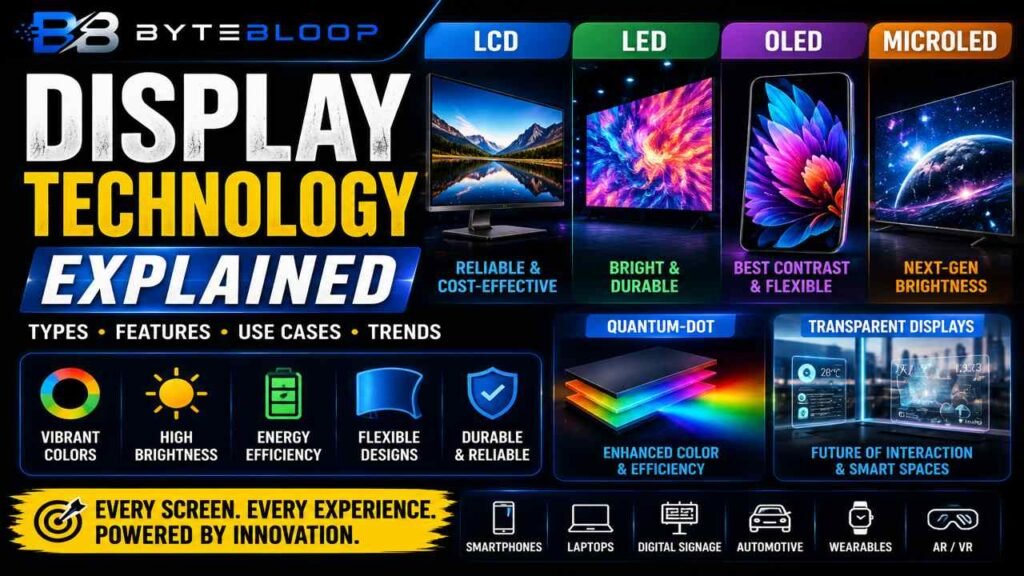
Display Technology: Explained
Introduction
Display technology has moved from bulky cathode‑ray tubes to ultra‑thin, flexible panels that can bend, stretch, and even be transparent. At its core, a display converts electrical signals into light that we perceive as images, text, or video. The evolution of this technology has been driven by the demand for higher resolution, lower power consumption, and richer color gamut across devices—from smartphones and laptops to stadium‑sized LED walls and digital signage. Today’s displays are not just passive screens; they integrate AI, cloud connectivity, and interactive touch, redefining how we consume media and communicate. Understanding the fundamentals of LCD, LED, OLED, and emerging flexible displays helps consumers, designers, and technologists choose the right solution for each application. This guide breaks down the science behind each type, highlights key industry trends, and offers practical examples of where each technology shines. Whether you’re a developer building a new wearable or a marketer planning a high‑impact digital billboard, a clear grasp of display technology will inform smarter decisions and future‑proof investments. The following sections cover the physics, manufacturing, and real‑world use cases of the most common display types, while also looking ahead to the next wave of innovations.
LCD: The Workhorse of Everyday Screens
Liquid Crystal Display (LCD) panels use a backlight—traditionally cold‑cathode fluorescent lamps (CCFL) and now light‑emitting diodes (LED)—to illuminate liquid crystals that modulate light. According to the Expert Guide to LCD Panels, the liquid crystals are sandwiched between two polarized glass layers; when an electric field is applied, the crystals twist, allowing varying amounts of light to pass through. This technology powers the majority of TVs, monitors, and smartphones, offering excellent color accuracy and wide viewing angles.
LCD manufacturing involves precise deposition of thin films, alignment layers, and polarizers, making it a mature but costly process. The trend toward higher pixel densities and thinner bezels has pushed manufacturers to adopt advanced panel architectures such as In‑Plane Switching (IPS) and Quantum‑dot enhancement. However, LCDs still consume more power than newer technologies because they rely on a constant backlight, and they can suffer from limited contrast ratios compared to OLED.
LED: From Backlights to Full‑Color Panels
LED displays can refer to both the backlighting of LCDs and to full‑color Light‑Emitting Diode panels. In the latter case, each pixel is an individual LED, allowing for higher brightness and faster refresh rates. According to the Future Advancements in Display Technology Today, LED panels are now used in outdoor digital signage, stadium screens, and automotive dashboards. Their modular construction enables large‑scale installations with minimal weight.
LED technology offers excellent durability and can operate in extreme temperatures, making it ideal for outdoor advertising. The downside is that LED panels can be less energy efficient than OLED for static content, and their color gamut, while improving, still lags behind OLED in some high‑end models.
OLED: The Pinnacle of Image Quality
Organic Light‑Emitting Diode (OLED) displays generate light directly from organic compounds when an electric current passes through them. This eliminates the need for a backlight, allowing for true black levels, higher contrast ratios, and faster response times. The Display Technology Guide notes that OLED panels can be manufactured on flexible substrates, leading to curved or rollable screens.
OLED’s self‑emissive nature reduces power consumption for dark content and enables ultra‑thin designs. However, organic materials can degrade over time, leading to burn‑in risks and shorter lifespans compared to LCD or LED. The cost of OLED production remains high, limiting its prevalence to premium smartphones, TVs, and high‑end monitors.
Emerging Technologies: MicroLED, Quantum‑Dot, and Transparent Displays
MicroLED is a hybrid that combines the self‑emissive benefits of OLED with the durability of inorganic LEDs. Each pixel is a microscopic LED, offering near‑infinite brightness and longevity. According to The Future of LED Display Technology, MicroLED is poised to replace OLED in flagship TVs and large‑screen applications within the next decade.
Quantum‑dot displays enhance LED or LCD panels by adding a thin layer of semiconductor nanocrystals that emit precise wavelengths of light. This boosts color gamut and efficiency. Transparent displays, another trend highlighted in the Future Advancements guide, allow images to be projected onto glass surfaces, opening possibilities for augmented reality and smart windows.
Choosing the Right Display for Your Project
When selecting a display, consider resolution, brightness, contrast, power consumption, form factor, and cost. For mobile devices, OLED offers superior visuals but at a premium price. For large outdoor signage, LED panels provide brightness and durability. If flexibility or ultra‑thinness is essential, consider OLED or emerging flexible MicroLED. Finally, for budget‑conscious projects, high‑quality LCDs remain a reliable choice.
Industry Trends Shaping 2026 and Beyond
Digital signage is increasingly driven by AI personalization and cloud integration, as noted in the Top 8 Digital Signage Trends 2026 guide. Interactive displays that respond to touch or gestures are becoming standard in retail and public spaces. Transparent and flexible displays are moving from concept to commercial products, especially in automotive and wearable markets. Manufacturers are also focusing on reducing power consumption and improving sustainability by using recyclable materials and more efficient backlighting.
Key Takeaways
- LCD remains the most common display for everyday devices due to mature manufacturing and excellent color accuracy.
- LED panels excel in outdoor and large‑scale applications thanks to durability and modularity.
- OLED provides the best contrast and flexibility but at higher cost and potential burn‑in risks.
- Emerging MicroLED and quantum‑dot technologies promise to combine OLED’s quality with LED’s longevity.
- AI, cloud, and interactivity are redefining digital signage and consumer displays.
- Transparent and flexible displays are moving from niche to mainstream use cases.
Frequently Asked Questions
What is display technology explained?
Display technology refers to the engineering behind converting electrical signals into visual output on screens, encompassing LCD, LED, OLED, and emerging flexible panels.
What are the key features of OLED displays?
OLED panels are self‑emissive, offering true blacks, high contrast, fast response times, and flexibility, but they can suffer from burn‑in and higher production costs.
What are the best use cases for LED panels?
LED panels are ideal for outdoor digital signage, stadium screens, and automotive dashboards where brightness, durability, and modularity are critical.
What are the pros and cons of LCD technology?
Pros include mature manufacturing, wide availability, and good color accuracy. Cons are higher power consumption due to backlighting and lower contrast ratios compared to OLED.
Conclusion
Based on the available information and industry analysis, display technology has evolved from bulky CRTs to flexible OLEDs and emerging MicroLEDs, each offering distinct advantages in brightness, contrast, power efficiency, and form factor. As manufacturers push the boundaries of color gamut, energy savings, and interactivity, the next wave of displays will likely blend the best traits of current technologies while enabling new applications in AR, automotive, and large‑scale digital signage.
Related Reading
- How LED vs OLED Impact Smartphone Battery Life
Sources & References