OLED: Explained
Introduction
Organic Light Emitting Diodes, or OLEDs, have reshaped the way we view screens by eliminating the need for backlighting. Unlike traditional LCD panels that rely on a separate light source, OLEDs generate light directly from organic compounds sandwiched between two conductors. This simple yet elegant construction allows for incredibly thin displays, vibrant colors, and true blacks that were once the domain of high-end cinema. The result is a viewing experience that feels more natural, with deeper contrast ratios and faster response times, making OLEDs the go‑to choice for flagship smartphones, premium TVs, and cutting‑edge monitors. The technology’s evolution—from early prototypes to today’s high‑resolution, high‑brightness panels—has been driven by advances in materials science and manufacturing precision. Understanding how OLED works, its strengths, and its limitations is essential for anyone looking to invest in a new screen or simply appreciate the science behind the glow. In this guide, we’ll break down the core principles, highlight recent innovations like LG’s Hyper Radiant Color Tech, and compare OLED to competing display technologies.
How OLEDs Work
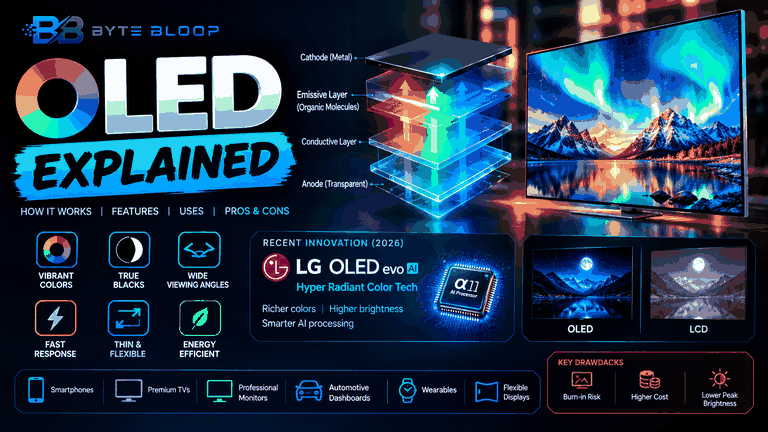
At its heart, an OLED panel consists of several ultra‑thin layers of organic molecules that emit light when an electric current passes through them. The layers are placed between two electrodes: a transparent anode and a metal cathode. When voltage is applied, electrons travel from the cathode to the anode, recombining with holes in the organic layer and releasing photons—light—in the process. Because each pixel can light up independently, OLEDs can achieve perfect blacks by simply turning pixels off. This contrasts with LCDs, which must dim the entire backlight to achieve darkness, often resulting in gray‑ish blacks.
Key Features of OLED Displays
- Infinite Contrast Ratio: Pixels can be turned off completely, producing true black.
- Wide Viewing Angles: Color and brightness remain stable even when viewed from extreme angles.
- Fast Response Times: Pixel changes happen in microseconds, eliminating motion blur.
- Thin & Flexible Design: The absence of a backlight allows for ultra‑thin panels and bendable displays.
- Energy Efficiency at Low Brightness: Dark scenes consume less power because fewer pixels are illuminated.
Recent Innovations
In 2026, LG introduced its “Hyper Radiant Color Tech,” an integrated picture system that enhances color gamut and brightness while maintaining the deep blacks OLED is known for. According to the company’s own feature list, the LG OLED evo AI C6 incorporates this technology along with an α11 AI processor to upscale content and deliver richer detail. This development underscores the ongoing push to make OLEDs not only visually stunning but also smarter and more adaptable to a variety of content types.
Comparing OLED to Other Display Types
While OLEDs excel in contrast and color accuracy, they face competition from Quantum‑Dot and Mini‑LED technologies. Quantum‑Dot displays use tiny semiconductor crystals to enhance color, while Mini‑LED panels improve brightness and local dimming by using thousands of tiny LEDs behind an LCD panel. However, neither can match OLED’s ability to turn individual pixels off completely, which is why OLED remains the preferred choice for cinematic viewing and high‑end gaming.
Practical Applications
OLEDs are now standard in flagship smartphones like the latest iPhone and Samsung Galaxy models, where their high contrast and color fidelity enhance photography and video playback. In the television market, OLED panels dominate premium 4K and 8K sets, delivering immersive home‑cinema experiences. Monitors that prioritize color accuracy—such as those used by professional photographers and designers—also favor OLED for its precise color reproduction. Beyond consumer electronics, OLEDs are finding use in automotive dashboards, wearable devices, and even flexible signage, thanks to their lightweight and adaptable nature.
Potential Drawbacks
Despite their many advantages, OLED panels have a few limitations. One concern is the risk of image retention or burn‑in when static images are displayed for extended periods. Manufacturers mitigate this risk with pixel‑shifting and screen‑saver features, but users should still be mindful of prolonged static content. Additionally, OLED panels can be more expensive to produce than LCDs, which can drive up the price of high‑end devices. Finally, while OLEDs perform exceptionally at lower brightness levels, they generally achieve lower peak brightness than the brightest Mini‑LED panels, which may affect HDR performance in very bright viewing environments.
Key Takeaways
- OLEDs generate light from organic layers, eliminating backlighting.
- They offer true blacks and infinite contrast ratios.
- Recent tech like LG’s Hyper Radiant Color Tech boosts color and brightness.
- OLEDs are ideal for smartphones, premium TVs, and professional monitors.
- Main drawbacks include potential burn‑in and higher production costs.
Frequently Asked Questions
What is OLED technology?
OLED stands for Organic Light Emitting Diode, a flat display that emits light from organic thin films between conductors, allowing each pixel to light up independently.
What are the key features of OLED displays?
Infinite contrast ratio, wide viewing angles, fast response times, thin and flexible design, and energy efficiency at low brightness.
What are the best use cases for OLED panels?
Premium smartphones, high‑end TVs, professional color‑accurate monitors, automotive dashboards, and flexible wearable displays.
What are the pros and cons of OLED technology?
Pros include true blacks, vibrant colors, and thin form factors; cons involve risk of image retention, higher cost, and lower peak brightness compared to some LED technologies.
Conclusion
Based on the available information and industry analysis, OLED technology delivers unparalleled contrast, color accuracy, and flexibility, making it the preferred choice for premium displays in smartphones, TVs, and professional monitors. Recent innovations such as LG’s Hyper Radiant Color Tech continue to push OLED performance, while ongoing improvements in manufacturing help mitigate drawbacks like burn‑in and cost. As the market evolves, OLED remains a cornerstone of high‑quality visual experiences, offering both aesthetic excellence and functional versatility.
Related Reading
- The Rise of Quantum‑Dot Displays
Sources & References