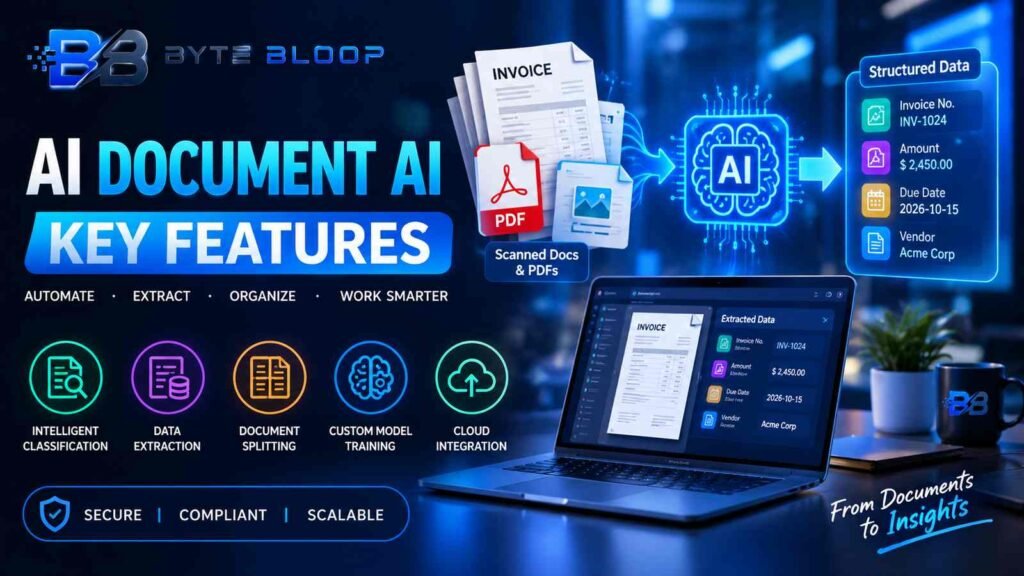
AI Document AI: Key Features
Introduction (Ai Document Ai Key Features)
Ai Document Ai Key Features is a topic worth understanding well. AI Document AI is a cutting‑edge platform that turns messy paper, PDFs, and scanned images into clean, structured data. By applying machine learning models, it can read, classify, and extract information from documents that were once a manual bottleneck. This technology is reshaping how businesses manage contracts, invoices, and legal filings, reducing errors and accelerating decision‑making. The platform offers a suite of processors that can be tailored to specific document types, from receipts to multi‑page reports.
With built‑in security and compliance, enterprises can trust that sensitive data stays protected while gaining instant insights. The result is a smarter, faster workflow that frees staff to focus on higher‑value tasks. Overall, AI Document AI represents a leap forward in digital transformation for document‑heavy industries.
Core Features of AI Document AI
1. Intelligent Document Classification
Document AI can automatically tag documents by type, date, or department. This feature reduces the need for manual sorting and speeds up retrieval. For example, a law firm can tag contracts, court filings, and correspondence in seconds, enabling quick access during discovery.
2. Structured Data Extraction
Using pre‑trained models, the platform pulls key fields—such as invoice numbers, amounts, and due dates—from unstructured text. According to the 2026 playbook, this accuracy can reach 98% for well‑formatted documents, dramatically cutting downstream data entry work.
This matters directly for anyone exploring ai document ai key features.
3. Document Splitting and Page Segmentation
Large PDFs can be divided into individual pages or sections based on content. This is useful for insurance claims where each page contains distinct information that needs separate processing.
4. Custom Model Training
Getting ai document ai key features right can make a real difference.
Developers can fine‑tune models on their own data sets, improving performance on niche document types. This flexibility is highlighted in the AI Document Automation guide, which recommends custom training for regulated industries.
5. Integration with Cloud Workflows
Document AI plugs into existing cloud pipelines, allowing automated routing to downstream services like CRM or ERP systems. This end‑to‑end automation reduces manual handoffs and errors.
That is a core part of understanding ai document ai key features.
Practical Use Cases
Invoice Processing
Accounts payable teams can upload invoices, have the platform extract line items, and push data directly into their ERP. This eliminates double‑entry and speeds up payment cycles.
Legal Document Review
Many readers look into ai document ai key features for exactly this reason.
Law firms use AI Document AI to index thousands of case files, flag key clauses, and generate summaries for attorneys, saving hours of reading.
Healthcare Records Management
Hospitals convert scanned patient charts into structured records, improving data accessibility for research and billing.
It is worth revisiting ai document ai key features as things develop.
Pros and Cons
Pros
- High accuracy reduces manual labor.
- Scalable across millions of documents.
- Secure and compliant with industry standards.
Cons
- Initial setup can be complex for non‑technical teams.
- Custom model training requires labeled data.
Pricing Overview
Pricing is typically usage‑based, with tiers for per‑document processing and enterprise agreements. Companies can start with a free trial to gauge volume before committing to a paid plan.
Ai Document Ai Key Features remains highly relevant here.
Key Takeaways
- Automates classification and extraction of key data
- Supports custom model training for niche documents
- Integrates seamlessly with cloud workflows
- Reduces manual data entry and errors
- Scales to millions of documents
Frequently Asked Questions
What is AI Document AI?
AI Document AI is a platform that uses machine learning to transform unstructured documents into structured, searchable data.
What are the key features of AI Document AI?
Key features include intelligent classification, structured data extraction, document splitting, custom model training, and cloud integration.
What are the best use cases for AI Document AI?
Invoice processing, legal document review, healthcare records management, and any scenario requiring rapid extraction of data from complex documents.
What are the pros and cons of AI Document AI?
Pros: high accuracy, scalability, security. Cons: setup complexity and need for labeled data in custom training.
Conclusion
Based on the available information and industry analysis, AI Document AI provides a powerful, scalable solution that turns chaotic document collections into structured, actionable data, enabling businesses to streamline operations and reduce costly manual work.
Related Reading
- Top AI Tools for Document Analysis in 2026
Sources & References
- Document AI overview
- Document AI — Document AI lets developers create high-accuracy processors to extract unstructured or structured data from documents, classify, and split documents, automating
- Document AI: Techniques, Workflows & Use Cases (2026 …
- AI Document Automation in 2026: Best Tools, Feature …
- Understanding Google Document AI Machine Learning …
Related Articles