AI OCR Tools: Key Features
Introduction (Ai Ocr Tools Key Features)
Ai Ocr Tools Key Features is a topic worth understanding well. Artificial intelligence has reshaped how businesses handle documents. OCR, or optical character recognition, turns images and scans into editable text, and AI enhancements have taken accuracy and speed to new heights. Modern AI OCR tools can process complex layouts, recognize handwriting, and even translate languages in real time. They support a wide range of formats, from PDFs and JPEGs to multi-page forms, making them indispensable for finance, legal, and healthcare sectors.
By automating data capture, these tools reduce manual entry errors and free up staff for higher‑value tasks. They also integrate with existing workflows, feeding data directly into ERP, CRM, or cloud storage systems. As companies push toward digital transformation, understanding the core features of AI OCR solutions becomes critical for selecting the right partner. Below, we break down the most important capabilities and illustrate how they benefit everyday operations.
Core Features of AI OCR Tools
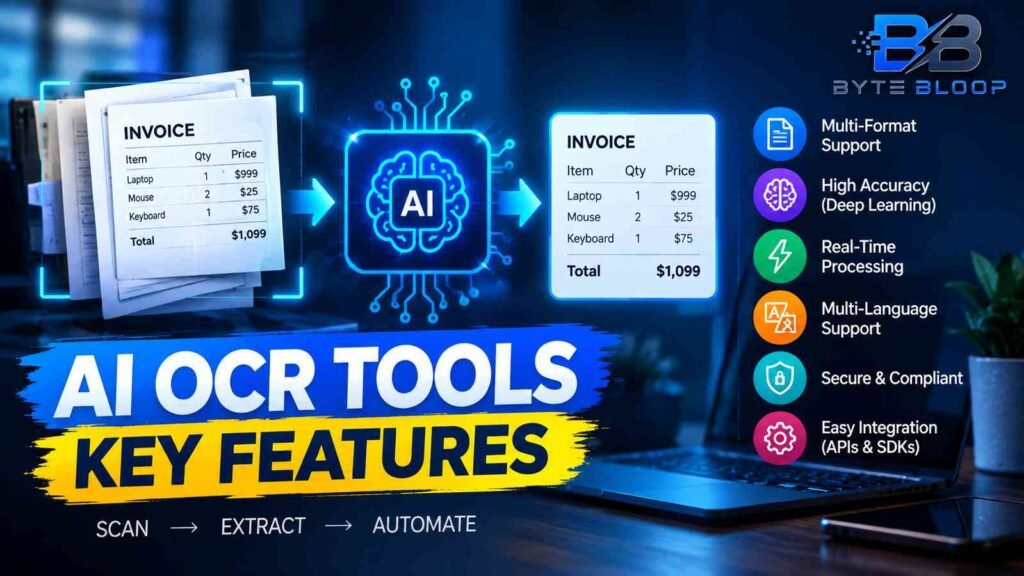
1. Multi‑Format Document Processing—AI OCR systems can read PDFs, TIFFs, JPEGs, and scanned paper. According to the 2026 guide on AI OCR automation, this flexibility is a baseline requirement for enterprise adoption. 2. Neural‑Network‑Based Accuracy—Modern engines use deep learning to achieve near‑human recognition rates, especially on low‑resolution or noisy images. The 2026 best OCR software review highlights neural‑network OCR as a key differentiator. 3. Real‑Time Performance—Real‑time processing allows instant data extraction, essential for high‑volume environments like banks and hospitals.
The OCR data capture article notes enterprise‑grade speed as a core feature. 4. Intelligent Layout Analysis—Tools can detect tables, columns, and multi‑column text, preserving the original structure. This capability reduces post‑processing effort. 5. Language and Script Support—Many solutions cover dozens of languages, including right‑to‑left scripts, and can auto‑detect the language in a document. 6. Integration APIs—RESTful APIs and SDKs enable seamless embedding into custom applications, as highlighted by Google AI’s Document AI offering. 7.
Security and Compliance—Built‑in encryption, role‑based access, and audit trails help meet GDPR, HIPAA, and other regulatory standards. 8. Post‑OCR Editing and Validation—Some platforms provide built‑in editors or validation rules to correct errors before export.
Practical Use Cases
Invoice Processing—AI OCR can extract line items, totals, and vendor data, feeding directly into accounting software. Legal Document Review—Law firms use OCR to index case files, making keyword searches fast and accurate. Healthcare Records—Hospitals digitize patient charts, ensuring that medical histories are searchable and shareable while preserving privacy. Supply Chain—Customs declarations and shipping labels are parsed instantly, accelerating clearance times. Education—Institutions convert exam papers and lecture notes into searchable archives.
This matters directly for anyone exploring ai ocr tools key features.
Choosing the Right Tool
When evaluating AI OCR solutions, consider the following criteria:
- Accuracy on your specific document types
- Supported languages and scripts
- API flexibility and documentation quality
- Compliance certifications and data residency options
- Pricing model—subscription versus per‑page fees
Comparing tools like Abbyy FineReader, Google Cloud Vision, and emerging agents from the 2026 best OCR list can clarify which platform aligns with your workflow.
Getting ai ocr tools key features right can make a real difference.
Pricing Overview
Pricing structures vary widely. Some providers offer tiered monthly plans based on page volume, while others charge per processed page. Enterprise agreements often include dedicated support and custom SLAs. For example, Google’s Document AI offers a pay‑as‑you‑go model, whereas Abbyy FineReader provides a perpetual license with optional cloud add‑ons.
That is a core part of understanding ai ocr tools key features.
Key Takeaways
- AI OCR combines deep learning for near‑human accuracy.
- Real‑time processing boosts productivity in high‑volume settings.
- Multi‑format support eliminates the need for separate tools.
- Secure APIs enable smooth integration into existing workflows.
- Compliance features help meet industry regulations.
Frequently Asked Questions
What is AI OCR and how does it differ from traditional OCR?
AI OCR uses neural networks to recognize characters and layouts with higher accuracy, especially on complex or low‑quality images, whereas traditional OCR relies on rule‑based algorithms.
Many readers look into ai ocr tools key features for exactly this reason.
What are the key features of AI OCR tools?
Key features include multi‑format processing, neural‑network accuracy, real‑time performance, intelligent layout analysis, language support, integration APIs, security compliance, and post‑OCR editing.
It is worth revisiting ai ocr tools key features as things develop.
What are the best use cases for AI OCR tools?
Common use cases are invoice processing, legal document review, healthcare record digitization, supply chain documentation, and educational content indexing.
Ai Ocr Tools Key Features remains highly relevant here.
What are the pros and cons of AI OCR solutions?
Pros: high accuracy, speed, integration ease, and compliance support. Cons: higher upfront cost, learning curve for configuration, and potential dependency on vendor updates.
This is a key consideration when it comes to ai ocr tools key features.
Conclusion
Based on the available information and industry analysis, AI OCR tools provide transformative benefits by converting diverse document types into editable, searchable data with near‑human accuracy. Their real‑time processing and robust integration capabilities enable organizations across finance, legal, healthcare, and supply chain sectors to streamline workflows, reduce manual errors, and comply with regulatory standards. As AI models continue to evolve, these tools will become even more precise, accessible, and indispensable for digital transformation initiatives.
Related Reading
- Top 5 AI Document Management Systems of 2026
Sources & References
- OCR With Google AI — Key features
- Best OCR Software of 2026: Agentic AI vs. Legacy Solutions — Core Features
- OCR Data Capture with Artificial Intelligence
- 5 Best OCR Software Tools in 2026 (Full Demo & Comparison)
- Leveraging OCR and AI Tools: A Comparative Guide to …
- The Guide to AI OCR
- OCR Software: The Ultimate Guide to the Best Tools in 2026
- AI OCR Automation Tools: The Ultimate 2026 Guide to …
Related Articles
- Effective Object-Oriented Programming Explained (2026)
- Best Complete Password manager reviews features tested
- Effective Account Takeover Prevention Explained
- Powerful Audio Editor Reviews Features Tested
This matters directly for anyone exploring ai ocr tools key features.