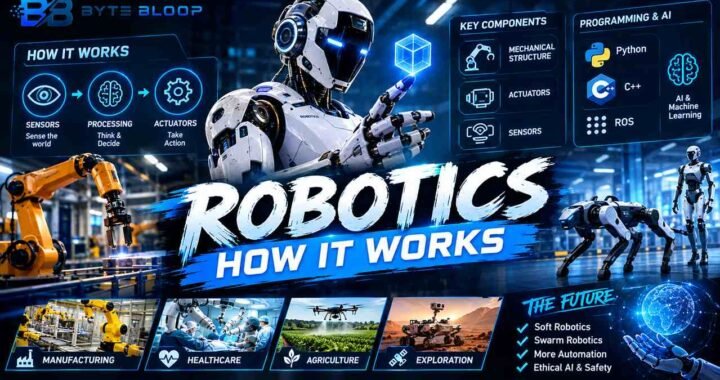
Autonomous Systems: How It Works
Introduction (Autonomous Systems How It Works)
Autonomous Systems How It Works is a topic worth understanding well. Autonomous systems are engineered to operate independently, making decisions and executing actions without continuous human intervention. At their core, these systems blend advanced sensors, real‑time data processing, and machine‑learning algorithms to perceive their environment, plan paths, and adapt to unexpected events. The concept extends from simple household robots to complex vehicles navigating urban streets, and even to industrial robots that assemble products with minimal supervision.
Their growing prevalence reflects a shift toward smarter, more efficient operations across sectors such as logistics, manufacturing, healthcare, and transportation. Understanding how these systems integrate hardware and software layers is essential for anyone interested in the future of automation. In this guide we break down the key components, illustrate practical examples, and discuss the benefits and challenges that accompany widespread deployment of autonomous technology.
Core Architecture of an Autonomous System
Every autonomous system follows a similar architecture: perception, cognition, and action. Sensors such as cameras, LiDAR, radar, and ultrasonic detectors feed raw data into the perception module. This module uses computer‑vision and signal‑processing algorithms to construct a representation of the environment—identifying obstacles, mapping terrain, and tracking dynamic objects.
The cognition layer interprets this representation through machine‑learning models, typically deep neural networks, to make decisions. It evaluates possible actions, predicts outcomes, and selects the most appropriate response based on safety, efficiency, or user preferences. This decision-making process is often guided by reinforcement learning, where the system learns optimal policies through trial and error in simulated or real environments.
This matters directly for anyone exploring autonomous systems how it works.
Finally, the action layer translates decisions into motor commands that drive actuators—wheels, arms, or thrusters—allowing the system to physically interact with the world. Feedback loops between action and perception enable continuous refinement, ensuring the system remains responsive to changing conditions.
Getting autonomous systems how it works right can make a real difference.
Learning and Adaptation
Autonomous systems rely heavily on data‑driven learning. According to the AI Engineering of Autonomous Systems program, training involves large datasets that capture diverse scenarios, enabling models to generalize across varied contexts. Reinforcement learning further enhances adaptability by rewarding desirable behaviors and penalizing failures, allowing systems to improve over time without explicit reprogramming.
That is a core part of understanding autonomous systems how it works.
Retraining is also essential when operating environments evolve. The Future Of Autonomous Systems podcast notes that continuous learning pipelines help maintain performance in the face of new obstacles, regulatory changes, or shifting user expectations.
Many readers look into autonomous systems how it works for exactly this reason.
Real‑World Applications
Self‑Driving Vehicles use a combination of LiDAR, cameras, and radar to navigate roads, detect pedestrians, and obey traffic laws. Autonomous trucks are already reducing delivery times and cutting fuel consumption in logistics.
It is worth revisiting autonomous systems how it works as things develop.
Industrial Automation employs robotic arms that can assemble complex components with precision, often working alongside human operators in collaborative settings.
Autonomous Systems How It Works remains highly relevant here.
Healthcare Robotics assist surgeons with minimally invasive procedures, while autonomous mobile robots deliver medications and supplies within hospitals.
This is a key consideration when it comes to autonomous systems how it works.
Agricultural Drones monitor crop health, apply fertilizers, and harvest produce, increasing yield while reducing labor costs.
This matters directly for anyone exploring autonomous systems how it works.
Benefits and Challenges
Autonomous systems promise higher safety, lower operating costs, and increased productivity. They can perform repetitive or hazardous tasks, freeing humans for higher‑value work. However, challenges remain: ensuring robust perception in adverse weather, addressing cybersecurity risks, and navigating ethical questions around decision ownership.
Getting autonomous systems how it works right can make a real difference.
Regulatory frameworks are still catching up, and public trust hinges on transparent accountability mechanisms. As the technology matures, interdisciplinary collaboration between engineers, ethicists, and policymakers will be crucial.
Key Takeaways
- Sensors + AI create real‑time perception
- Machine learning powers adaptive decision‑making
- Continuous retraining keeps systems current
- Applications span from transport to healthcare
- Safety and ethics remain top concerns
Frequently Asked Questions
What is an autonomous system?
An autonomous system is a machine that can sense its environment, make decisions, and act without continuous human control.
What are the key features of autonomous systems?
Key features include advanced sensing, real‑time data processing, machine‑learning‑based decision making, and actuation for physical interaction.
What are the best use cases for autonomous systems?
Use cases include self‑driving vehicles, industrial automation, healthcare robotics, and precision agriculture.
What are the pros and cons of autonomous systems?
Pros: increased safety, efficiency, and productivity. Cons: high development cost, cybersecurity risks, and ethical/legal challenges.
Conclusion
Based on the available information and industry analysis, autonomous systems represent a transformative convergence of sensing, learning, and actuation that is reshaping industries from transportation to healthcare. Their ability to adapt through continuous learning, coupled with advances in sensor technology, drives both operational efficiency and new business models. Nonetheless, realizing their full potential requires addressing safety, regulatory, and ethical hurdles to build public trust and ensure responsible deployment.
Related Reading
- The Rise of AI in Manufacturing
- Ethical Considerations in Autonomous Driving
Sources & References
- AI Engineering of Autonomous Systems — This English-taught Master’s programme will train you to become an expert in the development of intelligent systems that can learn from data, adapt accordingly
- The Future Of Autonomous Systems — We talk about AI and autonomous systems, the use of robots in our daily lives, the training of systems to mimic the human brain, and the retraining of humans in …
- Robotics and Autonomous Systems | Springer Nature Link — In this chapter, the author analyses the principle, technological elements, and real-life uses of robotics and autonomous systems with special …
- Next-Generation Physical Autonomy: Advancing Intelligent … — Physical autonomous systems integrate artificial intelligence (AI), information processing, sensing and electro-mechanical capability to perceive, decide and …
- Autonomous System – an overview — Autonomous systems, in the context of computer science, refer to systems that have the ability to change their behavior in response to unexpected events …
- Robotics and Autonomous Systems: A 2026 Field Guide — Robotics and autonomous systems combine physical machines with software that senses, plans, acts, and improves performance in the real world.
- Robotics and Autonomous Systems Research — It involves designing intelligent machines that can perform tasks with little or no human help. From self-driving cars to industrial robots and …
Related Articles