Brain‑Computer Interfaces: How It Works
Introduction (Brain-computer Interfaces How It Works)
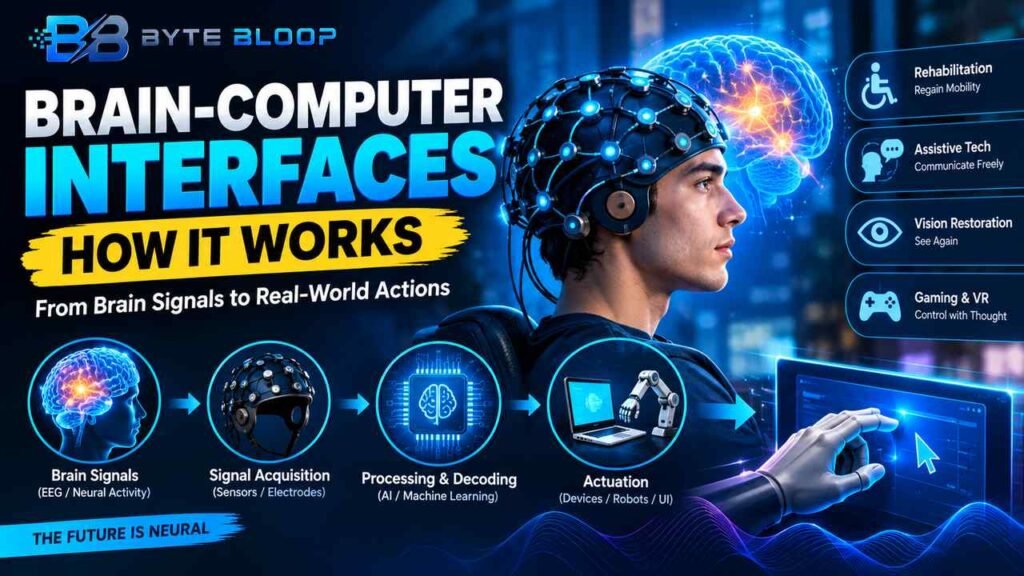
Brain-computer Interfaces How It Works is a topic worth understanding well. Brain‑computer interfaces (BCIs) are emerging as a frontier technology that turns neural signals into commands for computers, robots, or prosthetics. By capturing electrical activity from the cortex, BCIs translate intention into digital output, enabling people to control wheelchairs, type, or even restore vision without moving a muscle. This capability hinges on a closed‑loop system: sensors detect brain waves, algorithms decode intent, and actuators deliver the desired action.
The technology promises to reshape rehabilitation, gaming, and human‑machine collaboration, while raising ethical and safety questions. Recent breakthroughs in implantable retinal chips and wireless neural headsets illustrate the rapid pace of progress. As BCIs move from research labs to commercial products, understanding their mechanics, applications, and limitations becomes essential for developers, clinicians, and curious consumers alike. In this guide we unpack the core components, signal‑processing workflow, and real‑world use cases that define how BCIs work today and what the future may hold.
How the Brain Generates Signals
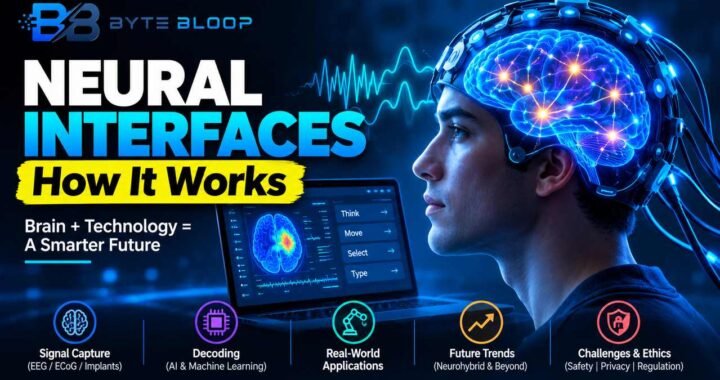
Neurons communicate via tiny voltage changes called action potentials. When a group of neurons fires, electrodes placed on the scalp or inside the brain record a composite electrical pattern known as electroencephalography (EEG) or intracortical activity. These signals are noisy, overlapping, and highly individualized, which is why BCI systems rely on sophisticated filtering and pattern recognition to isolate the user’s intent. According to Brain‑Computer Interfaces: The Technology of Our Future, this raw data is the foundation upon which all decoding algorithms are built.
Signal Acquisition: Invasive vs. Non‑Invasive
BCI hardware falls into two main categories. Non‑invasive systems use surface electrodes, offering safety and ease of deployment but lower spatial resolution. Invasive devices, such as Utah arrays or micro‑electrode implants, penetrate the cortex to capture single‑neuron spikes, delivering high‑bandwidth signals at the cost of surgical risk. The choice depends on the application: consumer gaming favors non‑invasive EEG headsets, while medical prosthetics often require invasive precision.
This matters directly for anyone exploring brain-computer interfaces how it works.
Decoding Algorithms: From Waves to Words
Once signals are captured, they pass through preprocessing stages—band‑pass filtering, artifact removal, and feature extraction. Machine‑learning models then map these features to discrete commands. Early BCIs used linear classifiers like support vector machines, but recent work leverages deep neural networks that can learn complex, non‑linear relationships. The Brain–computer interface: trend, challenges, and threats review highlights how adaptive algorithms that retrain on user data improve accuracy over time.
Getting brain-computer interfaces how it works right can make a real difference.
Actuation: Delivering the Result
The decoded output must be translated into a tangible action. For a cursor on a screen, the system sends a command to a graphical interface; for a robotic limb, it drives servos or motors; for a retinal implant, it stimulates photoreceptors with precise light patterns. The latency between thought and action is a critical metric; state‑of‑the‑art systems achieve sub‑second delays, making real‑time interaction feasible.
That is a core part of understanding brain-computer interfaces how it works.
Real‑World Applications
BCIs are already impacting several fields:
Many readers look into brain-computer interfaces how it works for exactly this reason.
- Rehabilitation: Patients with spinal cord injuries use BCIs to control exoskeletons or wheelchairs, regaining mobility.
- Assistive Technology: Individuals with locked‑in syndrome can communicate by selecting letters on a screen through imagined movements.
- Vision Restoration: Companies like Science have developed retinal implants that stimulate the optic nerve, offering a glimpse of sight to the blind.
- Gaming and Virtual Reality: EEG headsets let players navigate virtual worlds with thought, enhancing immersion.
Challenges and Ethical Considerations
Despite promise, BCIs face hurdles. Signal variability across users, long‑term biocompatibility of implants, and the potential for neural data misuse are significant concerns. The Brain–computer interface: trend, challenges, and threats article outlines regulatory gaps and the need for robust data privacy frameworks.
It is worth revisiting brain-computer interfaces how it works as things develop.
The Road Ahead
Future research aims to increase channel density, reduce power consumption, and develop fully wireless, implantable systems. The convergence of AI, neuromorphic hardware, and advanced materials is expected to bring BCIs from niche medical devices to mainstream consumer products. As these technologies mature, interdisciplinary collaboration among neuroscientists, engineers, ethicists, and policymakers will be crucial to ensure safe, equitable deployment.
Brain-computer Interfaces How It Works remains highly relevant here.
Key Takeaways
- BCIs translate brain signals into digital commands via sensors, decoding algorithms, and actuators.
- Non‑invasive EEG headsets are safe but less precise; invasive implants offer high bandwidth at surgical risk.
- Machine‑learning models, especially deep learning, drive the accuracy of intent decoding.
- Current applications span rehabilitation, assistive tech, vision restoration, and immersive gaming.
- Ethical and regulatory challenges include data privacy, long‑term implant safety, and equitable access.
Frequently Asked Questions
What is a brain‑computer interface?
A brain‑computer interface (BCI) is a system that establishes a direct communication pathway between the brain’s electrical activity and an external device, allowing users to control computers, prosthetics, or other technologies using their thoughts.
This is a key consideration when it comes to brain-computer interfaces how it works.
What are the key components of a BCI system?
The core components include signal acquisition hardware (EEG electrodes or implantable arrays), preprocessing and feature extraction algorithms, machine‑learning decoders that translate neural patterns into commands, and actuators that deliver the intended action.
This matters directly for anyone exploring brain-computer interfaces how it works.
What are the most common applications of BCIs today?
BCIs are used in medical rehabilitation for spinal cord injury patients, assistive communication for individuals with severe motor impairments, vision restoration via retinal implants, and immersive gaming or virtual reality experiences.
Getting brain-computer interfaces how it works right can make a real difference.
What are the main challenges facing BCI technology?
Key challenges include signal variability across users, the invasiveness and biocompatibility of implants, latency and accuracy of decoding, and ethical concerns around data privacy and equitable access.
Conclusion
Based on the available information and industry analysis, brain‑computer interfaces provide a transformative bridge between neural intent and digital action, offering unprecedented opportunities for medical rehabilitation, assistive technology, and human‑machine interaction. Continued advances in signal acquisition, machine‑learning decoding, and biocompatible hardware are poised to expand the reach of BCIs, while thoughtful regulation and ethical oversight will be essential to safeguard user privacy and ensure equitable access.
Related Reading
- The Future of Brain‑Computer Interfaces: Emerging Trends
Sources & References
- Brain-Computer Interfaces: The Technology of Our Future
- The Past, Present And Future Of Brain-Computer Interfaces
Related Articles