Advanced Manufacturing Explained: 10 Technologies, Benefits & Future in 2026
Introduction
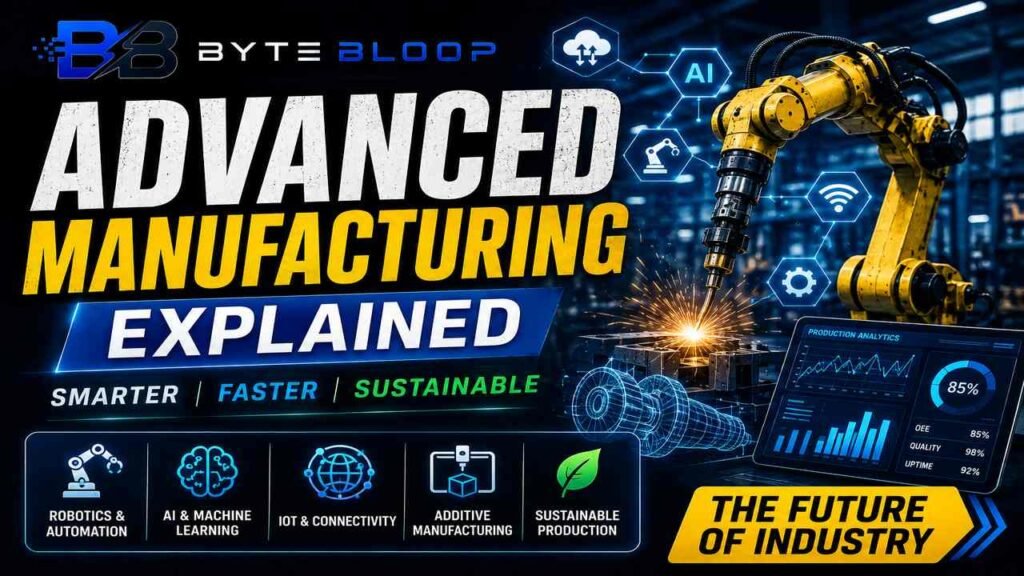
Advanced manufacturing explained in simple terms, it is the use of modern technologies, digital systems, automation, data, and advanced production methods to improve how products are designed, made, inspected, and managed.
Unlike traditional manufacturing workflows that may rely heavily on fixed processes and manual intervention, advanced manufacturing can connect machines, software, sensors, people, and production data. Technologies such as artificial intelligence, robotics, industrial IoT, additive manufacturing, advanced sensors, simulation, and digital twins can work together as part of a connected manufacturing environment. NIST research identifies smart sensors, IoT, AI, machine learning, cloud computing, and digital twins as important components of modern manufacturing digitalization.
Advanced manufacturing is not simply about replacing workers with machines. Modern systems can involve people, software, machines, and automated processes working together. Human oversight can remain important, particularly when systems require validation, quality control, safety decisions, or specialized domain knowledge.
In this advanced manufacturing explained guide, we will cover the major technologies, benefits, industrial applications, challenges, digital twins, cybersecurity, workforce requirements, and future trends shaping modern production.
What Is Advanced Manufacturing?
Advanced manufacturing refers to manufacturing approaches that use modern technologies to improve production, product development, quality, flexibility, efficiency, or decision-making.
The term can cover a wide range of technologies and processes rather than one specific machine or software platform.
Depending on the industry, advanced manufacturing can include:
- Artificial intelligence
- Robotics and automation
- Industrial Internet of Things (IIoT)
- Additive manufacturing
- Advanced sensors
- Digital twins
- Simulation and modeling
- Edge computing
- Data analytics
- Automated inspection
- Advanced materials
- Connected production systems
The exact combination depends on the product, factory, production volume, quality requirements, and business objectives.
How Advanced Manufacturing Works
Advanced manufacturing typically combines physical production systems with digital technologies.
1. Digital Product Design
The process often begins with digital design tools.
Engineers can create and modify products using CAD software, simulation tools, and other digital engineering systems before manufacturing begins.
2. Connected Equipment
Machines, sensors, robots, and production systems can generate operational information.
This information can include measurements related to equipment status, process conditions, production output, or product quality.
3. Data Analysis
Collected data can be processed using analytics, machine learning, or AI systems.
Depending on the application, analytics can help identify trends, detect anomalies, support maintenance decisions, or optimize parts of a manufacturing process.
4. Automated or Assisted Decisions
Some manufacturing systems can respond automatically to defined conditions.
Other systems provide information to human operators or engineers, who then make the final decision.
NIST describes smart manufacturing as involving data-enabled decision-making and analysis at machine and system levels.
5. Continuous Improvement
Production data can also be used to improve future processes.
Manufacturers can compare production results, identify recurring problems, refine process settings, and improve product designs over time.
Core Technologies Driving Advanced Manufacturing
Several technologies form the foundation of modern advanced manufacturing.
Artificial Intelligence and Machine Learning
AI and machine learning can analyze large amounts of manufacturing data.
Potential applications include:
- Predictive maintenance
- Anomaly detection
- Quality inspection
- Process optimization
- Demand forecasting
- Production planning
- Design optimization
AI can support decision-making, but its usefulness depends heavily on data quality, model validation, system integration, and the specific manufacturing problem being addressed.
Robotics and Automation
Industrial robots can perform repetitive or highly precise tasks.
Examples include:
- Assembly
- Welding
- Material handling
- Packaging
- Painting
- Inspection
- Machine tending
Automation can improve consistency and reduce repetitive manual work. However, implementing industrial robotics also requires appropriate programming, safety systems, maintenance, and workforce training.
Industrial Internet of Things
The Industrial Internet of Things, or IIoT, connects industrial equipment, sensors, software, and other devices so operational data can be collected and shared.
A connected production line can provide information about:
- Machine status
- Temperature
- Vibration
- Energy consumption
- Production output
- Equipment performance
- Process conditions
This information can support monitoring and analytics.
Additive Manufacturing
Additive manufacturing, commonly associated with 3D printing, creates parts by adding material layer by layer.
It can be useful for:
- Rapid prototyping
- Customized components
- Complex geometries
- Specialized tooling
- Selected production applications
For a deeper explanation of additive manufacturing, see:
Advanced Sensors
Sensors provide information from machines and production processes.
Depending on the application, sensors can measure:
- Temperature
- Pressure
- Vibration
- Position
- Force
- Speed
- Electrical characteristics
- Environmental conditions
High-quality sensor data can improve monitoring and support automated decision-making.
Edge Computing
Edge computing moves some data processing closer to machines and devices rather than sending every operation to a remote cloud environment.
This can be useful when manufacturing systems need rapid responses, local analysis, or reduced communication latency.
Simulation and Modeling
Simulation allows engineers to evaluate processes digitally before making physical changes.
It can help with:
- Process planning
- Equipment configuration
- Production optimization
- Product design
- Failure analysis
- Capacity planning
Simulation can reduce the need for some physical experimentation, although real-world validation remains important.
Digital Twins in Advanced Manufacturing
Digital twins are becoming an important part of advanced manufacturing.
A digital twin can be understood as a synchronized virtual representation of a physical object, process, or manufacturing system.
NIST describes digital twins as virtual models that can help manufacturers represent, diagnose, predict, and optimize operations.
How Digital Twins Work
A manufacturing digital twin can combine:
- Sensor data
- Machine information
- Simulation models
- Historical production data
- AI or machine learning
- Process information
This allows the digital representation to reflect aspects of the real manufacturing system.
Benefits of Digital Twins
Digital twins may help manufacturers:
- Monitor operations
- Study process behavior
- Identify potential problems
- Test changes virtually
- Support predictive maintenance
- Optimize production
- Improve lifecycle management
However, NIST also highlights challenges involving standards, interoperability, verification, validation, uncertainty, cybersecurity, and workforce readiness.
Digital Twins and Cybersecurity
Digital twins can also be explored for cybersecurity applications.
NIST researchers have demonstrated a digital-twin-based approach for detecting anomalies and cyberattacks in manufacturing environments, including experiments involving a 3D printer.
Benefits of Advanced Manufacturing
Advanced manufacturing can provide several potential benefits.
Improved Productivity
Automation and better process monitoring can help manufacturers improve production workflows.
The actual productivity impact depends on the technology, implementation quality, production environment, and business process.
Better Quality Control
Sensors, machine vision, analytics, and automated inspection can help identify defects and process variations.
This can allow manufacturers to detect problems earlier in the production cycle.
Greater Flexibility
Digital production systems can make it easier to adjust processes for changing products, demand, or production requirements.
Flexible manufacturing can be especially useful when companies produce multiple product variants.
Faster Product Development
Simulation, additive manufacturing, and digital design tools can accelerate parts of product development.
Engineers can test and revise digital designs before committing to more expensive production processes.
Predictive Maintenance
Manufacturers can use sensor data and analytics to monitor equipment conditions.
Instead of relying only on fixed maintenance schedules, predictive approaches can help identify signs of potential equipment problems.
Better Resource Management
Data can help manufacturers monitor energy usage, material consumption, production efficiency, and equipment utilization.
The resulting information can support efforts to reduce waste and improve operational efficiency.
Industry Applications of Advanced Manufacturing
Advanced manufacturing is relevant across many industries.
Automotive Manufacturing
Automotive factories use robotics, automation, machine vision, sensors, simulation, and data analytics in many stages of vehicle production.
Digital technologies can support assembly, inspection, tooling, maintenance, and product development.
Aerospace Manufacturing
Aerospace manufacturing often requires high precision, strict quality control, and detailed validation.
Advanced technologies such as additive manufacturing, simulation, advanced inspection, and digital engineering can support these requirements.
NASA and other aerospace organizations have studied additive manufacturing and digital production technologies for aerospace applications.
Healthcare and Medical Manufacturing
Advanced manufacturing can support the production of medical devices, customized components, laboratory equipment, and other specialized products.
In regulated healthcare environments, manufacturing processes must also meet applicable quality and regulatory requirements.
Electronics Manufacturing
Electronics production relies heavily on automation, robotics, machine vision, precision equipment, and real-time process monitoring.
Advanced manufacturing can help production systems maintain consistency across large numbers of components.
Pharmaceutical Manufacturing
Pharmaceutical manufacturing can use advanced automation, process monitoring, data systems, and specialized manufacturing technologies.
Because pharmaceutical production is highly regulated, digital systems must be implemented alongside appropriate quality and compliance procedures.
Consumer Products
Manufacturers of consumer products can use digital design, robotics, automation, connected equipment, and rapid prototyping to develop and produce products more efficiently.
Advanced Manufacturing and Sustainability
Sustainability is becoming an important consideration in manufacturing.
Advanced technologies can help organizations measure and manage:
- Energy consumption
- Material usage
- Waste
- Equipment efficiency
- Production losses
- Product lifecycle data
Digital design can also support lightweight products and optimized material usage.
However, using an advanced technology does not automatically make a manufacturing process sustainable. The overall environmental impact depends on materials, energy sources, transportation, equipment efficiency, product lifetime, and end-of-life handling.
Circular Manufacturing
Circular manufacturing focuses on keeping materials and products in use for longer.
Design decisions can consider:
- Repairability
- Reuse
- Recycling
- Disassembly
- Material recovery
- Product lifecycle
Digital manufacturing systems can provide additional data that helps organizations understand product and process lifecycles.
Challenges of Advanced Manufacturing
Advanced manufacturing also introduces significant challenges.
High Initial Investment
Robotics, sensors, industrial software, advanced machinery, and connected infrastructure can require substantial investment.
Smaller businesses may find the initial cost difficult to justify without a clear business case.
Skills Gap
Modern manufacturing requires workers who understand areas such as:
- Automation
- Data analysis
- Software
- Robotics
- Industrial networking
- Cybersecurity
- Engineering
- Equipment maintenance
Workforce development and training can therefore be important parts of digital transformation.
Cybersecurity Risks
Greater connectivity can increase the number of systems and devices that need to be protected.
NIST notes that smart manufacturing systems face cybersecurity challenges associated with increased connectivity, wireless networks, sensors, and IT integration.
Manufacturers should therefore consider:
- Device authentication
- Network security
- Access controls
- Secure updates
- Monitoring
- Incident response
- Data protection
Integration With Legacy Equipment
Factories often contain older machinery that was not designed for modern connected systems.
Connecting legacy equipment with modern platforms can require additional hardware, software, protocols, or gateways.
Interoperability
Different machines and software systems may use different data formats, communication methods, and interfaces.
NIST identifies interoperability as one of the important challenges in digital-twin and advanced manufacturing environments.
Data Quality
AI and analytics are only as useful as the data supporting them.
Missing, duplicated, inaccurate, or poorly structured data can lead to unreliable analysis.
Validation and Trust
Manufacturers need confidence that digital systems and models are representing real processes accurately.
NIST research highlights the importance of verification, validation, and uncertainty quantification for trustworthy digital twins.
Workforce and Human Skills
Advanced manufacturing does not remove the need for human expertise.
Workers can remain responsible for:
- System configuration
- Equipment maintenance
- Quality assurance
- Engineering decisions
- Safety
- Process validation
- Troubleshooting
- Production management
As manufacturing systems become more digital, workers may need a broader combination of mechanical, electrical, software, data, and automation skills.
NIST’s 2026 digital-twin workshop report also identifies workforce readiness as one of the ongoing considerations for broader adoption of trustworthy digital manufacturing systems.
Advanced Manufacturing vs Traditional Manufacturing
Traditional and advanced manufacturing are not necessarily completely separate approaches.
Many factories use a combination of both.
Traditional manufacturing remains valuable for established production methods such as:
- Machining
- Casting
- Forging
- Injection molding
- Stamping
- Conventional assembly
Advanced manufacturing adds newer capabilities such as:
- Robotics
- AI
- IoT
- Digital twins
- Advanced analytics
- Additive manufacturing
- Automated inspection
The best manufacturing approach depends on the product, materials, production volume, cost, quality requirements, and manufacturing environment.
How Companies Can Adopt Advanced Manufacturing
Companies do not always need to transform an entire factory at once.
A practical approach can begin with one clearly defined problem.
Step 1: Identify a Business Problem
Examples include:
- High machine downtime
- Production defects
- Slow inspection
- Excessive material waste
- Manual data entry
- Difficult maintenance planning
Step 2: Measure the Current Process
Collect baseline data before introducing new technology.
This provides a way to compare results later.
Step 3: Choose the Right Technology
Not every problem requires AI or robotics.
A simple sensor, dashboard, software integration, or process change may deliver more value than a complicated system.
Step 4: Start With a Pilot
Test the technology on a limited production line or process.
A pilot can reveal technical, operational, and workforce issues before a wider rollout.
Step 5: Validate the Results
Compare the pilot results against the original goals.
Check:
- Productivity
- Quality
- Costs
- Downtime
- Safety
- Data accuracy
- Worker feedback
Step 6: Scale Carefully
Once the technology is validated, it can be expanded to additional machines, processes, or facilities where appropriate.
Future of Advanced Manufacturing
The future of advanced manufacturing is likely to involve deeper integration between physical production and digital systems.
AI-Driven Production
AI may increasingly support production planning, quality inspection, anomaly detection, design optimization, and maintenance.
However, reliable deployment will require strong data, appropriate testing, and human oversight.
More Capable Digital Twins
Digital twins are expected to remain an important area of manufacturing research and development.
NIST’s current work focuses on making manufacturing digital twins more reliable, interoperable, and trustworthy.
Edge AI
AI processing closer to machines can support applications that require local analysis and rapid responses.
Advanced Materials
New materials and material-processing techniques can expand what manufacturers are able to produce.
Greater Automation
Automation is likely to expand across inspection, material handling, assembly, maintenance, and production monitoring.
Stronger Cybersecurity
As factories become increasingly connected, protecting industrial systems will remain important.
Human-in-the-Loop Systems
Future manufacturing systems are likely to combine automated decision support with human expertise rather than relying exclusively on autonomous operation. NIST research explicitly explores architectures that combine AI with human cognition in smart manufacturing.
Advanced Manufacturing in 2026
Advanced manufacturing in 2026 is increasingly centered on connected production systems rather than isolated technologies.
AI, IIoT, robotics, additive manufacturing, simulation, and digital twins can work together to create manufacturing environments where data moves between design, production, inspection, and maintenance.
At the same time, current research highlights that technology adoption is still constrained by interoperability, cybersecurity, validation, standards, workforce readiness, and implementation complexity.
This means manufacturers should evaluate technologies based on specific business and engineering requirements rather than adopting a tool simply because it is described as “AI-powered” or “smart.”
Key Takeaways
- Advanced manufacturing combines modern digital technologies with physical production.
- AI, robotics, IIoT, additive manufacturing, sensors, simulation, and digital twins are important technologies in the field.
- Data can support better monitoring, maintenance, quality control, and production decisions.
- Digital twins can help represent, diagnose, predict, and optimize manufacturing operations.
- Advanced manufacturing can improve flexibility and support rapid product development.
- Cybersecurity becomes increasingly important as factories become more connected.
- Interoperability, data quality, workforce skills, and system validation remain significant challenges.
- Human expertise continues to be important even in highly automated environments.
- Companies can adopt advanced manufacturing gradually through targeted pilot projects.
- The future will likely involve more connected, automated, data-driven, and AI-assisted manufacturing systems.
Frequently Asked Questions
What is advanced manufacturing?
Advanced manufacturing is the use of modern technologies, digital systems, automation, data, and advanced production methods to improve manufacturing processes and products.
What are the main technologies used in advanced manufacturing?
Common technologies include artificial intelligence, robotics, industrial IoT, additive manufacturing, sensors, simulation, edge computing, digital twins, and advanced analytics.
What is smart manufacturing?
Smart manufacturing is a connected approach to manufacturing in which machines, systems, data, and people can work together to support monitoring, analysis, and decision-making.
What is a digital twin in manufacturing?
A digital twin is a virtual representation of a physical manufacturing object, process, or system that can use data to support monitoring, analysis, prediction, or optimization.
How does AI help advanced manufacturing?
AI can support predictive maintenance, anomaly detection, quality inspection, production analysis, design optimization, and other data-intensive manufacturing tasks.
Is 3D printing part of advanced manufacturing?
Yes. Additive manufacturing, commonly known as 3D printing, is one of the technologies used within advanced manufacturing.
What are the benefits of advanced manufacturing?
Potential benefits include improved productivity, quality control, flexibility, process visibility, rapid prototyping, predictive maintenance, and better use of manufacturing data.
What are the disadvantages of advanced manufacturing?
Challenges can include high initial costs, workforce requirements, cybersecurity risks, legacy-system integration, interoperability problems, data quality issues, and implementation complexity.
Is advanced manufacturing only for large companies?
No. Smaller manufacturers can adopt advanced technologies as well, but the appropriate solution depends on the company’s budget, processes, equipment, workforce, and business goals.
Does advanced manufacturing replace workers?
Not necessarily. Advanced manufacturing can automate specific tasks while creating new requirements for engineering, programming, maintenance, quality, data, and system management.
What is IIoT in manufacturing?
IIoT stands for Industrial Internet of Things. It refers to connected industrial devices, machines, sensors, and systems that collect and exchange operational data.
What is predictive maintenance?
Predictive maintenance uses equipment data and analysis to identify signs of potential problems so maintenance can be planned based on actual equipment conditions.
Why is cybersecurity important in advanced manufacturing?
Connected industrial systems can create additional security risks and attack surfaces. Manufacturing cybersecurity therefore needs to protect devices, networks, software, data, and industrial operations.
What is edge computing in manufacturing?
Edge computing processes some data closer to machines or production equipment instead of relying entirely on a remote cloud system.
How can a company start using advanced manufacturing?
A company can begin by identifying a specific production problem, collecting baseline data, choosing a suitable technology, testing it through a pilot, validating results, and then scaling the solution where it provides measurable value.
Conclusion
Advanced manufacturing explained simply is the combination of modern production methods with digital technologies that improve how products are designed, manufactured, inspected, and managed.
AI, robotics, industrial IoT, additive manufacturing, advanced sensors, simulation, and digital twins can provide manufacturers with better visibility into their operations and create new ways to improve processes.
At the same time, advanced manufacturing is not simply about buying more technology. Successful implementation depends on data quality, interoperability, cybersecurity, workforce skills, system validation, and a clear business objective. NIST’s current research into digital twins and smart manufacturing highlights many of these technical and organizational challenges.
For manufacturers, the practical approach is to identify specific problems, test suitable technologies, measure the results, and expand successful solutions gradually.
As manufacturing becomes more connected and data-driven, advanced manufacturing is likely to remain an important part of product development, industrial automation, and modern production.
Related Reading
3D Printing Explained: How It Works, Types, Uses and Benefits
https://bytebloop.com/3d-printing-explained/
ByteBloop Software Guides
https://bytebloop.com/category/software/
ByteBloop AI Guides
https://bytebloop.com/category/ai/
Sources & References
NIST — Digital Twins for Advanced Manufacturing
https://www.nist.gov/programs-projects/digital-twins-advanced-manufacturing
NIST — Manufacturing Digital Twin Standards
https://www.nist.gov/publications/manufacturing-digital-twin-standards
NIST — Cybersecurity for Smart Manufacturing Systems
https://www.nist.gov/programs-projects/cybersecurity-smart-manufacturing-systems
NIST — Digital Twin-Based Cyber-Attack Detection Framework
https://www.nist.gov/publications/digital-twin-based-cyber-attack-detection-framework-cyber-physical-manufacturing
NIST — Digital Twins Workshops Summary Report 2026
https://www.nist.gov/publications/digital-twins-workshops-summary-report
NIST — Credibility Consideration for Digital Twins in Manufacturing
https://www.nist.gov/publications/credibility-consideration-digital-twins-manufacturing