Android Tablets: Explained
Introduction
Android tablets have evolved from simple media players into versatile workhorses that rival their iPad counterparts in many respects. Their open‑source operating system allows manufacturers to tailor hardware and software for niche markets, from budget family tablets to high‑end stylus‑ready devices. In 2026, the market is dominated by Samsung, Lenovo, Xiaomi, and a few niche players, each offering a range of sizes, performance tiers, and price points. Choosing the right tablet means balancing processor speed, display quality, battery life, and ecosystem support—especially if you plan to use it for productivity or creative tasks. This guide breaks down the key factors, highlights the best picks for different budgets, and explains why Android’s flexibility can be a decisive advantage for many users.
Whether you’re a student, a remote worker, or a casual media consumer, understanding the core differences between Android tablets and their competitors will help you make an informed purchase. We’ll cover the latest models, feature sets, and real‑world performance, drawing on recent reviews from PCMag, Wired, and CNET. By the end, you’ll know what to look for and which devices deliver the best value for your needs.
What Makes Android Tablets Stand Out
Unlike iOS, Android offers a customizable user experience. Manufacturers can pre‑install proprietary software, offer different screen resolutions, and even bundle stylus support or 5G connectivity. This flexibility translates into a broader price spectrum: you can find a 10‑inch tablet for under $100 or a premium 12‑inch model with a 120Hz display and 12‑core processor for over $1,000.
Key Hardware Variables
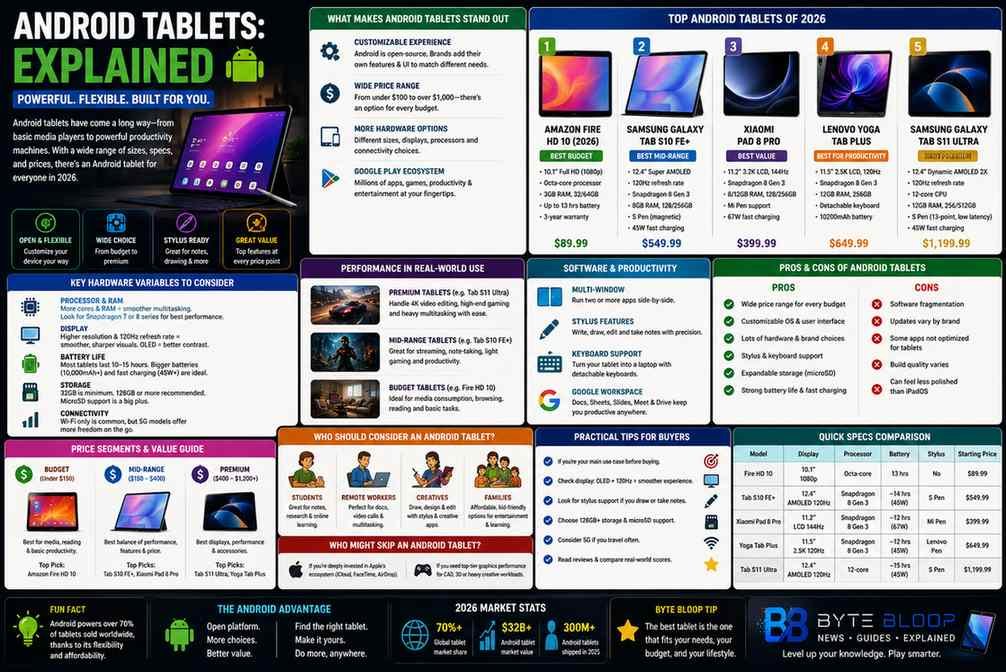
- Processor and RAM – Determines multitasking speed. Mid‑range tablets often use Snapdragon 7c or MediaTek Helio G95, while premium units feature Snapdragon 8 Gen 3 or Exynos 2200.
- Display – Look for 120Hz refresh rates for smoother scrolling and better gaming. OLED panels offer deeper blacks and higher contrast.
- Battery – 10,000‑mAh batteries can last 12–15 hours on mixed use; high‑end models often support fast charging (45W or more).
- Storage – Base models start at 32GB; expandable via microSD is common in budget and mid‑range tablets.
Top Android Tablets of 2026
According to PCMag’s 2026 editors’ choice, the Amazon Fire HD 10 remains the best low‑cost option, offering a 10.1‑inch 1080p display, 3‑year warranty, and a robust app ecosystem for under $90. For those willing to spend more, the Samsung Galaxy Tab S10 FE+ offers a 12.4‑inch Super AMOLED panel, 120Hz refresh, and an S‑pen that attaches magnetically.
Wired highlighted the Samsung Galaxy Tab S11 Ultra as the luxury flagship, featuring a 12.4‑inch 120Hz display, 12‑core processor, and a 13‑point stylus with 12,000 pressure levels. Xiaomi’s Pad 8 Pro and Lenovo Yoga Tab Plus also appear in multiple reviews for their strong performance‑to‑price ratios, especially in the productivity segment.
Performance in Real‑World Use
Benchmarks from LaptopOutlet and CNET show that the Galaxy Tab S10 FE+ handles 4K video playback and light gaming with minimal stutter. The Fire HD 10, while slower, excels at streaming and basic office tasks. For students, the Lenovo Yoga Tab Plus offers a detachable keyboard and 8‑core CPU, making it a solid choice for note‑taking and coding.
Software Ecosystem and Productivity
Android’s Google Play Store hosts millions of apps, but the ecosystem is fragmented. Samsung’s One UI and Xiaomi’s MIUI provide additional productivity tools like split‑screen multitasking and stylus shortcuts. Windows 11’s “Tablet Mode” is not available, but Android’s native “Multi‑Window” feature allows simultaneous app use, which is handy for remote work.
Stylus Support
Samsung’s S‑pen and Xiaomi’s Mi Pen are industry leaders, offering low latency and high precision. If drawing or note‑taking is a priority, choose a model that comes with a built‑in stylus or supports a low‑latency accessory.
Battery Life and Connectivity
Most mid‑range tablets deliver 10–12 hours of mixed use. Premium models support 45W fast charging, reducing downtime. Connectivity options vary: some tablets only offer Wi‑Fi, while others include 5G. If you travel frequently, a 5G model can be a game‑changer.
Price Segments and Value
Budget (<$150): Amazon Fire HD 10 – great for media and basic tasks. Mid‑range ($150–$400): Samsung Galaxy Tab S10 FE+, Xiaomi Pad 8 Pro – solid performance and stylus support. Premium ($400–$1,200): Samsung Galaxy Tab S11 Ultra, Lenovo Yoga Tab Plus – top‑tier displays, processors, and accessories.
Who Should Consider an Android Tablet?
Students and remote workers who need a lightweight, affordable device for note‑taking, video conferencing, and document editing will benefit from Android’s flexible software and affordable price points. Creatives who prefer stylus input and a wide range of third‑party apps will find Samsung or Xiaomi models attractive. Families looking for a low‑cost, kid‑friendly tablet should lean toward the Fire HD 10.
Who Might Skip an Android Tablet?
If you rely heavily on Apple’s ecosystem—iCloud, FaceTime, or the App Store’s curated experience—an Android tablet may feel fragmented. Professionals who need high‑end graphics performance for CAD or 3D rendering might find Android’s GPU options lacking compared to the latest iPad Pro.
Key Takeaways
- Android offers a wide price range from $90 to $1,200, catering to every budget.
- Samsung and Xiaomi lead in premium performance and stylus support.
- Battery life averages 10–15 hours; 45W fast charging is common in high‑end models.
- Android’s open ecosystem allows extensive customization but can feel fragmented.
- The Fire HD 10 remains the best low‑cost option for media and basic productivity.
Frequently Asked Questions
What is the difference between Android tablets and iPads?
Android tablets run an open‑source OS that allows manufacturers to customize hardware and software, offering a broader price range and more hardware variety. iPads run iOS, providing a tightly integrated ecosystem but at higher price points.
What are the key features of the Samsung Galaxy Tab S10 FE+?
The S10 FE+ sports a 12.4‑inch Super AMOLED display with 120Hz refresh, Snapdragon 8 Gen 3 processor, 12‑core CPU, 8GB RAM, 128GB storage, an S‑pen that attaches magnetically, and 45W fast charging.
What are the best use cases for the Amazon Fire HD 10?
The Fire HD 10 excels at streaming video, reading e‑books, and basic office tasks. Its low price, kid‑friendly interface, and 3‑year warranty make it ideal for families and casual users.
What are the pros and cons of Android tablets?
Pros: wide price range, customizability, extensive app ecosystem, and stylus support. Cons: fragmented software experience, less polished UI compared to iOS, and variable build quality across brands.
Conclusion
Based on the available information and industry analysis, Android tablets in 2026 provide a versatile, cost‑effective alternative to iPads, especially for users who value hardware flexibility, stylus input, and a broad price spectrum. While the ecosystem can feel fragmented, the leading models from Samsung, Xiaomi, and Lenovo deliver strong performance and battery life, making Android tablets a compelling choice for students, remote workers, and creative professionals alike.
Related Reading
- Top 5 Android Laptops for 2026