Asset Allocation: Explained
Introduction
Asset allocation is the cornerstone of any disciplined investment strategy. It involves dividing a portfolio among broad asset categories—such as equities, fixed income, and cash equivalents—to manage risk while pursuing returns. By spreading exposure across assets that behave differently under varying market conditions, investors can smooth out volatility and protect against sharp downturns. The goal is to match the portfolio’s risk profile to the investor’s objectives, time horizon, and comfort level with uncertainty. A well‑structured allocation also simplifies rebalancing, ensuring that the portfolio stays aligned with long‑term goals. In practice, asset allocation is less about picking individual stocks or bonds and more about choosing the right mix of asset classes and adjusting that mix as life circumstances change. This article walks through the core principles, practical steps, and common pitfalls so you can design a strategy that works for you.
Why Asset Allocation Matters
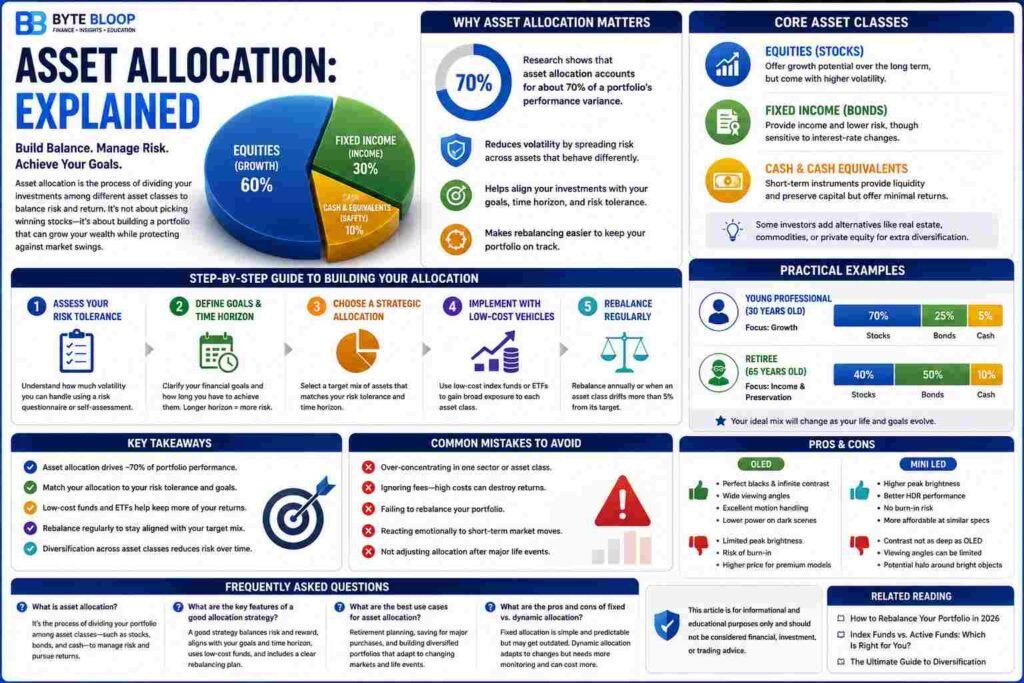
Research shows that the choice of asset mix accounts for about 70% of a portfolio’s performance variance, while individual security selection explains only a fraction. That means a solid allocation can outperform a portfolio that relies on picking winners. Moreover, as you age or your financial goals shift, the appropriate mix changes—retirees, for example, typically tilt toward bonds for income and stability, whereas young investors may favor equities for growth.
Core Asset Classes
The traditional framework divides assets into three buckets:
- Equities – Stocks offer growth potential but come with higher volatility.
- Fixed Income – Bonds provide income and lower risk, though they can be sensitive to interest‑rate movements.
- Cash & Cash Equivalents – Short‑term instruments give liquidity and preserve capital, but offer minimal returns.
Some investors add alternative assets—real estate, commodities, or private equity—to diversify further, but the fundamentals remain the same: balance risk and return across categories.
Step‑by‑Step Guide to Building Your Allocation
1. Assess Your Risk Tolerance
Start by answering how much volatility you can stomach. Tools like risk‑profile questionnaires or simple self‑assessment can help quantify your comfort level. A higher tolerance generally leads to a larger equity share, while a lower tolerance favors bonds and cash.
2. Define Goals and Time Horizon
Identify what you’re saving for—retirement, a down payment, or a child’s education—and how long you have to grow those funds. Longer horizons can accommodate more risk, whereas short‑term goals require stability.
3. Choose a Strategic Allocation
Based on risk and horizon, pick a target mix. For example, a 60/30/10 split (stocks/bonds/cash) is common for mid‑career investors. Adjust the percentages to reflect personal circumstances.
4. Implement Through Low‑Cost Vehicles
Use index funds or ETFs to gain broad exposure to each asset class. Low expense ratios preserve returns over time. For instance, a total stock market ETF, a broad bond fund, and a money‑market fund can form a simple core.
5. Rebalance Regularly
Market movements can skew your allocation. Rebalancing—selling over‑grown assets and buying under‑represented ones—keeps the portfolio on track. A rule of thumb is to rebalance annually or when a class deviates by more than 5% from its target.
Practical Examples
Consider two scenarios:
- Young Professional (30 years old) – 70% stocks, 25% bonds, 5% cash. The heavy equity tilt seeks growth, with bonds providing a safety net.
- Retiree (65 years old) – 40% stocks, 50% bonds, 10% cash. The allocation prioritizes income and capital preservation.
Both portfolios follow the same logic: align the mix with life stage and risk appetite.
Common Mistakes to Avoid
Many investors fall into pitfalls that erode returns:
- Over‑concentration in a single sector or geography.
- Ignoring the impact of fees, which can erode gains over decades.
- Failing to adjust the mix after major life events—marriage, a new job, or a market crash.
Sticking to a disciplined, research‑backed framework mitigates these errors.
Key Takeaways
- Asset allocation shapes 70% of portfolio performance variance.
- Risk tolerance and time horizon guide the equity‑bond‑cash split.
- Low‑cost index funds simplify implementation and reduce drag.
- Regular rebalancing keeps the portfolio aligned with goals.
- Avoid concentration and high fees to protect long‑term gains.
Frequently Asked Questions
What is asset allocation?
Asset allocation is the process of dividing an investment portfolio among broad asset categories—such as equities, bonds, and cash—to manage risk and pursue returns based on an investor’s goals and risk tolerance.
What are the key features of a good allocation strategy?
A sound strategy balances risk and reward, aligns with time horizon and risk appetite, uses low‑cost vehicles, and includes a clear rebalancing plan to maintain target proportions.
What are the best use cases for asset allocation?
Asset allocation is essential for retirement planning, saving for major purchases, and building a diversified investment base that can adapt to changing market conditions and personal life events.
What are the pros and cons of a fixed allocation versus a dynamic one?
A fixed allocation offers simplicity and predictability, but may miss opportunities or expose you to outdated risk levels. A dynamic allocation adjusts to market shifts and life changes, but requires more monitoring and can incur higher transaction costs.
Conclusion
Based on the available information and industry analysis, asset allocation remains the most powerful tool for managing investment risk and achieving long‑term returns. By systematically dividing portfolios among equities, bonds, and cash—and adjusting for personal circumstances—investors can align their strategies with goals while minimizing volatility. Regular reviews and disciplined rebalancing further enhance performance, ensuring that the portfolio stays on course as markets and life evolve.
Related Reading
- How to Rebalance Your Portfolio in 2026
This article is for informational and educational purposes only and should not be considered financial, investment, or trading advice.
This article is for informational and educational purposes only and should not be considered financial, investment, or trading advice.