OLED vs Mini LED: Key Differences
Introduction
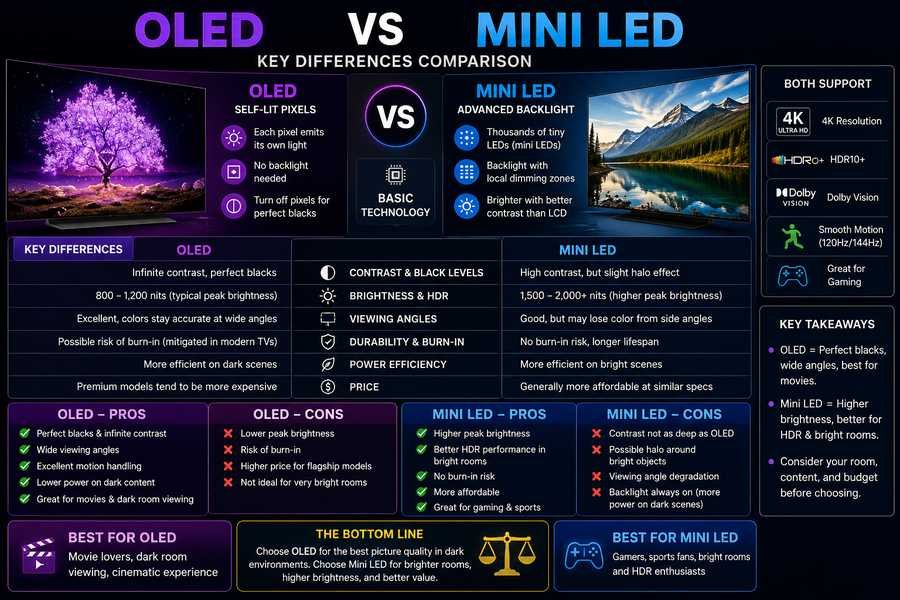
When it comes to choosing a new TV, the debate between OLED and Mini LED has become the most common question among tech enthusiasts and casual viewers alike. Both technologies promise stunning picture quality, but they differ fundamentally in how light is produced and controlled. OLED panels use organic compounds that emit light when an electric current passes through them, allowing each pixel to light up individually. Mini LED, on the other hand, is an LCD‑based system that replaces traditional LEDs with thousands of smaller diodes to create a more precise backlight. This difference translates into distinct strengths and weaknesses in brightness, contrast, color accuracy, and viewing angles.
Understanding these core distinctions is essential because the right choice depends on your viewing environment, content preferences, and budget. While OLED offers unrivaled black levels and wide viewing angles, Mini LED can deliver higher peak brightness and better HDR performance, especially in brightly lit rooms. The following sections break down each technology, compare their key features, and help you decide which display is best for your setup.
OLED Technology
OLED, or Organic Light‑Emitting Diode, is a self‑lit display. Each pixel contains organic molecules that produce light when energized, eliminating the need for a separate backlight. This architecture yields perfect blacks—pixels can be turned off entirely—resulting in a contrast ratio that feels almost cinematic. OLED panels also boast extremely wide viewing angles; color and luminance remain consistent even when you sit off‑center.
Because each pixel is independent, OLED can render motion with minimal ghosting. However, the same self‑lit nature limits maximum brightness; most OLED TVs peak around 800–1,200 nits, which can be insufficient for HDR content in very bright rooms. Additionally, OLED panels are susceptible to burn‑in over prolonged static image display, though modern models mitigate this with pixel‑shift and screen‑saver features.
Mini LED Technology
Mini LED is an evolution of traditional LCD. The key innovation is the use of thousands of tiny LEDs—often 10–20 microns in diameter—clustered into hundreds of zones. This dense zoning allows the backlight to be dimmed with fine granularity, producing deeper blacks than standard LCDs while still maintaining high peak brightness, often exceeding 1,500–2,000 nits.
Mini LED panels typically pair a blue LED backlight with quantum‑dot color converters to generate the full color spectrum. The result is vibrant hues and improved color volume, especially in HDR scenes. However, because the backlight still exists, contrast ratios are not as extreme as OLED, and viewing angles can suffer if the LED distribution is uneven.
Key Differences
Contrast and Black Levels
OLED outperforms Mini LED in true black depth. Pixels can be turned off entirely, delivering infinite contrast. Mini LED achieves near‑black levels through local dimming but still has a slight halo effect around bright objects.
Brightness and HDR
Mini LED’s dense backlight allows higher peak brightness, which is crucial for HDR10+ and Dolby Vision content. OLED’s brightness ceiling limits HDR performance in very bright viewing conditions.
Color Accuracy and Viewing Angles
OLED maintains color fidelity across wide angles, making it ideal for large living rooms with multiple seats. Mini LED can exhibit color shift when viewed from the side, depending on the panel’s design.
Durability and Burn‑In
OLED panels risk burn‑in from static UI elements, though modern mitigation reduces the risk. Mini LED, being an LCD, is immune to burn‑in and generally has a longer lifespan.
Energy Efficiency
OLED can be more power‑efficient when displaying dark content because black pixels consume no power. Mini LED uses a constant backlight, so power consumption is higher for dark scenes but can be lower for bright content due to better efficiency at high luminance.
Performance/Features Comparison
When you look at flagship models, OLED TVs such as the LG G2 series deliver exceptional color accuracy, local dimming, and a buttery‑smooth motion. Mini LED examples like Samsung’s QN90B or LG’s QNED evo show superior peak brightness and HDR peak, making them excellent for bright rooms and gaming.
Both technologies support 4K resolution, HDR10+, and Dolby Vision, but Mini LED’s higher brightness gives it an edge in HDR10+ peak performance. OLED’s superior contrast, however, shines in dark‑room cinema experiences.
Pros and Cons
OLED Pros
- Infinite contrast and perfect blacks
- Wide viewing angles
- Excellent motion handling
- Lower power usage on dark scenes
OLED Cons
- Limited peak brightness
- Risk of burn‑in
- Higher price for high‑end models
Mini LED Pros
- Higher peak brightness for HDR
- Better color volume with quantum dots
- No burn‑in risk
- Generally more affordable than OLED at similar specs
Mini LED Cons
- Contrast ratio lower than OLED
- Potential viewing angle degradation
- Backlight halo around bright objects
Which One Should You Choose?
If your primary use is cinematic watching in a dark room, OLED’s unmatched contrast and color depth make it the clear winner. For gamers or HDR enthusiasts who need peak brightness and a wide color gamut in a bright living space, Mini LED offers a compelling alternative. Ultimately, consider your room lighting, content type, and budget when deciding.
Key Takeaways
- OLED delivers perfect blacks and wide viewing angles, ideal for dark‑room cinema.
- Mini LED offers higher peak brightness and better HDR performance in bright rooms.
- OLED can suffer from burn‑in; Mini LED is immune to this issue.
- Both technologies support 4K, HDR10+, and Dolby Vision, but brightness and contrast differ.
- Choosing depends on viewing environment, content preference, and budget.
Frequently Asked Questions
What is the main difference between OLED and Mini LED panels?
OLED panels are self‑lit, allowing each pixel to emit light independently, while Mini LED panels use thousands of tiny LEDs to create a precise backlight for an LCD display.
Which technology provides better HDR performance?
Mini LED typically offers higher peak brightness, which enhances HDR10+ and Dolby Vision performance, especially in bright rooms.
Are OLED panels susceptible to burn‑in?
Yes, OLED panels can experience burn‑in from static images over time, but modern models include pixel‑shift and screen‑saver features to mitigate the risk.
How do viewing angles compare?
OLED displays maintain color and luminance across wide angles, whereas Mini LED viewing angles can degrade if the LED distribution is uneven.
Is Mini LED more energy‑efficient than OLED?
Mini LED consumes more power for dark scenes due to its constant backlight, but can be more efficient for bright content; OLED uses less power when displaying dark images.
Conclusion
Based on the available information and industry analysis, OLED and Mini LED each bring distinct advantages: OLED excels in contrast and viewing angles, making it ideal for cinematic experiences, while Mini LED delivers higher brightness and HDR performance suited to bright rooms and gaming. Choosing between them hinges on your viewing environment, content preferences, and budget. By weighing these key differences, you can select a TV that best matches your lifestyle and viewing habits.
Related Reading
- Top 5 OLED TVs of 2026
- Mini LED vs. QLED: Which Is Better for Gaming?