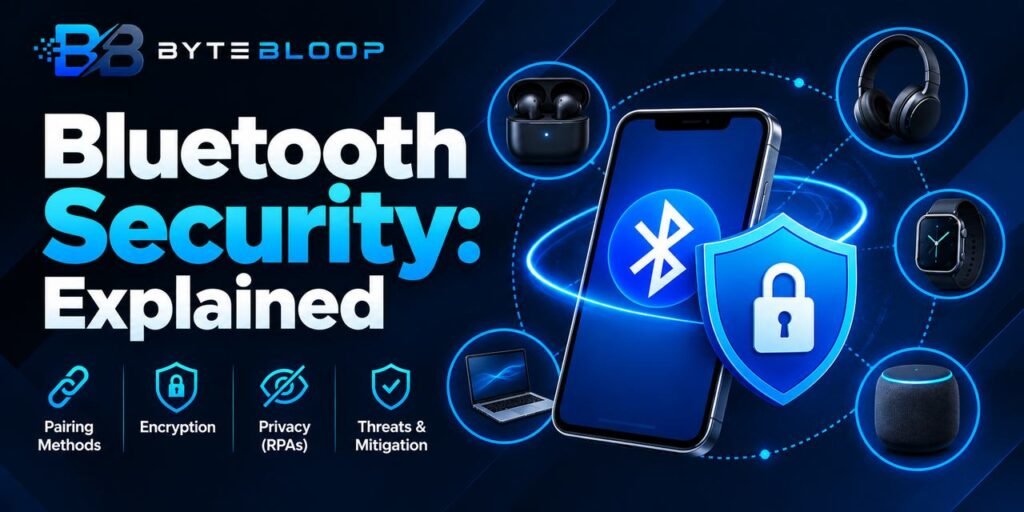
Bluetooth Security: Explained
Introduction
Bluetooth has become the default wireless standard for everything from headphones to smart home hubs. Yet the convenience of a quick tap or a silent connection can hide a complex web of security protocols and potential vulnerabilities. Understanding how Bluetooth safeguards data, how devices authenticate each other, and what gaps still exist is essential for both consumers and developers. This guide walks through the core concepts of Bluetooth security, from pairing methods to encryption, and explains why privacy matters in a world where every device is increasingly connected.
At its core, Bluetooth security relies on a layered approach: physical proximity, pairing, authentication, and encryption. Devices first establish a trust relationship through a pairing process, which can involve simple passkeys, numeric comparison, or more advanced Secure Connections. Once paired, a unique link key encrypts all subsequent traffic, ensuring that eavesdroppers cannot read or tamper with the data stream. However, the evolution of Bluetooth Low Energy (BLE) has introduced new privacy mechanisms, such as randomized addresses, to mitigate tracking and location‑based attacks. By the time a device is ready for production, it must pass through a battery of security tests, including compliance with the latest Bluetooth SIG specifications and NIST guidelines.
Pairing Methods and Their Security Levels
Bluetooth offers several pairing methods, each with a different balance of user convenience and security. The simplest is the Just Works mode, which requires no user interaction and is vulnerable to Man‑in‑the‑Middle (MitM) attacks. The Numeric Comparison mode displays a six‑digit code on both devices; the user must confirm that the codes match, providing a higher level of protection. Finally, Passkey Entry and Out‑of‑Band (OOB) methods involve a user‑entered passcode or a secure external channel, respectively, and offer the strongest security guarantees.
According to the 2025 guide on BLE security, the introduction of LE Secure Connections has raised the bar by using Elliptic Curve Diffie‑Hellman (ECDH) for key exchange, which is resistant to passive eavesdropping and active MitM attacks. This method is now the default for most modern devices and is required for any application that handles sensitive data.
Encryption and Key Management
Once a link key is established, Bluetooth uses AES‑CCM encryption to protect data. The encryption strength depends on the key size: 128‑bit keys are standard, while 256‑bit keys offer enhanced security for high‑risk applications. Key management is critical; keys must be stored securely in the device’s Trusted Platform Module (TPM) or secure element, and they should be rotated periodically to limit the damage from a compromised key.
Research from the Purple Book highlights that many legacy devices still rely on outdated encryption algorithms, making them susceptible to brute‑force attacks. Manufacturers are urged to update firmware to support the latest security patches and to disable legacy pairing modes when possible.
Privacy Mechanisms: Randomized Addresses
Bluetooth SIG introduced Resolvable Private Addresses (RPAs) to prevent tracking. When privacy is enabled, a device generates a new random address every few minutes, making it difficult for an attacker to correlate traffic to a specific device. According to the BLE specification overview, RPAs can be resolved by a trusted peer that holds the identity address, allowing legitimate devices to maintain a persistent connection while keeping the public address hidden.
Audio devices, such as wireless earbuds, have adopted this mechanism to protect user location data. An engineer at Cardinal Peak notes that randomizing addresses reduces the risk of stalking and unauthorized profiling, especially in crowded public spaces.
Common Threats and Mitigation Strategies
Bluetooth is vulnerable to several attack vectors, including:
- Bluejacking: sending unsolicited messages. Mitigation: disable discoverable mode when not pairing.
- Bluesnarfing: unauthorized data access. Mitigation: enforce strong authentication and disable legacy protocols.
- Bluebugging: remote control of a device. Mitigation: keep firmware updated and monitor for unusual activity.
Guidelines from NIST’s Bluetooth Security guide recommend that organizations adopt a risk‑based approach: perform regular security audits, enforce least privilege on device capabilities, and educate users about safe pairing practices.
Best Practices for Developers and Consumers
Developers should:
- Implement LE Secure Connections by default.
- Use RPAs for all BLE peripherals.
- Avoid storing sensitive data in the device’s non‑volatile memory without encryption.
- Provide clear pairing instructions to users to prevent accidental Just Works pairing.
Consumers can protect themselves by:
- Turning off Bluetooth when not in use.
- Ensuring devices display a passkey or code before pairing.
- Regularly updating device firmware.
Key Takeaways
- Bluetooth uses layered security: pairing, authentication, and encryption.
- LE Secure Connections and RPAs protect against MitM and tracking.
- Legacy devices may rely on weak encryption; updates are essential.
- Users should disable discoverable mode and keep firmware current.
- Developers must adopt best‑practice guidelines from NIST and the Bluetooth SIG.
Frequently Asked Questions
What is Bluetooth security explained?
Bluetooth security refers to the protocols and mechanisms that protect data, privacy, and device integrity during wireless communication.
What are the key features of Bluetooth security?
Key features include pairing methods (Just Works, Numeric Comparison, Passkey Entry, OOB), LE Secure Connections, AES‑CCM encryption, and privacy mechanisms like Resolvable Private Addresses.
What are the best use cases for Bluetooth security?
Bluetooth security is essential for personal devices, medical wearables, industrial IoT, and any scenario where sensitive data or location privacy matters.
What are the pros and cons of Bluetooth security?
Pros: convenient proximity‑based pairing, robust encryption, and privacy features. Cons: legacy devices may use weak protocols, and improper pairing can expose devices to MitM attacks.
Conclusion
Based on the available information and industry analysis, Bluetooth security provides robust protection through layered encryption, secure pairing, and privacy mechanisms like randomized addresses. However, legacy devices and user misconfigurations still pose significant risks, underscoring the need for continuous firmware updates, adherence to NIST guidelines, and user education to maintain a secure wireless ecosystem.
Related Reading
- Understanding BLE Pairing: A Deep Dive
- Top 5 Bluetooth Vulnerabilities to Watch
Sources & References
- Bluetooth Low Energy (BLE) Security & Privacy: A 2025 Guide
- Overview – Bluetooth Security Features
- Exploring Wireless Security – Bluetooth and RF
- Bluetooth LE Security and Privacy in Wireless Audio Devices
- Bluetooth Security – an overview
- Guide to Bluetooth Security
- A Comprehensive Guide to Protecting Your Wireless Devices
- An introduction to the Bluetooth LE security study guide