Education Technology: Explained
Introduction
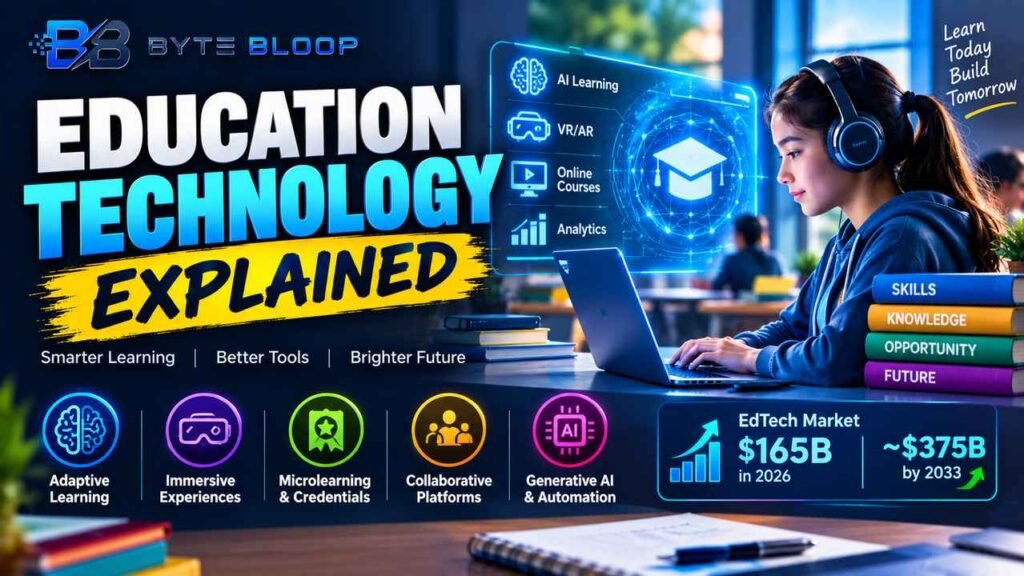
Education Technology Explained is a topic worth understanding well. Education technology—often shortened to EdTech—refers to digital tools, platforms, and pedagogical approaches that enhance teaching and learning. From AI‑driven personalized learning systems to immersive VR experiences, EdTech is redefining how students acquire knowledge and how educators deliver instruction. The rapid evolution of these technologies is driven by advances in artificial intelligence, increased connectivity, and a growing demand for flexible, learner‑centered environments. In 2026, the market is projected to reach USD 165 bn, with expectations to nearly double by 2033, underscoring the sector’s explosive growth. This article explores the core components of EdTech, highlights emerging trends, and offers practical examples for schools and institutions looking to stay ahead.
At its heart, EdTech blends curriculum design with technology to create interactive, data‑rich learning experiences. It spans a spectrum from simple digital textbooks to sophisticated learning analytics platforms that track student progress in real time. By leveraging these tools, educators can tailor instruction to individual needs, foster collaboration, and prepare learners for a digital future. The following sections break down the key elements, showcase current tools, and discuss the benefits and challenges of integrating technology into education.
Core Pillars of Modern EdTech
1. Adaptive Learning Platforms use AI to adjust content difficulty, pacing, and style based on learner performance. According to Education Technology Trends to Watch in 2026, these systems are becoming the backbone of personalized instruction.
2. Immersive & Gamified Experiences combine virtual reality (VR), augmented reality (AR), and game mechanics to make abstract concepts tangible. The same source notes that VR/AR is now a standard feature in science labs and history simulations.
This matters directly for anyone exploring education technology explained.
3. Microlearning & Microcredentials deliver bite‑size lessons and digital badges that validate specific skills. This trend aligns with the growing demand for lifelong learning and workforce upskilling.
4. Collaborative Platforms such as Figjam, Genially, and NotebookLM enable real‑time co‑creation and feedback. Caplan’s review highlights these tools as essential for remote and hybrid classrooms.
Getting education technology explained right can make a real difference.
Emerging Trends Shaping 2026
Generative AI is at the forefront of EdTech innovation. 10 EdTech Trends Reshaping Education in 2026 lists generative AI assessments as a replacement for rote testing, while AI agents move beyond chatbots to manage campus operations.
Gamification continues to rise, with immersive learning environments driving higher engagement. According to the OECD Digital Education Outlook 2026, educators are experimenting with AI‑generated content to create dynamic lesson plans that adapt in real time.
That is a core part of understanding education technology explained.
Microcredentials are becoming mainstream, offering learners a pathway to stackable, industry‑validated skills. The market analysis from Coherent Market Insights projects a steady annual growth rate for microcredential platforms, reflecting institutional demand for flexible certification.
Practical Tools for Today’s Educators
1. NotebookLM – an AI‑powered note‑taking assistant that auto‑summarizes lectures and generates study guides.
Many readers look into education technology explained for exactly this reason.
2. Genially – a visual storytelling platform that blends interactive graphics with quizzes, ideal for project‑based learning.
3. Make Concepts Stick – a microlearning suite that delivers daily micro‑lessons aligned with curriculum standards.
It is worth revisiting education technology explained as things develop.
4. Inspire Curiosity – an AI tutor that recommends exploratory projects based on student interests.
Benefits of Integrating EdTech
- Personalization: AI adapts to each learner’s pace and style.
- Engagement: Gamified and immersive content keeps students motivated.
- Data‑Driven Decisions: Analytics provide actionable insights for teachers.
- Scalability: Cloud‑based platforms support large cohorts without extra infrastructure.
Challenges to Overcome
- Equity Gap: Unequal access to devices and broadband can widen learning disparities.
- Privacy Concerns: Data collection must comply with regulations like FERPA and GDPR.
- Teacher Training: Effective use requires professional development and ongoing support.
Key Takeaways
- EdTech blends AI, VR, and microlearning to personalize instruction
- 2026 market hits USD 165 bn, projected to double by 2033
- Key tools: NotebookLM, Genially, Make Concepts Stick
- Benefits: engagement, data insights, scalability
- Challenges: equity, privacy, teacher readiness
Frequently Asked Questions
What is education technology explained?
Education technology, or EdTech, refers to digital tools and platforms that enhance teaching and learning through personalized, interactive, and data‑rich experiences.
Education Technology Explained remains highly relevant here.
What are the key features of modern EdTech?
Core features include adaptive learning, immersive VR/AR, microlearning modules, collaborative platforms, and AI‑driven analytics.
What are the best use cases for AI in education?
AI is used for personalized lesson plans, automated grading, real‑time feedback, campus operations management, and generative content creation.
What are the pros and cons of integrating EdTech?
Pros: increased engagement, personalized pacing, scalable delivery, data insights. Cons: potential equity gaps, privacy issues, and the need for teacher training.
Conclusion
Based on the available information and industry analysis, education technology explained demonstrates that AI, VR, and microlearning are not merely add‑ons but foundational shifts that enable personalized, engaging, and scalable learning environments. As the market grows toward USD 375 bn by 2033, institutions that invest in equitable access, robust data governance, and continuous educator support will be best positioned to harness these transformative tools.
Related Reading
- Top 5 AI Tools for Classroom Assessment
- How VR is Revolutionizing Science Labs
Sources & References
- Education Technology Trends to Watch in 2026
- 10 Useful Tech Tools for Educators in 2026 — Caplan
- 10 EdTech Trends Reshaping Education in 2026
Related Articles