Introduction
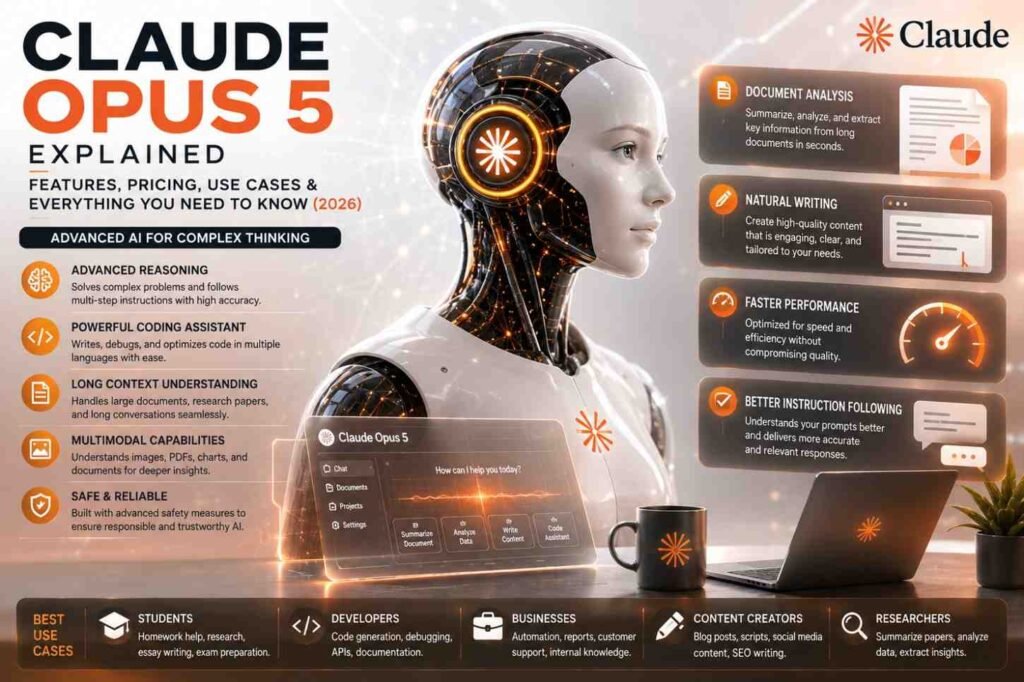
Artificial Intelligence continues to evolve at an extraordinary pace, with each new generation of AI models delivering smarter reasoning, stronger coding capabilities, and more advanced workflows. Among Anthropic’s latest models, Claude Opus 5 is designed for demanding coding, AI agents, professional work, and complex knowledge tasks.
Developed by Anthropic, Claude Opus 5 is built to handle challenging software engineering tasks, long-running agentic workflows, professional knowledge work, and complex document creation. The model is designed to maintain context across demanding tasks and provide reliable results with less supervision.
Whether you’re a developer building software, a business professional working with complex documents, a researcher analyzing information, or a content creator developing new ideas, this model can support a wide range of workflows.
In this comprehensive guide, we’ll explore Claude Opus 5, including its features, capabilities, pricing, advantages, limitations, use cases, and frequently asked questions.
What Is Claude Opus 5?
Claude Opus 5 is Anthropic’s latest Opus-tier AI model, designed for demanding coding, AI agents, professional workflows, and complex knowledge work.
Unlike conventional software that follows predefined rules, the model processes user instructions and surrounding context to generate responses and complete complex tasks.
It can assist with a wide range of activities, including:
- Software development
- Coding and debugging
- Research
- Document creation
- Data analysis
- Technical writing
- Business workflows
- Content creation
- Problem solving
- AI agent development
The model is particularly useful when a task requires extended reasoning, multiple steps, or sustained context.
For more information about Anthropic and its AI models, visit the official Anthropic website.
Who Developed Claude Opus 5?
Claude Opus 5 was developed by Anthropic, an AI company focused on developing advanced and reliable AI systems.
Anthropic places a strong emphasis on AI safety, reliability, and responsible development while continuing to improve model capabilities.
The Claude family has been used across software development, research, business workflows, document analysis, and other professional applications.
You can read more about the company and its AI products on the Anthropic official website.
Claude Opus 5 Release Overview
Anthropic introduced Claude Opus 5 on July 24, 2026. The company describes it as a significant improvement for the Opus tier, particularly for coding, long-running AI agents, and professional work.
The model is designed to provide stronger performance for demanding tasks while maintaining the same base API pricing as its predecessor.
Some of the major improvements include:
- Stronger coding performance
- Improved reasoning
- More capable AI agents
- Better support for long-running tasks
- Improved professional workflows
- Stronger instruction following
- Better efficiency on complex tasks
You can read the official Claude Opus 5 announcement from Anthropic for additional details.
Key Features of Claude Opus 5
Advanced Reasoning
One of the model’s important capabilities is its ability to handle complicated problems and multi-step tasks.
Instead of limiting responses to simple questions and answers, it can work through complex instructions and provide detailed solutions for technical and professional workflows.
This makes it useful for:
- Programming
- Research
- Mathematics
- Technical documentation
- Problem solving
- Business analysis
Advanced Coding Assistance
Developers can use Claude Opus 5 throughout the software development process.
It can assist with:
- Writing new code
- Debugging errors
- Reviewing existing code
- Explaining programming concepts
- Building applications
- Creating APIs
- Working with large codebases
- Optimizing software
- Finding potential problems
Anthropic positions the model particularly strongly for serious software engineering and long-running coding tasks.
Popular programming languages such as Python, JavaScript, TypeScript, Java, C++, PHP, Go, Rust, HTML, CSS, and SQL can be used with AI coding workflows.
Long-Running AI Agents
Another important capability is support for agentic workflows.
AI agents can perform multiple steps toward a goal instead of simply responding to one prompt. This can be useful for software development, research, automation, and other complex workflows.
Anthropic describes Opus 5 as being designed for long-running agents that can plan, verify their work, and continue working through complex tasks.
Professional Workflows
The model is also designed for professional and enterprise use.
It can support workflows involving:
- Documents
- Spreadsheets
- Presentations
- Research
- Business analysis
- Software engineering
- Knowledge management
This makes it useful for organizations that need AI assistance across multiple stages of a project.
Document Creation and Analysis
Claude can be useful when working with large amounts of information.
Depending on the platform and available features, users can work with documents and ask the model to summarize, analyze, organize, or explain information.
Possible applications include:
- Research papers
- Business documents
- Reports
- Technical documentation
- Meeting notes
- Presentations
- Contracts
Users should still verify important information before making professional or legal decisions based on AI-generated analysis.
Better Instruction Following
Claude Opus 5 is designed to handle detailed instructions and complex workflows.
Users can specify requirements such as:
- Writing style
- Output format
- Target audience
- Number of steps
- Technical requirements
- Business goals
Providing clear instructions and relevant context can help produce more useful results.
How Claude Opus 5 Works
Claude Opus 5 is a large language model developed by Anthropic.
When a user provides a prompt, the system processes the request and available context before generating a response. Depending on the platform and tools being used, the model can also work with files and other inputs to complete more advanced tasks.
For developers, the model is available through the Claude API using the model identifier claude-opus-5.
For additional technical and safety information, users can refer to Anthropic’s official model documentation and system-card resources.
Best Use Cases
For Developers
Developers can use Claude Opus 5 for:
- Software development
- Debugging
- Code reviews
- Application development
- API creation
- Technical documentation
- Large codebase analysis
- Automation
For Businesses
Businesses can use the model for:
- Business analysis
- Document creation
- Workflow automation
- Research
- Internal knowledge work
- Report generation
- Professional productivity
For Researchers
Researchers can use AI assistance for:
- Research organization
- Document analysis
- Information summarization
- Data interpretation
- Brainstorming
- Technical writing
For Content Creators
Content creators can use Claude for:
- Blog articles
- YouTube scripts
- Product descriptions
- Social media content
- Research
- Content planning
- Editing and rewriting
For Students
Students can use the model for:
- Study assistance
- Research summaries
- Learning difficult concepts
- Writing practice
- Note organization
- Brainstorming
AI-generated answers should still be checked against reliable sources when accuracy is important.
Claude Opus 5 Pricing
Claude Opus 5 is available through Anthropic’s Claude platform and API.
According to Anthropic, API pricing starts at $5 per million input tokens and $25 per million output tokens. The model is also available through Claude plans including Pro, Max, Team, and Enterprise.
Anthropic also offers additional pricing options such as prompt caching and batch processing for supported workloads.
Because pricing and availability can change, users should check the official Claude pricing information before purchasing or integrating the model.
Advantages of Claude Opus 5
- Strong coding capabilities
- Designed for complex professional work
- Powerful AI agent capabilities
- Good support for long-running tasks
- Useful for large software projects
- Strong reasoning capabilities
- Suitable for enterprise workflows
- Supports a wide range of professional applications
Disadvantages of Claude Opus 5
- API usage can become expensive at high volumes
- Results can vary depending on the task and instructions
- Some capabilities depend on the platform being used
- AI-generated information can contain mistakes
- Important professional decisions should not rely entirely on AI-generated output
Is Claude Opus 5 Safe?
Anthropic conducts safety, security, and reliability evaluations as part of its model development and release process. The company provides additional safety information through its model documentation and system-card resources.
However, users should still review AI-generated information carefully.
Sensitive information should also be handled responsibly, particularly when working with confidential business documents, personal information, legal material, or other private data.
Tips to Get Better Results
To get better results from Claude Opus 5:
- Be specific about what you want.
- Provide enough background information.
- Explain the desired output format.
- Break complicated tasks into clear steps.
- Specify your target audience.
- Provide examples when necessary.
- Ask the model to review its work.
- Verify important information before publishing or using it.
Clear prompts generally make it easier for an AI model to understand the desired outcome.
Frequently Asked Questions
What is Claude Opus 5?
Claude Opus 5 is Anthropic’s latest Opus-tier AI model, designed for demanding coding, AI agents, professional workflows, and complex knowledge tasks.
Is Claude Opus 5 free?
Access depends on the Claude plan or platform being used. API usage is charged according to token consumption, while access through Claude plans depends on the subscription tier.
Can Claude Opus 5 write code?
Yes. The model is designed for serious software engineering and can assist with code generation, debugging, code review, application development, and complex programming tasks.
Can Claude Opus 5 analyze documents?
Yes. Depending on the platform and supported features, Claude can work with documents and help summarize, analyze, organize, and explain information.
Is Claude Opus 5 good for coding?
Yes. Coding is one of the model’s major strengths. Anthropic specifically positions Opus 5 for serious coding and long-running software engineering tasks.
How much does Claude Opus 5 cost?
Anthropic lists API pricing starting at $5 per million input tokens and $25 per million output tokens.
Can businesses use Claude Opus 5?
Yes. Anthropic makes the model available for business and enterprise users, with applications including professional work, software development, AI agents, and complex knowledge workflows.
Is Claude Opus 5 better than previous Claude models?
Anthropic describes Opus 5 as a significant improvement over previous Opus models, particularly for coding, agents, and professional work. Actual results can vary depending on the task and workflow.
Final Verdict
Claude Opus 5 is a powerful AI model built for demanding coding, long-running AI agents, professional workflows, and complex knowledge work.
Its strongest areas include software development, agentic workflows, professional tasks, and complex problem solving. This makes it a useful option for developers, businesses, researchers, and other professionals who need more than basic chatbot functionality.
However, users should still verify important information, protect confidential data, and choose the appropriate plan based on their specific requirements.
As AI models continue to evolve, Claude Opus 5 represents another significant step toward more capable AI systems that can handle increasingly complex tasks with less manual supervision.
