Delhi HC Allows JNU PG Admissions to Continue Amid Deprivation Points Row
Introduction
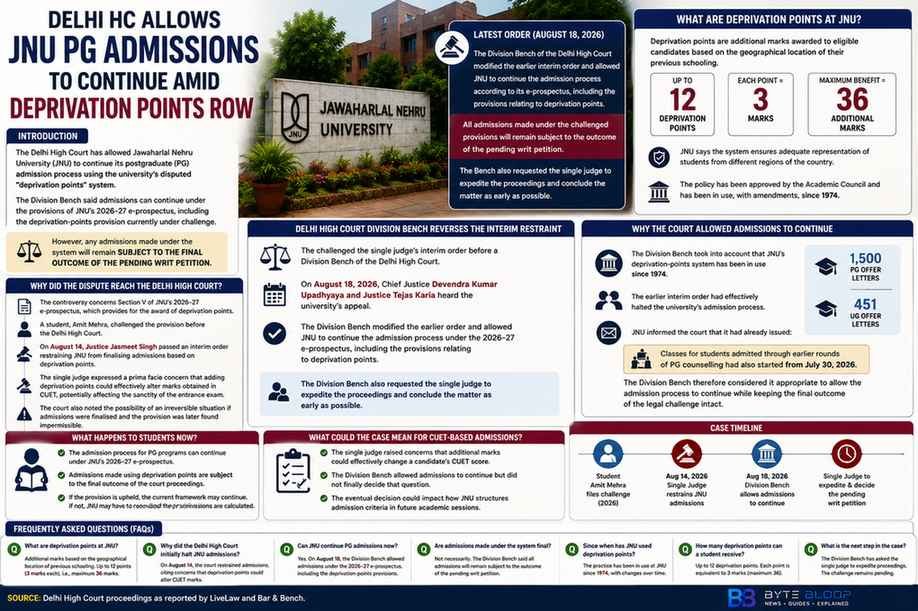
The Delhi High Court has allowed Jawaharlal Nehru University (JNU) to continue its postgraduate (PG) admission process using the university’s disputed “deprivation points” system. The decision modifies an earlier interim order that had temporarily restrained JNU from finalising admissions based on the policy.
The Division Bench said admissions can continue under the provisions of JNU’s 2026–27 e-prospectus, including the deprivation-points provision currently under challenge. However, any admissions made under the system will remain subject to the final outcome of the pending writ petition.
The development provides immediate relief to the university and allows the admission process to move forward, but it does not settle the larger legal question of whether JNU’s deprivation-points system is legally valid.
What Are Deprivation Points at JNU?
Deprivation points are additional marks awarded to eligible candidates based on the geographical location of their previous schooling.
Under JNU’s 2026–27 e-prospectus, candidates can receive up to 12 deprivation points. Each deprivation point is equivalent to 3 marks, meaning the maximum benefit can amount to 36 additional marks in the admission process.
JNU has defended the system by saying that it is intended to ensure adequate representation of students from different regions of the country.
The university has also told the court that the policy has been approved by its Academic Council and has been in use, with amendments over the years, since 1974.
Why Did the Dispute Reach the Delhi High Court?
The controversy concerns Section V of JNU’s 2026–27 e-prospectus, which provides for the award of deprivation points.
A student, Amit Mehra, challenged the provision before the Delhi High Court, arguing against the use of deprivation points in the PG admission process.
On August 14, Justice Jasmeet Singh passed an interim order restraining JNU from finalising admissions based on deprivation points until the matter could be considered further.
The single judge expressed a prima facie concern that adding deprivation points could effectively alter the marks obtained by candidates in the Common University Entrance Test (CUET), potentially affecting the sanctity of the entrance examination.
The court also noted the possibility of an irreversible situation if admissions were finalised and the deprivation-points provision was later found impermissible.
Delhi High Court Division Bench Reverses the Interim Restraint
JNU challenged the single judge’s interim order before a Division Bench of the Delhi High Court.
On August 18, 2026, Chief Justice Devendra Kumar Upadhyaya and Justice Tejas Karia heard the university’s appeal.
The Division Bench modified the earlier order and allowed JNU to continue the admission process according to its e-prospectus, including the provisions relating to deprivation points.
However, the court made an important qualification: all admissions made under the challenged provisions will remain subject to the outcome of the pending writ petition.
The Division Bench also requested the single judge to expedite the proceedings and conclude the matter as early as possible.
Why the Court Allowed Admissions to Continue
The Division Bench took into account the fact that JNU’s deprivation-points system has been in use since 1974 and that the earlier interim order had effectively halted the university’s admission process.
The court was also informed that JNU had already issued approximately 1,500 postgraduate offer letters and 451 undergraduate offer letters. Classes for students admitted through earlier rounds of PG counselling had also started from July 30, 2026.
The Division Bench therefore considered it appropriate to allow the admission process to continue while keeping the final outcome of the legal challenge intact.
This means the latest order is not a final decision upholding the legality of deprivation points. The underlying challenge remains pending before the single judge.
What Happens to Students Now?
For students seeking PG admission to JNU, the immediate effect is that the admission process can continue under the existing 2026–27 e-prospectus.
However, students admitted using deprivation points should be aware that their admissions are subject to the final outcome of the ongoing court proceedings.
The case therefore remains significant for both current applicants and future JNU admission policies.
If the court ultimately upholds the system, the existing framework could continue. If the deprivation-points provision is found legally impermissible, the university may have to reconsider how admissions are calculated.
What Could the Case Mean for CUET-Based Admissions?
The case raises a broader question about how universities can apply additional admission criteria alongside marks obtained in a central entrance examination.
The single judge’s August 14 order raised concerns about whether additional marks could effectively change a candidate’s CUET score for admission purposes.
The Division Bench, however, did not finally decide that question. Instead, it allowed the admission process to continue while the substantive challenge remains before the single judge.
The eventual decision could therefore have implications for how JNU structures its admission criteria in future academic sessions.
Frequently Asked Questions (FAQs)
What are deprivation points at JNU?
Deprivation points are additional marks awarded to eligible candidates based on the geographical location of their previous schooling. Under JNU’s 2026–27 prospectus, candidates can receive up to 12 points, with each point equivalent to 3 marks.
Why did the Delhi High Court initially halt JNU admissions?
On August 14, Justice Jasmeet Singh passed an interim order restraining JNU from finalising admissions based on deprivation points. The court expressed a prima facie concern that the system could effectively alter CUET marks.
Can JNU continue PG admissions now?
Yes. On August 18, the Division Bench allowed JNU to continue its admission process under the 2026–27 e-prospectus, including the challenged deprivation-points provisions.
Are admissions made under the system final?
Not necessarily. The Division Bench specifically said that admissions made under the challenged provisions will remain subject to the outcome of the pending writ petition.
Since when has JNU used deprivation points?
The Division Bench noted that the practice of awarding deprivation points has been in use at JNU since 1974, with changes made over time.
How many deprivation points can a student receive?
JNU’s 2026–27 e-prospectus provides for up to 12 deprivation points. Since each point is equivalent to 3 marks, the maximum benefit can amount to 36 marks.
What is the next step in the case?
The Division Bench has asked the single judge to expedite the pending proceedings. The underlying challenge to the deprivation-points provision therefore remains unresolved.
Conclusion
The Delhi High Court’s latest order has cleared the immediate roadblock to JNU’s postgraduate admission process, allowing the university to continue admissions under its 2026–27 e-prospectus.
However, the court has not given a final ruling on the legality of deprivation points. Admissions made under the challenged provisions will remain subject to the outcome of the pending writ petition.
The dispute therefore continues to raise important questions about university admission policies, regional representation and the role of additional marks alongside CUET scores.
For now, JNU can proceed with PG admissions, while the legal challenge over its deprivation-points system moves forward.
Source: Delhi High Court proceedings as reported by LiveLaw and Bar & Bench.