Machine Learning: Explained
Introduction
Machine learning (ML) is a branch of artificial intelligence that empowers computers to learn from data rather than rely solely on explicit programming. By detecting patterns and relationships within training datasets, ML models can make predictions, classify information, or generate new content with increasing accuracy over time. The technology underpins everyday applications—from recommendation engines on streaming platforms to fraud detection in banking—to cutting‑edge innovations like autonomous vehicles and personalized medicine. In 2026, the proliferation of cloud services, open‑source frameworks, and large‑scale datasets has accelerated ML adoption across industries, making it a critical skill for developers, data scientists, and business leaders alike. Understanding the fundamentals of ML, its core algorithms, and practical deployment strategies is essential for anyone looking to harness its potential in the modern digital economy. This guide breaks down the key concepts, real‑world examples, and actionable steps to start your ML journey today.
What Is Machine Learning?
At its core, machine learning is the subset of AI focused on algorithms that analyze and learn the patterns of training data to make accurate inferences. According to IBM, ML models improve their performance by iteratively adjusting internal parameters based on feedback from training data. MIT Sloan describes it as a powerful form of AI that is reshaping every industry, from finance to healthcare, by automating decision‑making and uncovering hidden insights.
Types of Machine Learning
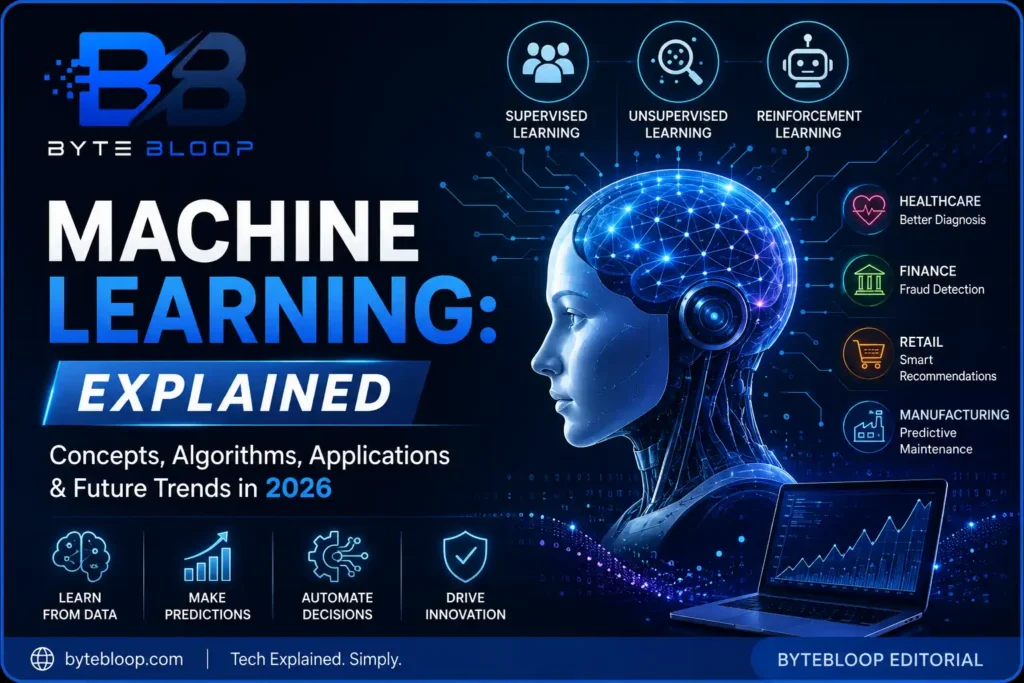
ML is typically divided into three main categories:
- Supervised learning: Models are trained on labeled data, such as classifying emails as spam or not spam.
- Unsupervised learning: Algorithms discover hidden patterns in unlabeled data, like customer segmentation.
- Reinforcement learning: Agents learn by receiving rewards or penalties for actions, exemplified by AlphaGo’s strategy development.
Key Algorithms and Techniques
Some of the most widely used algorithms include:
- Linear regression for predicting continuous outcomes.
- Decision trees and random forests for classification and regression tasks.
- Support vector machines that excel in high‑dimensional spaces.
- Neural networks, especially deep learning models like convolutional neural networks (CNNs) for image recognition and recurrent neural networks (RNNs) for sequential data.
Real‑World Applications
Machine learning is already transforming everyday life:
- Healthcare: Predictive models identify high‑risk patients and optimize treatment plans.
- Finance: Algorithms detect fraudulent transactions and power algorithmic trading.
- Retail: Personalization engines recommend products based on browsing history.
- Manufacturing: Predictive maintenance forecasts equipment failures before they occur.
Getting Started with Machine Learning
For beginners, the learning path typically involves:
- Mastering a programming language such as Python.
- Learning foundational statistics and linear algebra.
- Familiarizing yourself with libraries like scikit‑learn, TensorFlow, and PyTorch.
- Working through hands‑on projects, such as image classification or sentiment analysis.
- Exploring cloud platforms (AWS SageMaker, Azure ML, GCP Vertex AI) to scale models.
Several resources are available, including the 2026 guide by IBM that outlines essential concepts and real‑world use cases, and YouTube tutorials that walk through beginner‑friendly tools.
Challenges and Ethical Considerations
While ML offers powerful capabilities, it also presents challenges:
- Data quality: Garbage in, garbage out—models are only as good as the data they learn from.
- Bias and fairness: Skewed training data can lead to discriminatory outcomes.
- Explainability: Complex models, especially deep neural networks, can be opaque, making it hard to justify decisions.
- Computational cost: Training large models requires significant hardware resources.
Future Trends
Emerging directions include federated learning, which trains models across decentralized devices while preserving privacy, and automated machine learning (AutoML) platforms that simplify model selection and hyperparameter tuning. As data volumes grow, the demand for scalable, efficient ML solutions will continue to rise, making it a pivotal area for research and industry investment.
Key Takeaways
- ML enables computers to learn from data, not just rules
- Supervised, unsupervised, and reinforcement learning cover most use cases
- Python and libraries like scikit‑learn, TensorFlow, PyTorch are essential tools
- Data quality and bias remain top ethical challenges
- AutoML and federated learning are shaping the next wave of ML adoption
Frequently Asked Questions
What is machine learning?
Machine learning is a subset of artificial intelligence that uses algorithms to learn patterns from data and make predictions or decisions without explicit programming.
What are the key features of machine learning?
Key features include data-driven learning, model training, prediction accuracy, and adaptability to new data.
What are the best use cases for machine learning?
Common use cases span healthcare diagnostics, financial fraud detection, personalized marketing, autonomous vehicles, and predictive maintenance.
What are the pros and cons of machine learning?
Pros: automation, insight discovery, scalability. Cons: data dependency, potential bias, explainability issues, and computational cost.
Conclusion
Based on the available information and industry analysis, machine learning provides a transformative framework that enables systems to learn from data, adapt to new information, and drive innovation across diverse sectors. By mastering foundational concepts, leveraging modern tools, and addressing ethical considerations, practitioners can unlock the full potential of ML while mitigating its inherent risks.
Related Reading
- Deep Learning Demystified
- Building Your First AI Model