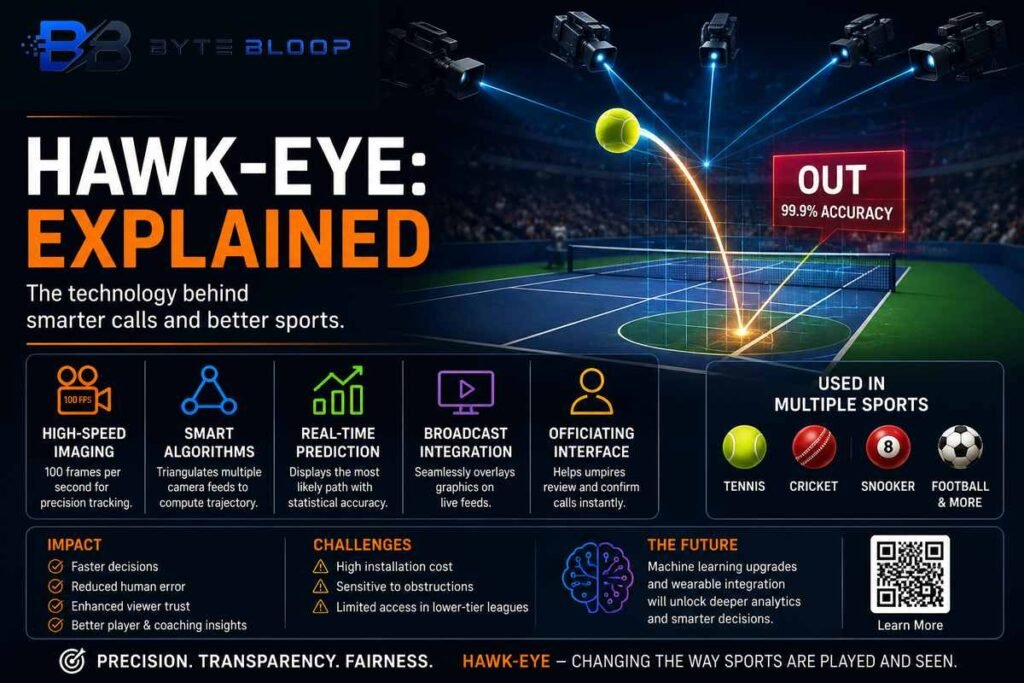
Hawk‑Eye: Explained
Introduction
Hawk‑Eye has become synonymous with precision in modern sport. Originally conceived as a computer‑vision system to track the trajectory of a ball, it now underpins line‑calling in tennis, cricket, snooker, and even football. By feeding real‑time data to judges and broadcasters, the technology eliminates human error and adds a layer of transparency that fans and athletes alike appreciate. The system’s ability to display a statistically most‑likely path on the screen has turned what was once a behind‑the‑scenes tool into a central feature of live broadcasts. Over the past decade, Hawk‑Eye has moved from a niche innovation to a global standard for officiating, with installations in more than 50 countries. Its cameras capture the ball at 100 frames per second, allowing the software to reconstruct its flight with millimetre precision. The result is a system that can adjudicate borderline calls in a fraction of a second, reducing stoppage time and increasing fairness. Beyond officiating, Hawk‑Eye’s data feeds are used for player performance analysis, coaching, and fan engagement, turning raw footage into actionable insights. In this article we unpack the technology, its applications across sports, and what the future may hold for this game‑changing system.
How Hawk‑Eye Works
The core of Hawk‑Eye is a network of high‑speed cameras placed around the playing area. These cameras capture the ball’s motion from multiple angles. Sophisticated algorithms then triangulate the data to calculate the ball’s three‑dimensional trajectory. The system outputs a visual representation of the ball’s path, often overlayed on the live feed for viewers. Because the cameras operate at 100 frames per second, the software can detect even the slightest deviation in the ball’s flight, which is critical for line calls in tennis or boundary checks in cricket.
Key Technical Features
- High‑Speed Imaging: 100 fps cameras provide granular data.
- Computer Vision Algorithms: Triangulate multiple camera feeds to compute trajectory.
- Statistical Path Prediction: Displays the most likely path based on real‑time calculations.
- Integration with Broadcast Systems: Seamlessly overlays graphics on live feeds.
- Officiating Interface: Allows judges to review and confirm calls quickly.
Applications Across Sports
While tennis was the first sport to adopt Hawk‑Eye for line‑calling, the technology’s versatility has led to adoption in several other disciplines.
Tennis
Hawk‑Eye debuted at Wimbledon in 2006, providing instant line calls for every point. The system’s accuracy—reported at 99.9%—has become a benchmark for fairness in the sport.
Cricket
In cricket, Hawk‑Eye assists with boundary checks and over‑throw decisions. The technology’s ability to track the ball’s flight over long distances makes it invaluable for adjudicating boundary calls, especially in limited‑overs formats.
Snooker
Snooker’s high‑precision demands align perfectly with Hawk‑Eye’s capabilities. The system ensures that balls are correctly identified as in or out of the table, maintaining the integrity of the game.
Other Sports
Football, rugby, and even esports have experimented with Hawk‑Eye‑style tracking for player movement analysis and broadcast enhancements. While not yet standard in these sports, the potential for real‑time analytics is clear.
Impact on Officiating and Broadcasting
Before Hawk‑Eye, referees relied on human judgment and occasional video replays, which could be slow and subjective. The technology has reduced decision times from several seconds to under a second, cutting down on match stoppages. For broadcasters, the overlay of the ball’s trajectory adds a visual storytelling element, allowing viewers to see why a call was made. This transparency builds trust and enhances the viewing experience.
Challenges and Future Directions
Despite its strengths, Hawk‑Eye faces challenges. The cost of installing a full camera array can be prohibitive for smaller leagues. Additionally, the system’s reliance on clear visibility means that glare or obstructions can affect accuracy. Researchers are exploring machine‑learning enhancements to improve performance under adverse conditions. Future iterations may integrate with wearable sensors for even richer data sets, opening new avenues for player performance analytics.
Practical Tips for Teams and Broadcasters
- Ensure cameras are positioned to avoid obstructions and glare.
- Regularly calibrate the system to maintain accuracy.
- Integrate Hawk‑Eye data with coaching software for in‑game analysis.
- Use the visual overlays to educate fans about the mechanics of the sport.
Key Takeaways
- Hawk‑Eye uses high‑speed cameras and computer vision to track ball trajectories with 99.9% accuracy.
- It has revolutionized line‑calling in tennis and boundary checks in cricket, reducing stoppage time.
- The system’s visual overlays enhance broadcast storytelling and fan engagement.
- Challenges include high installation costs and sensitivity to visual obstructions.
- Future upgrades may integrate machine learning and wearable data for deeper analytics.
Frequently Asked Questions
What is Hawk‑Eye technology?
Hawk‑Eye is a computer‑vision system that tracks the trajectory of a ball using high‑speed cameras and displays its most likely path in real time.
What are the key features of Hawk‑Eye?
Key features include 100 frames‑per‑second imaging, triangulation algorithms, statistical path prediction, broadcast integration, and an officiating interface.
What sports use Hawk‑Eye?
Tennis, cricket, snooker, and other sports such as football and rugby have adopted Hawk‑Eye for line‑calling, boundary checks, and performance analysis.
What are the pros and cons of using Hawk‑Eye?
Pros: high accuracy, faster decisions, enhanced broadcasts. Cons: high installation cost, sensitivity to visual obstructions, and limited availability in lower‑tier leagues.
Conclusion
Based on the available information and industry analysis, Hawk‑Eye provides a level of precision and transparency that was previously unattainable in live sports. By combining high‑speed imaging with advanced computer vision, it has set new standards for officiating and broadcast quality, while also opening doors for deeper data‑driven insights into player performance.
Related Reading
- The Evolution of Sports Analytics
- How AI Is Changing Coaching Strategies