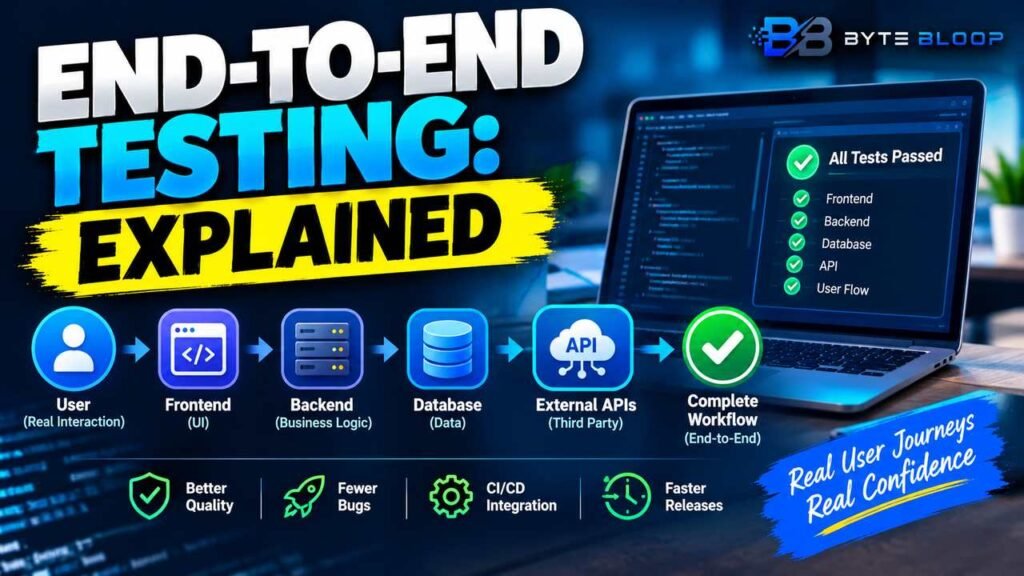
End-to-End Testing: Explained
Introduction (End-to-end Testing Explained)
End-to-end Testing Explained is a topic worth understanding well. End‑to‑end (E2E) testing is a software testing methodology that validates an entire application workflow from beginning to end, mirroring real user interactions. It moves beyond unit or integration tests to confirm that all integrated components—frontend, backend, databases, external APIs—operate together as intended. According to IBM, E2E testing ensures that the system behaves correctly under realistic conditions, catching issues that isolated tests might miss. In 2026, teams increasingly embed E2E tests into CI/CD pipelines to catch regressions before production releases.
This practice aligns with the industry trend of treating quality as a continuous delivery feature rather than a post‑build checkpoint. By simulating user journeys, E2E tests provide confidence that the product delivers value from the user’s perspective. They also serve as living documentation, illustrating how the system is expected to behave.
Despite its benefits, E2E testing can be resource‑intensive and brittle if not designed carefully. Tests that depend on specific data states or UI elements may fail due to unrelated changes, leading to high maintenance costs. Therefore, crafting robust, maintainable E2E suites requires thoughtful architecture, clear test boundaries, and smart tooling. The following sections outline a practical roadmap for implementing E2E testing, highlight common pitfalls, and share best practices that top engineering teams use in 2026.
Why E2E Testing Matters
When a new capability is introduced, it is critical to execute E2E tests alongside other functional tests before pushing updates into production. LeapWork notes that these tests help verify that the new feature integrates seamlessly with existing workflows, reducing post‑release incidents. E2E tests also validate end‑to‑end business scenarios, ensuring that user journeys—such as placing an order or resetting a password—complete successfully.
This matters directly for anyone exploring end-to-end testing explained.
Choosing the Right Tool
There are over a dozen E2E frameworks available, ranging from Selenium and Cypress to AI‑native platforms like ShipLight. A complete guide to E2E testing tools in 2026 recommends an eight‑step framework for tool selection, emphasizing factors such as language support, integration with CI/CD, and preview environment compatibility. For teams that prefer codeless solutions, Testim’s guide highlights how AI can reduce the need for manual scripting while maintaining test reliability.
Getting end-to-end testing explained right can make a real difference.
Building a Scalable Test Suite
1. Define clear user stories that map to test cases. Each test should represent a distinct user journey.
That is a core part of understanding end-to-end testing explained.
2. Use page objects or component wrappers to encapsulate UI logic, reducing duplication.
Many readers look into end-to-end testing explained for exactly this reason.
3. Isolate test data by using fixtures or database reset scripts, ensuring tests run against a known state.
It is worth revisiting end-to-end testing explained as things develop.
4. Leverage preview environments for every pull request, allowing developers to run tests against feature branches in isolation.
End-to-end Testing Explained remains highly relevant here.
5. Integrate with CI/CD so that E2E tests run automatically on every merge, catching regressions early.
This is a key consideration when it comes to end-to-end testing explained.
6. Parallelize execution across containers or cloud runners to keep test times short.
This matters directly for anyone exploring end-to-end testing explained.
7. Monitor flaky tests and implement retry logic where appropriate, but investigate root causes to avoid masking issues.
8. Maintain test documentation in the same repository as code, using comments and README files to explain intent.
Common Pitfalls and How to Avoid Them
- Relying on hard‑coded selectors that break with UI changes. Use stable data‑attributes instead.
- Testing too many steps in a single test, making debugging difficult. Keep tests focused and atomic.
- Running E2E tests against production data. Always use dedicated test or staging environments.
- Ignoring performance metrics. Include latency checks to ensure that user experience remains acceptable.
Best Practices in 2026
According to Bunnyshell, top engineering teams run reliable E2E tests using CI/CD, automation, and preview environments for every pull request. They also adopt AI‑driven test maintenance, which automatically updates selectors when the UI changes. Continuous monitoring of test health—tracking flakiness, execution time, and coverage—helps teams prioritize maintenance efforts.
Key Takeaways
- E2E tests validate real user journeys, catching issues that unit tests miss
- Tool selection should consider language support, CI/CD integration, and preview environments
- Maintainability hinges on page objects, isolated data, and clear test boundaries
- Flaky tests require monitoring and root‑cause analysis, not just retries
- AI‑native platforms are emerging to reduce manual scripting in 2026
Frequently Asked Questions
What is end‑to‑end testing?
End‑to‑end testing validates an entire application workflow from start to finish, ensuring all integrated components work together as a real user would experience.
What are the key features of E2E testing tools?
Modern E2E tools offer language support, CI/CD integration, preview environment support, AI‑driven selector maintenance, and parallel execution capabilities.
What are the best use cases for end‑to‑end testing?
Use E2E testing for critical user journeys such as checkout flows, authentication, data export/import, and any feature that spans multiple services or external APIs.
What are the pros and cons of end‑to‑end testing?
Pros include comprehensive coverage of real user scenarios and early defect detection. Cons involve higher maintenance overhead, slower execution, and potential brittleness if tests are not well designed.
Conclusion
Based on the available information and industry analysis, end‑to‑end testing provides a crucial safety net that verifies real user journeys across integrated systems, reducing post‑release incidents and improving confidence in new releases. By selecting the right tools, structuring tests around clear user stories, and embedding them in CI/CD pipelines, teams can maintain high quality while keeping test suites fast and maintainable.
Related Reading
- Top 5 E2E Testing Tools for 2026
Sources & References
- What is E2E? A guide to end-to-end testing
- A complete guide to end-to-end testing tools in 2025
- End-To-End Testing: 2026 Guide for E2E Testing
- Complete Guide to E2E Testing in 2026
- What is End-to-End (E2E) Testing?
- Best Practices for End-to-End Testing in 2026
- End-To-End Testing: The One Guide To Rule Them All
- 15 Best End-to-End Testing Tools and Frameworks in 2026
Related Articles