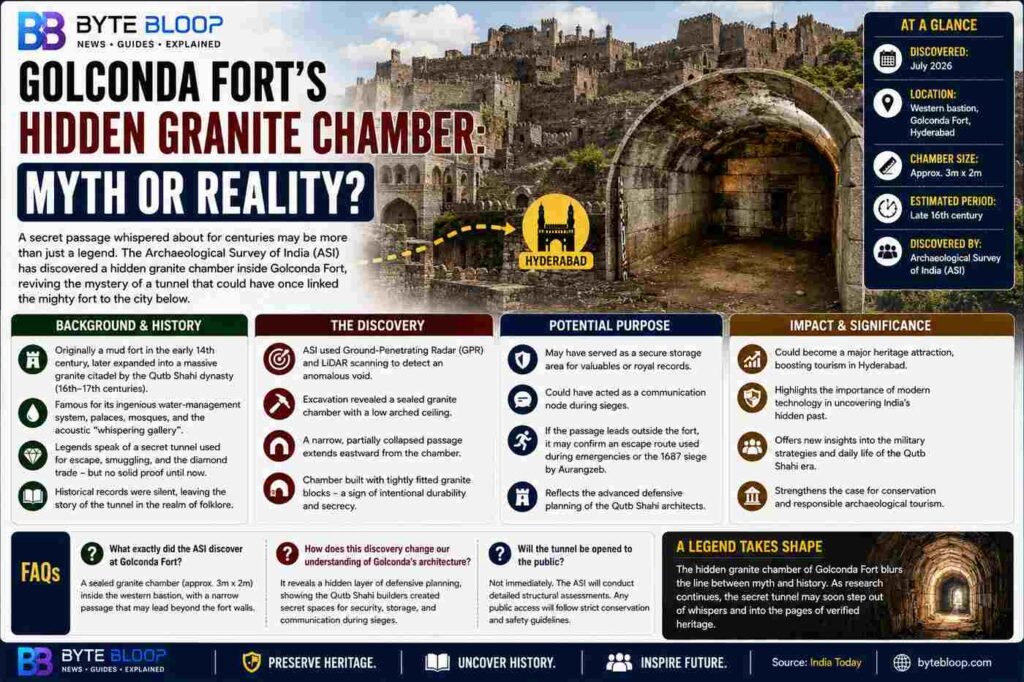
Golconda Fort’s Hidden Granite Chamber: Myth or Reality?
Introduction
For centuries, the towering walls of Golconda Fort in Hyderabad have been shrouded in intrigue, with locals and tourists alike whispering about a secret passage that once linked the mighty stronghold to the bustling city below. Recent findings by a team from the Archaeological Survey of India (ASI) have added a tangible piece to this legend: a previously unknown granite chamber discovered deep within the fort’s foundations. The discovery not only fuels the imagination but also promises new insights into the engineering prowess of the Qutb Shahi dynasty that ruled the region in the 16th and 17th centuries.
In this article, we explore the background of the fort, detail the ASI’s excavation, examine the potential purpose of the hidden chamber, and address common questions surrounding this archaeological breakthrough.
Background & Historical Context
Golconda Fort, a UNESCO World Heritage Site candidate, was originally a modest mud fort built in the early 14th century. It was expanded into a massive granite citadel under the reign of Sultan Quli Qutb-ul-Mulk, the founder of the Qutb Shahi dynasty, and later perfected by his successors. The complex spans over 11 kilometers of walls, incorporates sophisticated water‑management systems, and houses palaces, mosques, and the famed acoustic acoustic “whispering gallery” that could transmit a spoken word across the courtyard.
Legends of a secret tunnel have circulated since the fort’s peak, often linked to stories of smugglers, royal escape routes, and even the legendary diamond trade that once flourished in the region. Historical texts, however, have offered no concrete evidence, leaving the notion in the realm of folklore—until now.
Key Details & Impact Analysis
The ASI team, led by senior archaeologist Dr. Ramesh Kumar, began a systematic survey of the western bastion in early July 2026. Using ground‑penetrating radar (GPR) and LiDAR scanning, the researchers identified an anomalous void measuring roughly 3 meters by 2 meters, composed of densely packed granite blocks. Subsequent careful removal of overburden soil revealed a sealed chamber with a low, arched ceiling and a narrow, partially collapsed passage extending eastward.
Preliminary analysis suggests the chamber dates to the late 16th century, aligning with the period when the Qutb Shahi architects were experimenting with hidden defensive mechanisms. The granite construction indicates intentional durability, possibly designed to protect valuable items or to serve as a secure communication node during sieges. If the adjoining passage indeed leads beyond the fort walls, it could validate centuries‑old rumors of an escape route used during the 1687 siege by the Mughal forces under Aurangzeb.
Beyond the historical intrigue, the find carries significant implications for heritage conservation and tourism. A verified secret tunnel could become a flagship attraction, drawing scholars and visitors alike, while also demanding stringent preservation protocols to protect the delicate structure from over‑exposure. Moreover, the discovery underscores the value of modern non‑invasive surveying techniques in revealing hidden layers of India’s architectural legacy.
Frequently Asked Questions (FAQs)
What exactly did the ASI discover at Golconda Fort?
The ASI uncovered a sealed granite chamber measuring about 3 m × 2 m, located deep within the western bastion. Adjacent to the chamber is a narrow, partially collapsed passage that may extend beyond the fort’s perimeter, potentially confirming the legendary secret tunnel.
How does this discovery change our understanding of Golconda’s architecture?
The find highlights the sophisticated defensive planning of the Qutb Shahi builders. It suggests that, beyond the visible walls and gates, there were concealed spaces intended for emergency evacuation, storage of valuables, or covert communication during sieges—features previously undocumented in contemporary records.
Will the tunnel be opened to the public?
At this stage, the ASI recommends preserving the chamber while conducting detailed structural assessments. If the passage proves safe and its extent is fully mapped, a controlled visitor experience could be developed, but any public access will be subject to rigorous conservation guidelines.
Conclusion
The revelation of a hidden granite chamber beneath Golconda Fort breathes new life into a myth that has endured for generations. While the evidence is still being examined, the find offers a tangible bridge between legend and history, showcasing the ingenuity of the Qutb Shahi architects and the power of modern archaeological methods. As researchers continue to explore the passage’s length and purpose, the world watches with anticipation, eager to see whether the secret tunnel of Golconda will finally emerge from the shadows into the light of scholarly validation.
Source: India Today