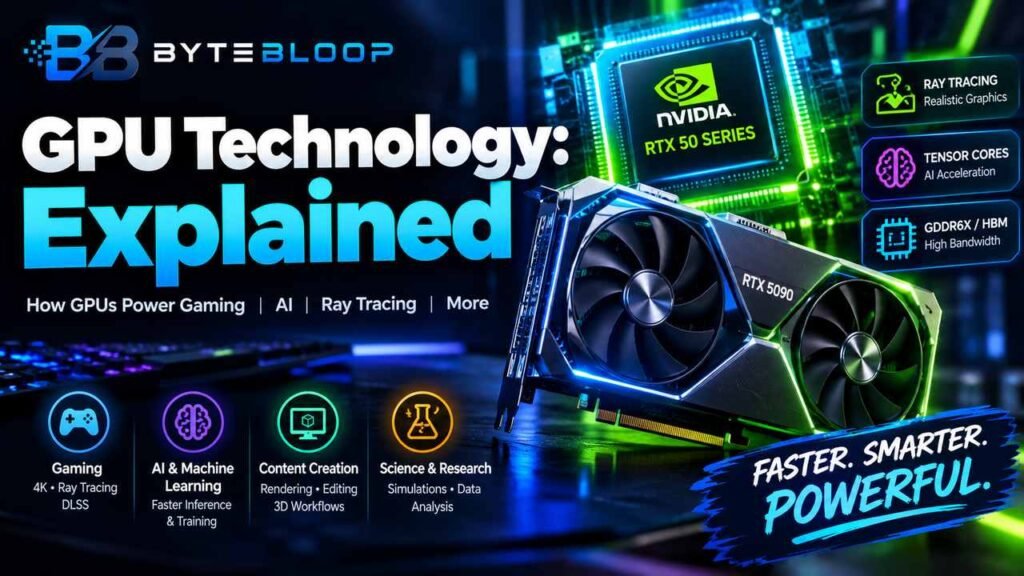
GPU Technology: Explained
Introduction
Graphics Processing Units, or GPUs, have evolved far beyond their original purpose of rendering images for video games. Today they drive everything from real‑time ray tracing and AI inference to scientific simulations and cryptocurrency mining. A GPU’s architecture is built for massive parallelism, with thousands of cores that can process many pixels or data points simultaneously. This parallelism is what makes GPUs far more efficient than CPUs for tasks that can be broken into independent chunks, such as rendering a 3D scene or training a neural network. Modern GPUs also incorporate specialized hardware like Tensor Cores for AI workloads and RT Cores for ray tracing, allowing developers to push visual fidelity and compute performance to new heights. The industry’s focus in 2026 is on higher VRAM capacity, improved power efficiency, and deeper integration of AI acceleration, making GPUs indispensable for both consumer and enterprise workloads. Understanding these trends helps gamers, developers, and IT professionals choose the right hardware for their needs. Below we break down the key components, recent innovations, and practical implications of today’s GPU technology.
Core Architecture and Parallelism
At the heart of every GPU is a large number of small processing units called CUDA cores (in NVIDIA terminology) or stream processors (in AMD). According to “Understanding Nvidia CUDA Cores: A Comprehensive Guide for 2026,” these cores handle floating‑point and integer operations in parallel, enabling tasks like shading, physics calculations, and AI inference to run thousands of times faster than on a single CPU core. The sheer number of cores is matched by high memory bandwidth; GPUs typically use GDDR6 or HBM2 memory, which can deliver several hundred gigabytes per second.
Specialized Hardware: Ray Tracing and AI Acceleration
Ray tracing, the technique of simulating light paths for photorealistic rendering, requires intensive calculations. NVIDIA’s RT Cores, first introduced with the RTX 20 series, accelerate these calculations by handling ray‑object intersection tests. In 2026, the RTX 50 series further refines ray tracing efficiency, allowing 4K gaming at 60 fps with realistic lighting and reflections. Meanwhile, Tensor Cores have become central to AI workloads. They perform mixed‑precision matrix operations, which are the backbone of deep learning inference. The latest DLSS 4.5, highlighted in “Best Graphics Cards for Gaming in 2026,” uses these Tensor Cores to upscale lower‑resolution frames to 4K, delivering smooth gameplay without the need for a high‑end GPU.
Memory and Bandwidth
Modern GPUs are moving toward larger VRAM capacities. The RTX 5090, for instance, ships with 24 GB of GDDR6X, which is essential for high‑resolution textures and large neural network models. According to “New GPU Technology 2026,” increased memory bandwidth also supports higher refresh rates and larger frame buffers, reducing stutter in competitive gaming and improving rendering pipelines in professional applications.
Power Efficiency and Thermal Design
As performance rises, so does power consumption. The RTX 50 series introduces a new power management architecture that dynamically adjusts clock speeds and voltage based on workload. This results in a better performance‑per‑watt ratio compared to the 40 series. The move toward more efficient silicon also aligns with data center demands, where cooling costs can dominate total ownership expenses.
Software Ecosystem and APIs
Hardware alone is insufficient; software must harness it. APIs like DirectX 12 Ultimate, Vulkan, and Metal expose GPU features to developers. NVIDIA’s G‑SYNC, referenced in “NVIDIA Technologies and GPU Architectures,” synchronizes display refresh rates with GPU output, eliminating tearing and reducing input lag—a critical benefit for esports and VR. In addition, CUDA and OpenCL provide low‑level access for custom compute kernels, while higher‑level libraries such as TensorRT and PyTorch abstract AI workloads.
Market Trends and Future Outlook
The GPU market in 2026 is dominated by NVIDIA’s RTX 50 series, but AMD’s Radeon RX 7000 series offers competitive performance with a more favorable price point. According to “Best GPU to Buy in 2026: A No‑BS Guide to Surviving…”, the RTX 5090 remains the top choice for enthusiasts, while the RTX 5070 Ti provides a sweet spot for 1440p and 4K gaming without the flagship price. As AI continues to permeate every sector, GPUs are likely to see even deeper integration of tensor cores and dedicated AI accelerators.
Choosing the Right GPU
When selecting a GPU, consider your primary workload: high‑resolution gaming, AI research, or professional rendering. For gamers, ray tracing support and DLSS performance are key. For AI practitioners, Tensor Core count and memory bandwidth matter most. For content creators, VRAM size and driver stability can make a significant difference. Finally, evaluate power supply requirements and case airflow to ensure reliable operation.
Key Takeaways
- GPUs excel at parallel tasks, enabling fast graphics and AI workloads.
- Ray tracing and AI acceleration are now built into core GPU hardware.
- Higher VRAM and memory bandwidth support 4K gaming and large AI models.
- Power‑efficient designs reduce cooling costs in both gaming and data‑center use.
- Software APIs and display technologies like G‑SYNC enhance user experience.
Frequently Asked Questions
What is a GPU and how does it differ from a CPU?
A GPU, or Graphics Processing Unit, contains thousands of small cores designed for parallel processing, whereas a CPU has fewer, more powerful cores optimized for sequential tasks.
What are the key features of modern GPUs?
Modern GPUs include RT Cores for ray tracing, Tensor Cores for AI acceleration, high‑bandwidth memory, and dynamic power management.
What are the best use cases for GPUs in 2026?
Gaming at 4K with ray tracing, AI inference and training, real‑time rendering for VR/AR, and scientific simulations.
What are the pros and cons of the latest NVIDIA RTX 50 series?
Pros: unmatched ray tracing performance, AI acceleration, and large VRAM. Cons: high power draw, premium price, and limited availability due to supply constraints.
Conclusion
Based on the available information and industry analysis, GPU technology in 2026 has shifted from pure graphics rendering to a hybrid platform that excels in AI acceleration, ray tracing, and high‑resolution gaming. The integration of specialized cores, increased memory bandwidth, and power‑efficient architectures makes modern GPUs indispensable for both consumer and enterprise workloads, ensuring they remain at the forefront of computing innovation.
Related Reading
- How DLSS 4.5 Transforms Gaming Performance
Sources & References
- NVIDIA Technologies and GPU Architectures
- Best Graphics Cards for Gaming in 2026
- What is a GPU? A Beginners Guide
- What is a GPU? Optimizing AI Infrastructure and Performance
- Best GPU to Buy in 2026: A No-BS Guide to Surviving …
- Understanding Nvidia CUDA Cores: A Comprehensive …
- New GPU Technology 2026