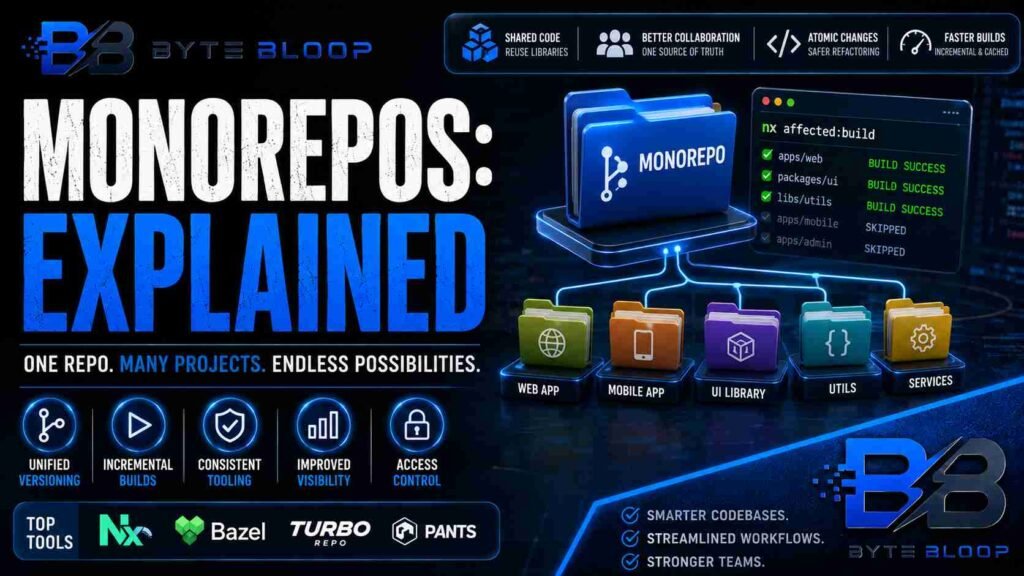
Monorepos: Explained
Introduction
Monorepos, short for monolithic repositories, are a code management strategy where multiple projects live in a single source‑control repository. The concept has gained traction since the early 2010s, as large companies like Google and Facebook discovered that a unified codebase could simplify dependency management, enforce consistent coding standards, and accelerate cross‑team collaboration. By centralizing code, teams can share libraries without publishing separate packages, reducing duplication and version drift. However, monorepos also introduce challenges such as scaling build systems, handling large histories, and configuring CI/CD pipelines to avoid unnecessary work. Understanding when and how to adopt a monorepo is essential for any organization looking to streamline its development workflow. This article breaks down the core ideas behind monorepos, outlines the tooling ecosystem, highlights common pitfalls, and offers practical guidance for implementation.
Why Consider a Monorepo?
According to Monorepo Explained, the primary advantage of a monorepo is the ability to treat all projects as a single unit of change. This means a bug fix in a shared library automatically propagates to every consumer without the need for version bumps or separate releases. The result is tighter integration, fewer version conflicts, and a single source of truth for the entire codebase. Additionally, monorepos enable powerful tooling such as incremental builds and fine‑grained access control, which can dramatically improve developer productivity.
Key Benefits
- Unified Versioning: One commit, one version for all services.
- Atomic Refactoring: Changes that span multiple projects can be committed together.
- Consistent Tooling: A single set of linting, formatting, and testing tools applies across the repo.
- Improved Visibility: All code lives in one place, making onboarding easier.
Common Challenges
Despite the benefits, monorepos are not a silver bullet. Decoding Monorepos in 2026 highlights three main pain points: large repository size, build times, and permission granularity. As the codebase grows, cloning the repo can become time‑consuming, and a naïve build system may trigger unnecessary recompilation of unrelated modules. Moreover, fine‑grained access control is harder to enforce when every developer has read access to the entire repository.
Choosing the Right Tooling
Modern monorepo tooling addresses many of these issues by providing incremental builds, caching, and dependency graph analysis. Top 5 Monorepo Tools for 2026 lists Bazel, Nx, Pants, Turborepo, and Pants as the leading solutions. For example, Nx offers a workspace CLI that understands project boundaries and only rebuilds affected packages. Bazel, originally built at Google, excels at handling large codebases with complex language mixes. Turborepo focuses on JavaScript/TypeScript stacks, providing a lightweight, zero‑config approach for incremental builds.
Sample Nx Workspace Setup
npx create-nx-workspace@latest myorg --preset=tsAfter initialization, the workspace contains a packages folder where each sub‑project resides. Nx automatically generates a dependency graph, and running nx affected:build will only rebuild projects that changed or depend on changed code.
CI/CD Patterns for Monorepos
Effective CI/CD pipelines for monorepos must avoid rebuilding everything on every push. Decoding Monorepos in 2026 recommends a two‑tier approach: a lightweight linting and unit‑test stage that runs on all pushes, and a heavier integration or deployment stage that triggers only when changes affect production code. Tools like GitHub Actions or GitLab CI can be configured with paths filters to limit job execution.
When to Prefer Polyrepos
Monorepos shine when projects share a lot of code and require tight coordination. However, if teams are highly independent, or if security policies demand strict isolation, a polyrepo may be more appropriate. What is a Monorepo? notes that choosing between monorepo and polyrepo should be guided by factors such as team size, codebase size, and release cadence.
Best Practices
- Define clear project boundaries and maintain a dependency graph.
- Use tooling that supports incremental builds and caching.
- Implement a strict branching strategy to avoid large merge conflicts.
- Automate code quality checks across the entire repo.
Key Takeaways
- Monorepos unify multiple projects into a single repository, simplifying dependency management.
- Incremental build tools like Nx and Bazel reduce build times in large codebases.
- CI/CD pipelines should be segmented to avoid unnecessary work on every commit.
- Choosing a monorepo depends on team size, code sharing, and security requirements.
Frequently Asked Questions
What is a monorepo?
A monorepo is a single repository that contains multiple distinct projects, allowing shared code and unified versioning.
What are the key features of monorepo tooling?
Monorepo tools provide incremental builds, caching, dependency graph analysis, and fine‑grained access control.
What are the best use cases for monorepos?
Monorepos are ideal when projects share libraries, require coordinated releases, or need consistent tooling across teams.
What are the pros and cons of monorepos?
Pros include unified versioning, atomic refactoring, and improved visibility. Cons involve large repository size, build complexity, and permission management.
Conclusion
Based on the available information and industry analysis, monorepos provide a powerful framework for managing multiple projects within a single repository, enabling atomic changes, consistent tooling, and streamlined dependency management. However, they demand robust tooling, careful CI/CD design, and thoughtful governance to mitigate challenges such as build scalability and access control. By selecting the right monorepo tools—such as Nx, Bazel, or Turborepo—and following best practices, teams can harness the full benefits of this architecture while minimizing its pitfalls.
Related Reading
- Nx vs. Bazel: Choosing the Right Monorepo Tool
Sources & References