Introduction
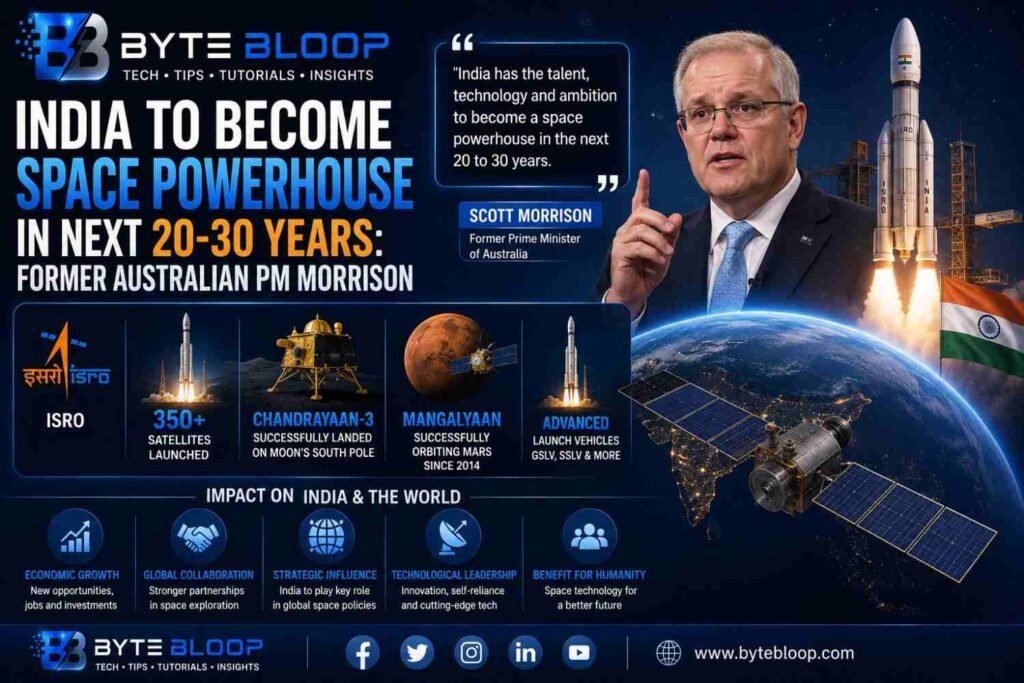
In a statement that highlights the growing influence of India in the global space industry, former Australian Prime Minister Scott Morrison has predicted that India will emerge as a space powerhouse in the next 20-30 years. This forecast is significant, given the rapid advancements India has made in space technology and exploration in recent years. From launching numerous satellites into orbit to embarking on ambitious missions to the Moon and Mars, India’s space program has been gaining momentum and international recognition.
The prediction by Morrison underscores the potential of India’s space sector, which has been driven by the Indian Space Research Organisation (ISRO), the country’s primary space agency. ISRO has been at the forefront of India’s space endeavors, achieving several milestones that have placed India among the elite group of space-faring nations. The prediction also reflects the growing collaboration between India and other countries in space exploration and the potential for India to play a leading role in international space missions and projects.
Background & Historical Context
India’s journey in space exploration began decades ago, but it has been the recent years that have seen a significant surge in activities and achievements. ISRO was established in 1969, and since then, it has been responsible for the development of India’s space program. Over the years, ISRO has launched numerous satellites for communication, navigation, and Earth observation, which have greatly benefited the country in terms of economic development, disaster management, and scientific research. One of the most notable achievements of ISRO was the successful landing of the Chandrayaan-3 mission on the Moon’s south pole, marking a historic milestone for India’s space program.
India’s space ambitions are not limited to Earth’s orbit or the Moon. The country has also set its sights on Mars, with the Mangalyaan mission, also known as the Mars Orbiter Mission, which was launched in 2013 and has been successfully orbiting Mars since 2014. This mission has provided valuable data and insights about the Martian atmosphere and geology. The success of these missions, along with the development of heavy-lift launch vehicles like the Geosynchronous Satellite Launch Vehicle (GSLV) and the upcoming Small Satellite Launch Vehicle (SSLV), demonstrates India’s capabilities in space technology and its commitment to becoming a major player in the global space industry.
Key Details & Impact Analysis
The prediction by former Australian PM Morrison that India will become a space powerhouse in the next 20-30 years is based on the country’s rapid progress in space technology and its increasing participation in international space projects. India’s space program has been characterized by its efficiency, innovation, and cost-effectiveness, making it an attractive partner for space-faring nations. The collaboration between India and other countries in space exploration is expected to grow, with potential partnerships in areas such as lunar and Mars missions, satellite development, and space science research. This collaboration will not only enhance India’s space capabilities but also contribute to global advancements in space technology and exploration.
The impact of India becoming a space powerhouse will be multifaceted. It will significantly enhance the country’s economic and strategic influence globally. The space sector is expected to create new opportunities for employment, innovation, and entrepreneurship, contributing to India’s economic growth. Furthermore, India’s leadership in space will also have geopolitical implications, as it will place India in a position to play a key role in shaping global policies and initiatives related to space exploration and the use of space technology for peaceful purposes. This, in turn, will elevate India’s status as a responsible and major player in the international community.
Frequently Asked Questions (FAQs)
What are the key factors driving India’s emergence as a space powerhouse?
The key factors driving India’s emergence as a space powerhouse include its rapid advancements in space technology, the efficiency and cost-effectiveness of its space program, and its increasing participation in international space projects and collaborations.
How does India’s space program contribute to its economic development?
India’s space program contributes to its economic development by providing satellite services for communication, navigation, and Earth observation, which support various sectors such as agriculture, fisheries, and disaster management. The space sector also generates employment and stimulates innovation and entrepreneurship.
What are the potential international collaborations for India in space exploration?
Potential international collaborations for India in space exploration include partnerships in lunar and Mars missions, joint development of satellites, and cooperation in space science research. These collaborations can involve countries like the United States, Russia, France, and Japan, among others, and will contribute to advancing global knowledge and capabilities in space technology and exploration.
Conclusion
In conclusion, the prediction by former Australian PM Morrison that India will become a space powerhouse in the next 20-30 years is well-founded, given the country’s significant advancements in space technology and exploration. As India continues to push the boundaries of space research and development, its emergence as a major player in the global space industry is not only anticipated but also welcomed. The implications of this emergence will be far-reaching, contributing to India’s economic growth, enhancing its global influence, and advancing the frontiers of space technology and exploration for the benefit of humanity.
Source: ANI News