Indian Football: Explained
Introduction (Indian football explained)
Indian football explained is a topic worth understanding well. India’s passion for football has grown from regional club matches to a national spectacle that now boasts a multi-tiered league system, international ambitions, and a vibrant fan culture. The sport’s evolution in the subcontinent is anchored by the All India Football Federation (AIFF), which oversees a pyramid that ranges from grassroots programs to the top-flight Indian Super League (ISL).
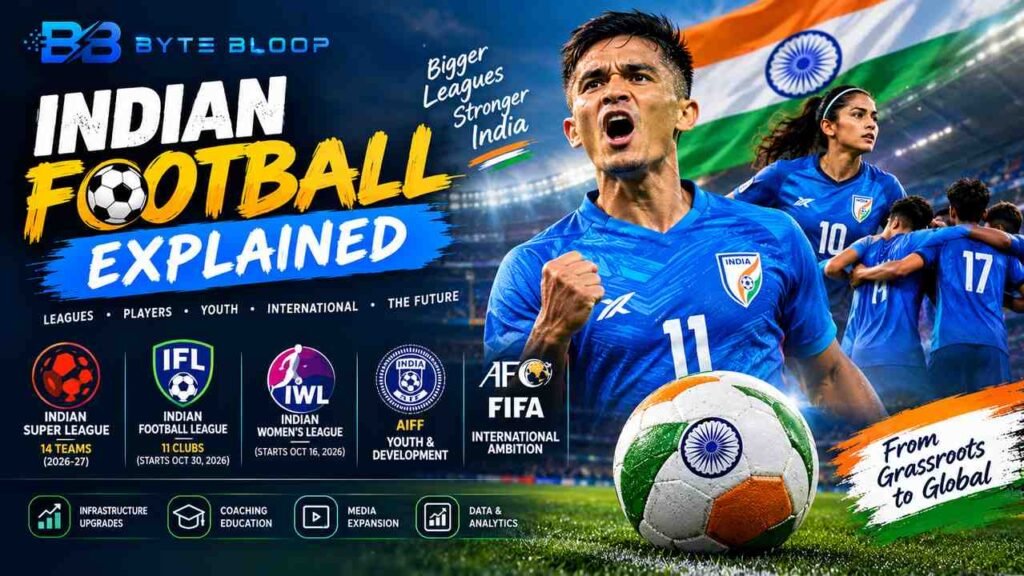
Recent seasons have seen the ISL expand to 14 clubs, while the Indian Football League (IFL) continues to nurture talent through a competitive second division. Internationally, India’s national teams are striving for qualification in AFC and FIFA tournaments, reflecting a broader strategy to raise the country’s footballing profile. The 2026-27 season, scheduled to begin in October, promises new rivalries, fresh talent pipelines, and a renewed focus on infrastructure development. For fans and aspiring players alike, understanding the league structures, calendar, and developmental pathways is essential to navigate this dynamic landscape.
This guide breaks down the key components of Indian football, from league formats to player development, and offers practical insights for supporters and participants.
League Structure and Calendar
The Indian football ecosystem is organized into a hierarchical league system. At the apex sits the Indian Super League (ISL), the country’s premier professional competition. According to the Indian Super League source, the ISL is the highest level of the Indian football league system and operates on a franchise model. The 2026-27 season will feature 14 teams, with four clubs still pending confirmation, and will run from October 10, 2026, to May 2027, as outlined in the Indian football 2026-27 calendar.
Below the ISL is the Indian Football League (IFL), which functions as a second-tier competition This is especially true when it comes to indian football explained. The IFL’s 2026-27 season is slated to kick off on October 30, 2026, with all eleven participating clubs returning for the new campaign, per the Indian Football League source. This league serves as a critical platform for clubs aspiring to secure promotion to the ISL through performance and infrastructure criteria.
Women’s Football and Youth Development
Parallel to the men’s leagues, the Indian Women’s League (IWL) provides a competitive arena for female footballers. The IWL schedule for 2026-27 begins on October 16, 2026, offering a structured pathway for women’s teams across the country. The AIFF’s commitment to gender equity is evident in its investment in coaching, facilities, and grassroots outreach.
Youth development is a cornerstone of Indian football’s long-term strategy This is especially true when it comes to indian football explained. The AIFF’s media releases highlight initiatives to identify and nurture talent from a young age, with academies partnering with local clubs to create a talent pipeline that feeds into both the IFL and ISL. This focus on youth is reflected in the AIFF’s recent announcement that India has been drawn into international groups alongside Bahrain, Cameroon, Grenada, Laos, and Senegal for upcoming FIFA competitions.
International Ambitions and Strategic Roadmaps
India’s national teams are actively pursuing qualification for AFC and FIFA tournaments. The AIFF’s latest draw positions India in a competitive group that will test the squad’s resilience and tactical depth. According to the Official Website of All India Football Federation, these international fixtures are part of a broader roadmap designed to elevate India’s standing in Asian and global football.
Strategic documents, such as the ISL 2026 Explained video from PranayTFB, outline a comprehensive roadmap that includes infrastructure upgrades, coaching education, and increased media coverage This is especially true when it comes to indian football explained. These efforts aim to create a sustainable ecosystem where clubs can thrive financially while delivering high-quality football to fans.
Choosing the Right Equipment: A Practical Guide
For players and coaches, selecting appropriate gear is essential. The How to Choose a Football in India 2026 guide provides a detailed look at ball sizes, materials, and surface suitability. Understanding the differences between natural and synthetic surfaces, as well as the impact of ball construction on play, can significantly affect training outcomes.
Coaches are encouraged to align equipment choices with the specific demands of their training environment, whether it be a grass pitch in a coastal city or a synthetic surface in an urban academy This is especially true when it comes to indian football explained. By following the recommendations in this guide, teams can ensure consistency in performance and reduce injury risk.
What to Expect in the 2026-27 Season
Looking ahead, the 2026-27 season will see increased media coverage, with broadcasters securing rights to stream ISL matches globally. Fans can anticipate high-profile signings, as clubs leverage the expanded budget to attract international talent. The AIFF’s focus on data analytics and performance metrics will also become more pronounced, providing clubs with actionable insights to refine tactics and player development.
Key Takeaways
- ISL is the top professional league with 14 teams in 2026-27
- IFL serves as the second tier, launching October 30, 2026
- IWL starts October 16, 2026, supporting women’s football
- AIFF is driving youth development and international qualification
- Strategic roadmap includes infrastructure, coaching, and media expansion
Frequently Asked Questions
What is the Indian Super League (ISL)?
The ISL is the highest level of professional football in India, operating on a franchise model with 14 clubs in the 2026-27 season.
What are the key features of the Indian Football League (IFL)?
The IFL is the second-tier league, featuring 11 clubs that compete for promotion to the ISL, with the 2026-27 season starting on October 30.
What are the best use cases for the Indian Women’s League (IWL)?
The IWL provides a competitive platform for female footballers, fostering talent development and increasing visibility for women’s football across India.
What are the pros and cons of the AIFF’s current development strategy?
Pros include a structured youth pipeline, infrastructure investment, and international exposure; cons involve limited financial resources for some clubs and the need for more consistent media coverage.
Conclusion
Based on the available information and industry analysis, Indian football is on a decisive trajectory of growth, driven by a robust league structure, strategic investment in youth and women’s programs, and an ambitious international roadmap that positions the country for greater competitiveness on the global stage.
Related Reading
- How to Get Involved in Indian Football Coaching
- Top 10 Indian Football Clubs to Watch in 2026
Sources & References
- Indian football 2026-27 calendar and schedule
- Indian Super League
- ISL 2026 Explained! The Indian Super League 2025-26 season kicks off February 14, 2026
- Official Website of All India Football Federation
- How to Choose a Football in India 2026 | Size, Material & …
Related Articles