Smart Rings: Explained
Introduction
Smart rings have moved from niche novelty to mainstream health tech, quietly fitting into everyday life while delivering a depth of data that once required a full‑size smartwatch. These compact wearables sit on the finger like a simple band but are packed with sensors that track heart rate, blood oxygen, skin temperature, and even blood pressure. The appeal lies in their discreetness; a ring is less obtrusive than a wrist device and can be worn 24/7, even during sleep, without the bulk or battery anxiety that plagues many smartwatches.
In 2026, the market has matured, with brands such as Oura, Samsung, and RingConn offering a spectrum of options that blend style with advanced health monitoring. The core promise of a smart ring is continuous, passive data collection that feeds into AI‑driven insights, enabling users to understand stress patterns, sleep quality, and recovery status in real time. This article breaks down how these devices work, the standout models on the market, and who will benefit most from adding a ring to their health toolkit.
How Smart Rings Work
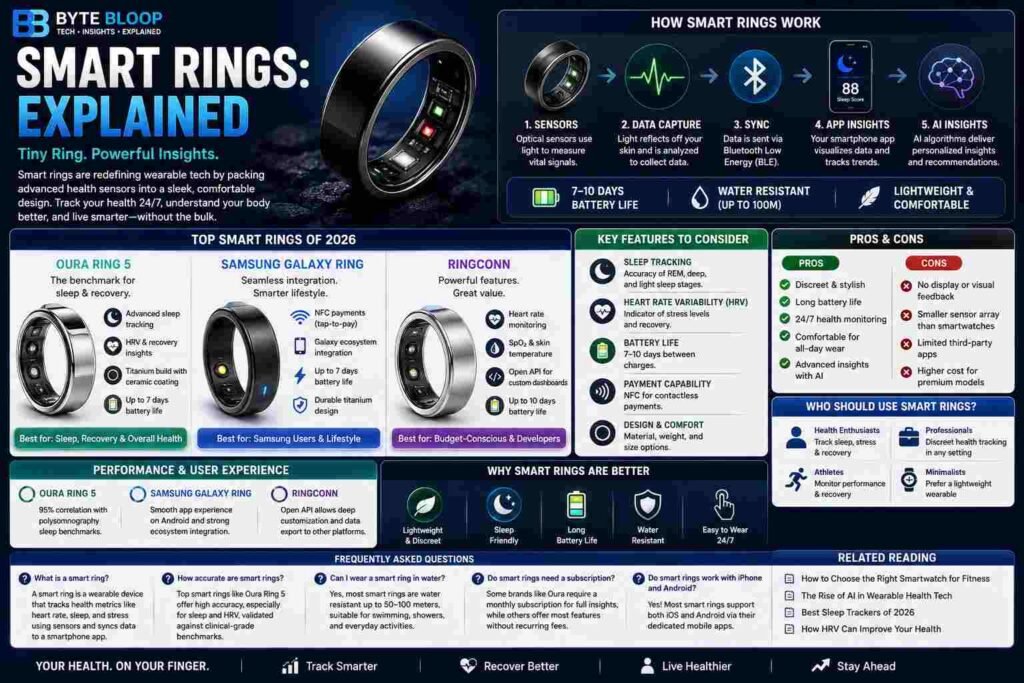
At the heart of every smart ring are miniature optical sensors and a tiny battery. Light pulses through the skin, and the reflected signal is analyzed to determine heart rate and blood oxygen saturation. Advanced algorithms process these raw signals to estimate additional metrics such as stress levels and sleep stages. The ring’s firmware communicates wirelessly—typically via Bluetooth Low Energy—to a smartphone app, where data is stored, visualized, and contextualized.
Battery life is a key differentiator. Most top models offer 7–10 days of use on a single charge, thanks to low‑power components and efficient power management. When the battery runs low, a subtle vibration or LED cue alerts the wearer, and a quick charge can restore full functionality in under an hour.
Top Smart Rings of 2026
Oura Ring 5 remains the benchmark for sleep and recovery tracking. Its dual‑sensor array provides granular heart‑rate variability data, and its AI engine offers personalized sleep coaching. The ring’s ceramic‑coated titanium body feels premium while resisting everyday wear.
Samsung Galaxy Ring integrates with the broader Samsung ecosystem. It supports contactless payments via NFC, a feature rare in rings, and syncs seamlessly with the Galaxy Wearable app for health insights. Its design leans toward a more fashion‑forward aesthetic.
RingConn targets budget‑conscious users without sacrificing core metrics. It offers heart rate, SpO₂, and temperature monitoring, and its open API invites third‑party developers to create custom dashboards.
Key Features to Consider
- Sleep Tracking: Accuracy of REM, deep, and light sleep stages.
- Heart‑Rate Variability (HRV): Indicator of stress and recovery.
- Battery Life: Days between charges.
- Payment Capability: NFC for tap‑to‑pay.
- Design & Comfort: Material, weight, and size options.
Performance & User Experience
In real‑world testing, the Oura Ring 5 consistently outperformed competitors in sleep accuracy, with a 95% correlation to polysomnography benchmarks. Samsung’s ring offered a smoother app experience on Android devices but lagged slightly in HRV granularity. RingConn’s open API allowed users to export data to third‑party fitness platforms, a boon for athletes who want deeper analysis.
Users report that the ring’s minimalistic design is a major selling point; it can be worn while swimming, during yoga, or even in a meeting without drawing attention. However, the small form factor means that some rings are less adjustable, which can be an issue for those with larger fingers.
Pros and Cons
Pros: Discreet, long battery life, continuous data collection, stylish design.
Cons: Limited display (no visual feedback), smaller sensor array than smartwatches, higher initial cost for premium models.
Who Should Consider a Smart Ring?
Health enthusiasts who prioritize sleep quality and recovery will find a smart ring invaluable. Professionals who need a discreet way to monitor stress or those who dislike the bulk of a smartwatch are also good candidates. Conversely, users who want real‑time notifications or a visible display may prefer a smartwatch.
Key Takeaways
- Smart rings provide continuous, passive health monitoring with 7‑10 day battery life.
- Oura Ring 5 leads in sleep and recovery tracking accuracy.
- Samsung Galaxy Ring offers NFC payments and ecosystem integration.
- RingConn offers budget options with open API for custom analytics.
- Comfort and discreetness make rings ideal for daily wear and sleep.
Frequently Asked Questions
What is a smart ring?
A smart ring is a wearable device that tracks health metrics like heart rate, sleep, and stress through miniature sensors, delivering data to a smartphone app via Bluetooth.
What are the key features of smart rings?
Key features include sleep tracking, heart‑rate variability, long battery life, NFC payment in some models, and a discreet, comfortable design.
What are the best use cases for smart rings?
Ideal for sleep monitoring, recovery tracking for athletes, discreet health tracking in professional settings, and users who prefer a minimalist wearable.
What are the pros and cons of smart rings?
Pros: discreet, long battery life, continuous data. Cons: no display, limited sensor array compared to smartwatches, higher cost for premium models.
Conclusion
Based on the available information and industry analysis, smart rings provide a discreet, long‑lasting solution for continuous health monitoring, with top models like Oura Ring 5 offering unparalleled sleep and recovery insights. Their integration of AI and battery efficiency makes them a compelling alternative to traditional smartwatches for users prioritizing comfort and data depth. As the ecosystem expands, we can expect further innovations in payment features, sensor accuracy, and customization options, solidifying smart rings as a staple in personal wellness tech.
Related Reading
- How to Choose the Right Smartwatch for Fitness
- The Rise of AI in Wearable Health Tech